

Introduction
When an intrusion alarm activates, the subsequent minutes define the entire value proposition of a commercial security investment. A delayed, confused, or manual response can render even the most sophisticated detection hardware ineffective. Modern security operations demand a shift from viewing alarm systems as isolated alert generators to treating them as the primary trigger within a tightly orchestrated, automated incident response engine. This article, authored by a consortium of security system architects, network engineers, and operations veterans, deconstructs the integration of alarm systems with incident response. We move beyond generic workflows to examine the protocol-level communication, architectural trade-offs, and operational realities that dictate success in enterprise environments, from multi-campus universities to distributed retail chains.
Understanding Alarm Incident Response Integration
Alarm Incident Response Integration is the engineered unification of physical intrusion detection systems with software-defined workflows for assessment, prioritization, dispatch, and resolution. It transforms a raw sensor signal (an Alarm Event) into a managed, trackable, and actionable Incident within a security operations framework.
Core Definitions: Event vs. Incident
- Alarm Event: A low-level signal generated by a sensor (e.g., motion detector, door contact) via an alarm control panel, indicating a potential breach of a defined zone. It contains basic data:
source,zone,type,timestamp. - Incident: A security event that has been contextualized, verified, assigned a priority, and entered into a managed workflow. It enriches the raw event with
location maps,video clips,assigned personnel,escalation rules, andresolution status.
The critical engineering leap is the automation of this transformation. In legacy systems, this relies on a monitoring operator hearing an audible alarm, calling a site, and manually logging details—a process prone to delay and error. Integrated systems automate the ingestion, correlation, and initial triage, presenting the operator with a pre-verified, prioritized incident ticket and recommended actions.
The High Cost of Fragmented Response: Why Manual Workflows Fail
The limitations of non-integrated, manual response are not merely inefficiencies; they are systemic risks quantified in extended response times, increased liability, and operational fatigue.
- Delayed Dispatch: Manual call-out procedures and call-list dialing can add 3-5 minutes minimum to initial response. For a verified intrusion, this is often the difference between apprehension and loss.
- Alert Fatigue & Desensitization: Operators bombarded by raw, unverified alarms (especially from poorly configured systems) develop “alarm blindness,” increasing the chance of missing a true critical event.
- Lack of Situational Awareness: Dispatched guards or police arrive “blind” without immediate access to live video feeds, floor plans, or asset lists relevant to the triggered zone.
- Inconsistent Escalation: Without automated rules, escalation depends on individual operator judgment and memory, leading to inconsistent handling of similar events across shifts.
- No Auditable Trail: Manual logs lack the granular, timestamped audit trail required for regulatory compliance (e.g., PCI-DSS, HIPAA) and post-incident analysis.
The Intrusion Event Lifecycle: A Step-by-Step Architectural View
A modern integrated response follows a deterministic lifecycle. Each stage represents a subsystem that must be engineered for reliability and speed.
1. Detection & Signal Generation
The journey begins at the edge: a passive infrared (PIR) detector, a shattered glass sensor, or a door contact changes state. The alarm panel samples this input, executes its local programming (entry delay, cross-zoning), and generates a digital alarm event packet. The integrity of this initial signal is paramount; faulty sensors or poorly configured panels create noise at the very source.
2. Alarm Transmission & Communication
This is the network transport layer, often the first point of failure. The panel uses a communication protocol to transmit the event packet to a monitoring platform.
- Legacy Dial-up (POTS/PSTN): Slow (30+ seconds), insecure, and single-threaded. Fails completely if the line is cut.
- Digital Cellular (GSM/LTE): Provides wireless backup but can suffer from latency and carrier outages.
- TCP/IP over Ethernet/Wi-Fi: The enterprise standard. Offers high speed (<2 seconds) and the ability to transmit rich data. Requires robust network QoS to prevent packet loss during network congestion.
- MQTT over TCP/IP: Becoming the de facto standard for cloud-native architectures. Its publish-subscribe model is ideal for scalable, bidirectional communication where the platform needs to send configuration updates or request system status.
3. Platform Ingestion & Event Correlation
The monitoring or incident management platform receives the event. Here, correlation engines activate:
- Video Verification: The platform automatically retrieves a 15-second pre- and post-alarm video clip from cameras associated with the alarmed zone, attaching it to the incident ticket.
- Access Control Cross-Check: It checks if an authorized badge was used in the vicinity recently, potentially downgrading the priority.
- GIS Integration: The incident is plotted on a digital map, showing responder proximity and ingress points.
4. Incident Creation & Automated Triage
Based on correlation results and pre-configured rules, the platform creates an incident. Rules engine examples:
IFalarm = “Perimeter Door Forced”ANDvideo shows forced entryANDtime is after hoursTHENpriority = CRITICAL, auto-dispatch police & guards.IFalarm = “Internal Motion”ANDvalid access card used nearby within 5 minutesTHENpriority = LOW, create log-only incident for morning review.
5. Operator Presentation & Dispatch
The high-priority incident appears on the Security Operator’s Dashboard with all attached context: video, map, asset list, and suggested action. A single click can dispatch via integrated CAD (Computer-Aided Dispatch) software, sending mobile alerts to guard teams with all relevant data.
6. Resolution & Reporting
Responders update status via mobile app (“En route,” “On scene,” “Secure”). The incident ticket tracks all actions. Upon closure, a full audit trail—from initial sensor to final report—is archived for compliance and analytics, feeding into system tuning to reduce future false alarms.
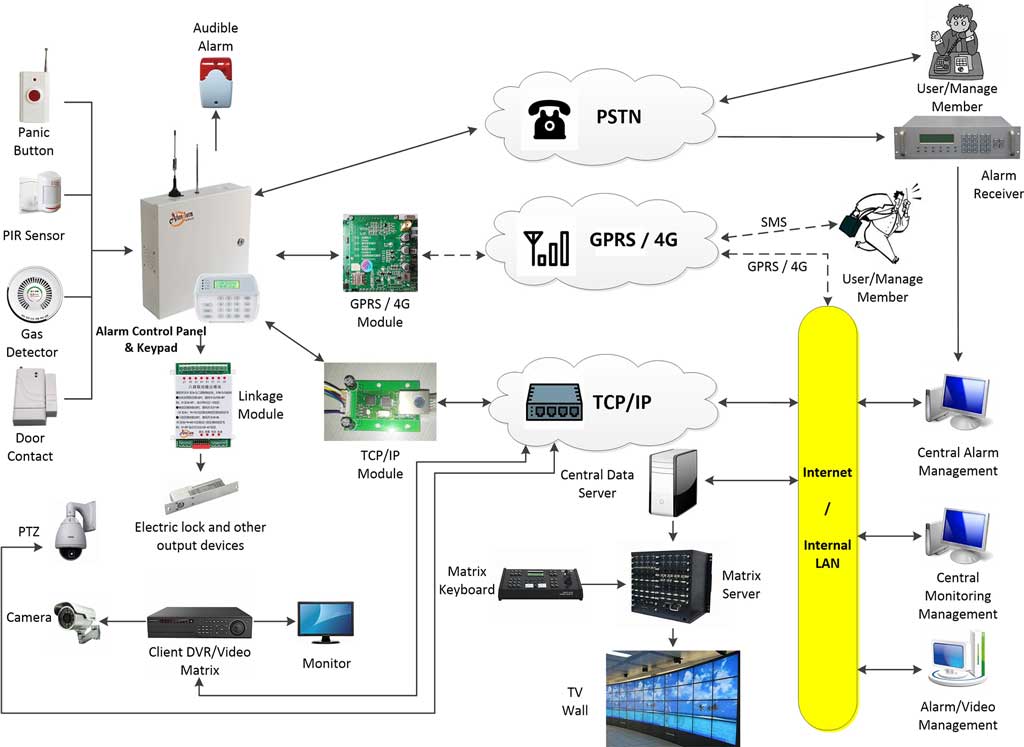
Alarm Communication Architecture: Choosing the Protocol Stack
The choice of communication protocol dictates system capabilities, resilience, and scalability.
| Protocol | Typical Transport | Latency | Data Payload | Best For | Key Engineering Consideration |
|---|---|---|---|---|---|
| Contact ID | PSTN, TCP/IP | Medium-High | Low (Fixed Code) | Legacy retrofit, basic P2P | Standardized but limited to event codes; no true bidirectional control. |
| SIA DC-09 | TCP/IP | Low | Medium | Central Station (ARC) | Industry standard for professional monitoring centers; supports rich data but complex. |
| Raw TCP/IP Socket | Ethernet, Cellular | Very Low | High (Custom) | Enterprise custom integration | Maximum flexibility but requires custom parsing and is fragile to firewall/network changes. |
| HTTPS REST API | TCP/IP (SSL) | Low | Very High | Cloud platform integration | Secure, stateless, ideal for web-based platforms. Adds overhead but is firewall-friendly. |
| MQTT | TCP/IP (SSL) | Very Low | High | Cloud-native, IoT-scale systems | Asynchronous, bidirectional, excellent for unreliable networks. Requires a broker architecture. |
Architectural Decision Point: For a multi-site retail chain deploying a new cloud platform, an MQTT-based architecture is superior. Panel events publish to a topic (site/nyc-store-001/alarm/perimeter). The cloud platform subscribes. This allows efficient handling of thousands of panels, built-in last-will messages for connection status, and easy integration of other IoT devices. The trade-off is the operational complexity of managing and securing the MQTT broker cluster.
Centralized vs. Cloud-Native Monitoring Architectures
The monitoring platform’s architecture determines its capacity for automation and scale.
Centralized Monitoring Station (CMS) Model
A physical security operations center (SOC) with dedicated receiver hardware (DLS cards, IP receivers) decoding proprietary alarm protocols (Contact ID, SIA). Strengths: Direct, reliable for high-volume traffic from like panels; often required for UL-listed monitoring. Limitations: Scalability is hardware-bound; adding new protocol types requires new hardware; advanced correlation with non-alarm systems (video, access) is often bolted-on and clunky.
Cloud-Native Incident Management Platform
A software-as-a-service (SaaS) platform hosted on AWS, Azure, or GCP. It receives alarms via IP protocols (MQTT, HTTPS API) and treats them as data streams. Strengths: Elastic scalability; native integration with cloud video (VSaaS), access control, and data analytics; rapid feature deployment. Limitations: Dependent on internet connectivity at the edge (requires robust cellular backup); must meet stringent data sovereignty and privacy requirements.
Engineering Reality Check: Even cloud platforms often integrate with a Central Station Automation layer to handle legacy PSTN and direct IP traffic from panels that cannot communicate natively via API/MQTT. This hybrid approach is common in large-scale deployments migrating from older systems.
Integrating Video Verification: Beyond “Video Clip Attachment”
True video verification is not merely fetching a clip. It involves intelligent orchestration to reduce operator cognitive load.
- Smart Camera Association: Linking alarm zones to specific camera presets or analytic regions.
- Pre-Alarm Buffer: Ensuring the video server maintains a rolling buffer (e.g., 30 seconds) to capture activity before the alarm.
- Analytic Trigger Corroboration: If the alarmed zone has video analytics (e.g., object detection), the platform can check for a simultaneous analytic rule trigger (e.g., “human in restricted area after hours”) to increase verification confidence.
- Operator UI Design: The verified video must play automatically in the incident pane—not require the operator to navigate to a separate VMS client. This shaves critical seconds off the verification step.

Architecting Escalation Logic: From Simple Rules to AI-Driven Orchestration
Escalation logic must be robust to handle shift changes, personnel availability, and incident progression.
Tier 1: Time & Priority-Based Rules
Rule:If a CRITICAL incident is not acknowledged by an operator within 60 seconds, escalate by sending SMS/email to Shift Supervisor and Senior Security Manager.- `Implementation Note:* This requires accurate monitoring of operator “state” (active, break, offline) in the dashboard.
Tier 2: Geographic & Availability Routing
Rule:If incident is at “Building B” and requires physical response, dispatch only to guard team members whose mobile GPS shows they are within a 5-mile radius and whose status is “Available.”- `Engineering Challenge:* This depends on reliable mobile data connectivity and battery management for guard devices.
Tier 3: AI-Assisted Dynamic Escalation
- `Logic:* The system analyzes historical data: Incidents at Warehouse Gate A on rainy Thursday nights have a 70% probability of being a false alarm due to wind shaking the fence line. The system might then automatically request a second verification step (e.g., review of a thermal camera) before escalating, reducing false dispatches.
The False Alarm Reduction Feedback Loop
Integration enables a proactive war on false alarms, which is the single greatest inhibitor of effective response.
- Categorization: Operators tag closed incidents as “Valid Intrusion,” “System Fault,” “User Error,” “Environmental (wind, wildlife).”
- Analytics Dashboard: Security managers review false alarm sources by zone, sensor type, and time.
- Physical Tuning: This data guides hardware adjustments: sensitivity reduction on a PIR facing a heating vent, reseating a loose door contact, adding strobe lights to deter wildlife.
- Workflow Tuning: If video verification consistently disproves alarms from a specific motion detector after hours, the rule engine can be modified to automatically downgrade its priority and require a second verification method before dispatch.
Deployment Best Practices: An Integrator’s Checklist
- Network Foundation: Ensure QoS is configured on network switches to prioritize alarm traffic (DSCP marking). Implement dual WAN paths with cellular failover at each site.
- Protocol Mapping: Clearly map each alarm panel model and its capabilities to the chosen communication method (e.g., Panel A uses MQTT for events, HTTPS for configuration).
- Redundancy at Every Layer: Dual network paths, redundant MQTT brokers, platform deployment across multiple availability zones.
- Staged Rollout: Pilot integration at 2-3 sites, stress-test the correlation and escalation rules, and measure mean time to acknowledge/verify before full deployment.
- Operator Training: Train on the new workflow, not just the new software. Use real, historical alarm events from the pilot sites in training simulations.
- Define KPIs & Review: Establish baseline metrics (e.g., current average response time: 8 minutes) and track improvement (target: under 3 minutes). Review false alarm rates monthly.
FAQs: Addressing Critical Operational Questions
Q1: What is the single biggest technical point of failure in alarm response integration?
A: The network link between the alarm panel and the monitoring platform. Mitigation requires a primary Ethernet with a cellular backup modem configured for automatic failover. The panel must be programmed to test both paths regularly.
Q2: How many sites can a single cloud incident platform realistically handle?
A: Architecturally, a well-designed cloud platform can handle tens of thousands of sites. The practical limit is often operator capacity. A key metric is “incidents per operator hour.” If one site generates 1 alarm per day, 10,000 sites generate ~10,000 daily alarms. With automation handling 80% through auto-verification and filtering, 2,000 incidents need human review. This dictates SOC staffing. The platform must provide tools to manage this volume effectively.
Q3: Can we integrate our old legacy alarm panels that only have a PSTN output?
A: Yes, using an IP Alarm Communicator Gateway. This device sits next to the old panel, captures its dial-out signal, converts it to a TCP/IP or MQTT message, and sends it over the network. This is a common transitional strategy.
Q4: What is “alarm storm” handling, and how is it managed?
A: An alarm storm is when a single fault (e.g., a power fluctuation) triggers dozens or hundreds of panels simultaneously, swamping the platform and operators. Modern platforms use rate-limiting and deduplication logic. For example, if 50 doors on a single site report “Supervisory Trouble” within 2 seconds, the platform may create one master “Site Power Trouble” incident and suppress the other 49, preventing dashboard overload.
Q5: How do we ensure compliance (e.g., GDPR, HIPAA) when video is automatically attached to incidents?
A: The platform must have data governance features: automatic redaction of unnecessary video areas, strict access controls based on incident role, automated deletion policies for video attached to closed non-critical incidents, and detailed audit logs of who accessed what clip and when.
Conclusion: From Alert to Actionable Intelligence
The integration of alarm systems with incident response is no longer a luxury but a foundational requirement for effective enterprise security. It represents a shift from reactive, labor-intensive processes to proactive, intelligence-driven operations. Success hinges on a deep understanding of the underlying protocols, a cloud-native or hybrid architecture designed for scale and resilience, and a relentless focus on automating verification and escalation to empower human operators. By architecting this integration with the engineering rigor outlined here—prioritizing network redundancy, intelligent correlation, and measurable KPIs—organizations can transform their alarm systems from simple noisemakers into the central nervous system of a dynamic, responsive security operation.