

Introduction
False alarms remain one of the most persistent challenges in intrusion detection systems (IDS). According to multiple industry assessments—including studies referenced by UL and SIA—over 90% of intrusion alarms reported to monitoring centers are false, driven by environmental noise, sensor misconfiguration, and user error. These unnecessary dispatches cost municipalities millions of dollars annually and degrade confidence in alarm performance.
Artificial intelligence (AI) is redefining how security systems interpret threats, shifting intrusion detection from a reactive model (trigger → verify → respond) to a predictive and contextual analysis model powered by machine learning and multi-sensor intelligence.
This article provides a detailed guide for alarm developers and system integrators on how to apply AI-driven false alarm reduction strategies, with actionable steps, implementation workflows, and best practices for machine learning intrusion detection optimization in burglar alarm ecosystems. The structure covers root causes, core AI technologies, integration procedures, case examples, challenges, and references to authoritative security standards.
1. Understanding False Alarms in Intrusion Detection Systems
What Is a False Alarm?
In security systems, a false alarm is an alarm activation with no genuine intrusion event. The most common causes include:
- Environmental triggers: wind vibration, pets, insects, shadows, HVAC airflow, temperature swings
- Sensor issues: low-quality PIR sensors, loose mounts, RF interference, improper sensitivity settings
- Human factors: incorrect arming/disarming, improper installation, bypass errors
- System factors: outdated firmware, latency in wireless sensors, inconsistent calibration
Impact on Stakeholders
False alarms create cascading operational issues:
- Higher operational costs for monitoring centers due to unnecessary dispatches
- Strained law-enforcement response, often leading to fines or dispatch suppression
- Reduced credibility of the alarm system, causing customer complaints and attrition
- Technician fatigue, leading to longer maintenance cycles and lower service quality
How AI Addresses These Pain Points
AI reduces false alarms by:
- Learning behavioral patterns from historical sensor data
- Identifying nuisance triggers vs. real intrusion signatures
- Detecting multi-sensor correlations for improved decision logic
- Applying predictive models to flag anomalies before an event escalates
This approach significantly enhances alarm verification, contextual awareness, and overall threat classification accuracy.
2. Core AI Technologies for False Alarm Reduction
2.1 Machine Learning Models in Alarm Analytics
Machine learning (ML) is the backbone of AI-based false alarm reduction. Developers typically use two types of models:
Supervised Learning
Used to classify “true intrusion” vs. “false alarm” based on labeled historical data.
Examples:
- Random Forest
- Gradient Boosting Models
- Lightweight Neural Networks
Unsupervised Learning
Useful when labeled data is limited. Identifies anomalies or abnormal sensor patterns.
Examples:
- Clustering (K-Means, DBSCAN)
- Autoencoders for anomaly detection
Practical Implementation Steps for Developers
- Collect and Label Sensor Datasets
Gather PIR, microwave, magnetic contact, vibration, and video metadata. Tag events as true or false based on service logs. - Train Models
Use frameworks such as scikit-learn, PyTorch, or TensorFlow. Start with small, explainable models (e.g., Random Forest) before moving to deep learning. - Integrate via APIs or Edge Firmware
- Export inference models to ONNX or TensorFlow Lite
- Deploy on alarm panels, edge processors, or gateway devices
- Create confidence thresholds (e.g., only alert if >85% intrusion probability)
- Test and Validate
Use confusion matrices, precision-recall curves, and ROC analysis to ensure improved classification and lower false positives.
2.2 Computer Vision and Sensor Fusion
Camera-based verification significantly reduces nuisance alarms by visually analyzing the trigger.
How AI Video Analytics Helps
- Differentiates humans vs. pets vs. non-threat motion
- Filters shadows, light reflections, insects, rain, or foliage movement
- Enhances contextual awareness (direction, posture, object carried)
Integration Steps for Developers / Integrators
- Choose Compatible AI-Ready Cameras
Opt for cameras supporting ONVIF, RTSP, or built-in edge AI capabilities. - Implement Edge AI Processing
Running inference on the camera or gateway reduces cloud latency and improves alarm accuracy. - Scenario-Based Testing
- Simulate human intrusion
- Test pets at different sizes
- Introduce lighting changes and natural movement
Adjust detection thresholds based on real-world patterns.
Sensor Fusion Best Practices
Combine inputs from:
- PIR + camera
- Magnetic contact + vibration sensor
- Radar + PIR
- Microwave + AI video
Fusion makes the system far more resilient to noise.
2.3 Predictive Analytics and Anomaly Detection
Predictive models review time-series data to identify:
- Unexpected access patterns
- Abnormal sensor frequencies
- Environmental anomalies at specific times
- Gradual hardware degradation (leading to sensor faults)
Technical Approach
- Use anomaly detection libraries in TensorFlow, PyTorch, or scikit-learn
- Apply rolling-window analytics
- Identify correlations between triggers and environmental data (humidity, temperature, occupancy)
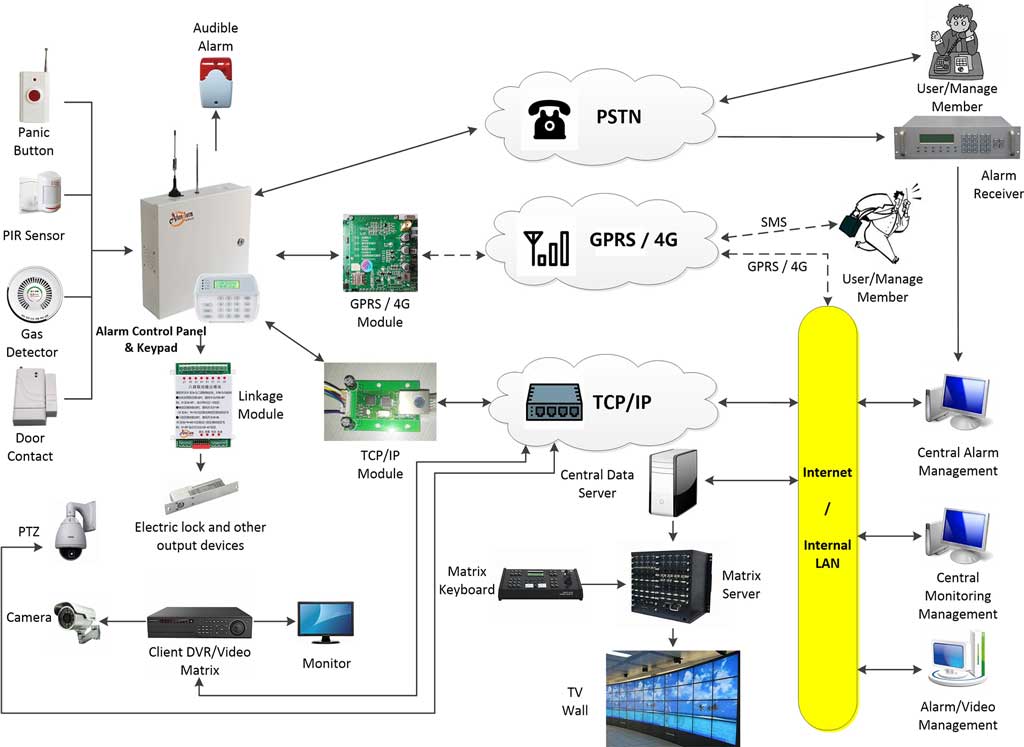
3. Implementation Strategies for Developers and Integrators
3.1 Data Collection & Preprocessing Best Practices
Real-world data is messy. Clean data ensures model accuracy.
Step-by-Step Workflow
- Aggregate Multi-Sensor Streams
Combine logs from PIR, door contacts, radar, microwave, and camera metadata. - Remove Outliers
Use statistical filtering (e.g., Z-Score, IQR) to remove noise events. - Normalize and Standardize Inputs
For consistent model performance across sites and sensor types. - Create Feature Sets
Examples of features:- Trigger duration
- Motion amplitude
- Signal strength (RSSI)
- Temperature/humidity correlation
3.2 Optimizing Machine Learning Models
Practical Workflow
- Evaluate Using Precision-Recall and F1 Score
Precision is crucial for minimizing false positives in alarm analytics. - Conduct A/B Testing in Live Environments
Compare AI-driven filter vs. traditional threshold logic. - Continuous Model Retraining
Retrain monthly or quarterly based on new event logs. - Model Update Pipeline
- Pull new data
- Clean and preprocess
- Retrain
- Validate
- Deploy OTA (over-the-air) to panels or gateways
3.3 Case Studies and Real-World Applications (Original Analysis)
Urban Commercial Use Case
A mid-size integrator implemented AI-driven multi-sensor analysis in 160+ retail stores:
- Combined PIR + AI camera verification
- Deployed supervised models trained on 20,000 labeled events
- Implemented adaptive thresholds based on store hours and environmental patterns
Result:
False alarms dropped by 70% within three months.
Technical support tickets reduced by 40%, while monitoring center dispatch accuracy improved significantly.
Industrial Perimeter Scenario
AI fusion of radar and PIR eliminated recurring false triggers caused by machinery vibrations.
Reduction: 84% fewer nuisance activations.
4. Challenges and Ethical Considerations
AI Bias in Diverse Environments
Models trained in one country or building type may not generalize to others.
Mitigation:
- Periodic bias audits
- Retraining with diverse datasets
- Region-specific calibration
Privacy and Data Handling
Video and sensor metadata must comply with regional regulations.
Recommendations:
- Align with GDPR for EU-based deployments
- Implement on-device processing to reduce cloud exposure
- Enforce encryption at rest and in transit
Reliability and Explainability
Security operators must understand why a model classified an event.
Use explainable AI tools (LIME, SHAP) to ensure transparency.
Conclusion
AI-driven analytics represent a major evolution in false alarm reduction. Through machine learning, computer vision, and predictive modeling, modern security systems can classify threats with higher accuracy, reduce unnecessary dispatches, and improve user trust in intrusion detection systems.
Alarm developers and integrators are encouraged to begin experimenting with the workflows provided—data preparation, model training, sensor fusion, and edge deployment. As AI becomes standard in the security ecosystem, organizations that deploy these strategies today will achieve stronger reliability, higher customer satisfaction, and significantly optimized intrusion detection performance.