

Introduction: Why “Cheap” Alarm Systems Often Become Expensive Mistakes
When procurement managers, system integrators, or security directors evaluate a network alarm system versus a traditional alarm, the first instinct is to compare hardware prices. On paper, traditional alarms often appear cheaper. Lower upfront cost, simpler installation, fewer components — what could go wrong?
A lot.
In real-world deployments across commercial buildings, warehouses, residential compounds, banks, chain stores, hotels, and industrial facilities, the visible price tag is rarely the true cost. The real financial impact of an alarm system unfolds over months and years — through maintenance cycles, false alarms, infrastructure dependencies, scalability limits, and operational inefficiencies that nobody warns you about at the point of purchase.
This article breaks down the hidden costs nobody tells you — from bandwidth consumption and server architecture to false alarm losses and long-term maintenance burdens — so you can make a high-confidence purchasing decision based on the full picture, not just the invoice.
Part 1: Defining the Two Systems (Beyond the Basics)
1.1 What Is a Traditional Alarm System?
A traditional alarm system typically relies on:
- Wired sensors (PIR motion detectors, door/window contacts, vibration detectors)
- Local control panels with limited zone capacity
- PSTN (telephone line) or GSM communication for signal transmission
- Dial-up or SMS-based alert delivery
- Standalone operation with minimal system integration
- On-site keypads for arming and disarming
These systems were designed for localized protection in an era before IP networking was ubiquitous. They function reasonably well for small, single-site applications with stable infrastructure, but they hit hard ceilings the moment you need to scale, integrate, or manage remotely.
One often-overlooked limitation: traditional alarm panels communicate via telephone lines or GSM modules that require monthly service contracts. If a telephone line is cut or a GSM signal is jammed — both of which are known burglar tactics — the entire communication pathway fails silently.
1.2 What Is a Network Alarm System?
A network alarm system is built on IP-based communication infrastructure and cloud or private server architecture. It includes:
- IP-enabled control panels supporting TCP/IP and 4G/LTE communication simultaneously
- Real-time data transmission over LAN, WAN, or cellular networks
- Cloud-based or privately hosted alarm management software
- Mobile app integration for remote arming, disarming, and status monitoring
- API-based system expansion connecting CCTV, access control, and IoT devices
- Multi-path communication redundancy (if one path fails, another activates automatically)
Unlike traditional systems, network alarm systems are data-driven, scalable, and remotely manageable. The Athenalarm network alarm system, for example, supports centralized management across security companies, banks, ATMs, chain stores, hotels, hospitals, communities, and industrial facilities — all from a single software platform.
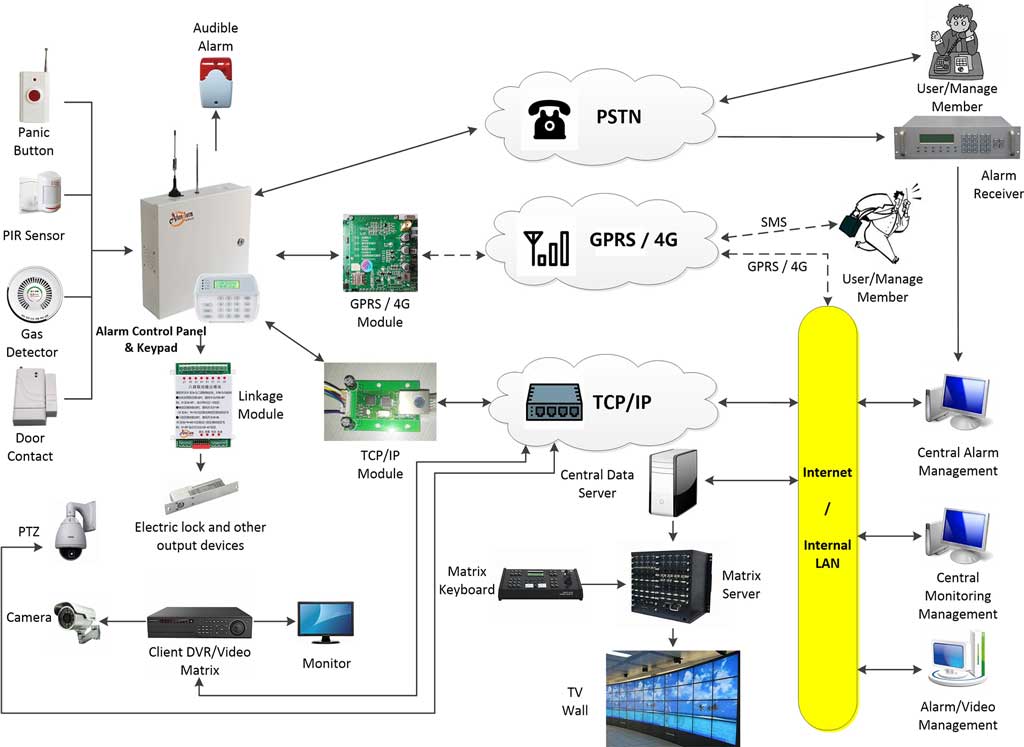
A critical architectural feature worth understanding: modern network alarm systems combine TCP/IP wired networking with 4G wireless as a backup channel. This dual-path design ensures that even if the broadband connection is interrupted, alarm signals still reach the monitoring center through the cellular network — a level of communication reliability that PSTN-based traditional systems simply cannot match.
Part 2: The Cost Illusion — Upfront Price vs Total Cost of Ownership (TCO)
2.1 Why Initial Price Is Misleading
The purchase price comparison often looks like this:
Traditional alarm systems:
- Lower initial hardware cost
- Simple wiring with familiar components
- Minimal networking requirements at the point of installation
Network alarm systems:
- Slightly higher initial investment
- Require network infrastructure and software configuration
- May involve server setup or cloud subscription fees
On day one, the traditional system appears to win. But this comparison is fundamentally flawed because it only counts what you pay once, not what you keep paying.
TCO (Total Cost of Ownership) calculated over three to five years consistently flips the equation. When you factor in maintenance labor, false alarm penalties, communication fees, scalability limitations, and lost productivity from system downtime, the traditional alarm’s “savings” evaporate — and then some.
The sections that follow break down exactly where those costs accumulate, with real figures that will change how you evaluate your next security procurement.
Part 3: Hidden Cost #1 — Maintenance and Service Costs
3.1 Traditional Alarm Maintenance Burden
Traditional systems require ongoing physical attention that many buyers fail to budget for accurately:
- Frequent manual inspections of detectors, panels, and wiring
- On-site troubleshooting for every fault, whether minor or serious
- Physical wiring repairs, especially in aging installations where cable insulation degrades
- Component replacement cycles — panels, batteries, and sensors all have finite lifespans
- Technician callout fees that compound quickly across multi-site deployments
Key issue: Every maintenance task requires physical presence. There is no remote diagnosis, no over-the-air fix, and no way to confirm system health without someone physically driving to the site.
Real-world scenario: A retail chain operating 20 locations with traditional alarms may face:
- $50–$150 per site visit (technician labor, transport)
- 2–4 visits per month across all locations
- Annual maintenance labor cost easily exceeding $30,000–$70,000
That figure often exceeds the original cost of the hardware itself — paid year after year, indefinitely.
Practical impact of wiring degradation: In climates with high humidity, temperature swings, or pest activity, wiring insulation breaks down over 5–8 years. Rewiring a traditional alarm in a commercial facility is a disruptive, expensive project that can run $5,000–$20,000 or more depending on building size and conduit access.

3.2 Network Alarm Maintenance Advantage
Network alarm systems fundamentally change the maintenance model:
- Remote diagnostics: The alarm software continuously monitors device health and flags faults before they cause failures
- Firmware updates over the air (OTA): Software improvements, security patches, and feature upgrades deploy remotely without a technician visit
- Real-time system health monitoring: Operators at the monitoring center can see the status of every zone, detector, and communication path at all times
- Predictive maintenance alerts: Sensors with declining signal quality or panels with battery degradation generate alerts before they fail outright
Cost impact in practice:
- Up to 60–80% reduction in physical maintenance visits
- Faster issue resolution — many problems resolved in minutes via remote access rather than hours waiting for a technician
- Lower system downtime, which directly reduces security exposure windows
Concrete example: With Athenalarm’s AS-ALARM network alarm center management software, operators at the monitoring center can perform remote diagnosis and maintenance from a standard Windows PC. A fault that would require a site visit under a traditional system is often resolved by pushing a configuration change through the software — no travel, no labor charge, no disruption to the protected site.
Part 4: Hidden Cost #2 — Bandwidth and Data Transmission Costs
4.1 The Overlooked Reality of Bandwidth
Network alarm systems rely on internet connectivity, and the cost impact depends almost entirely on how intelligently the system manages data transmission.
Poorly designed network alarm:
- Continuous data streaming regardless of activity
- Video feeds running 24/7 to a central server
- High bandwidth consumption driving up ISP costs
- Increased cloud storage costs for continuous recordings
Optimized network alarm (the right approach):
- Event-driven transmission: data is only uploaded when something happens
- Data compression reduces transmission size significantly
- Edge processing: the local panel pre-analyzes events before sending filtered data upstream
- Video linked to alarm events only: recordings are saved locally and uploaded to the server only when triggered
A well-architected network alarm system uses minimal bandwidth during normal (quiet) operations. The significant bandwidth usage occurs only during actual alarm events — which is exactly when you want rich data transmitted quickly.
Practical bandwidth estimate for a well-optimized system: A single-site installation using event-driven transmission typically consumes less than 2–5GB per month in normal operation, which falls well within standard commercial broadband packages at negligible incremental cost.
4.2 Traditional Alarm Communication Costs
Traditional systems use communication channels that appear simple but carry persistent recurring costs:
- PSTN (telephone lines): Monthly line rental fees, often $30–$60 per line per month
- SMS/GSM modules: Per-message charges for every alert sent, which accumulate rapidly in high-alert environments
- Dual-path communication (telephone + GSM): Many installations require both for redundancy, doubling the monthly telecom fees
- Line maintenance: Physical telephone infrastructure degrades and requires maintenance that falls on the building owner
Over a five-year period, a traditional alarm installation with PSTN and GSM communication at a single site may generate $2,000–$4,000 in telecom fees alone — before counting any calls to monitoring centers or SMS alert costs.
Critically, none of these costs deliver any improvement in system capability. You pay more, year after year, for the same basic functionality.
Part 5: Hidden Cost #3 — Server and Infrastructure Costs
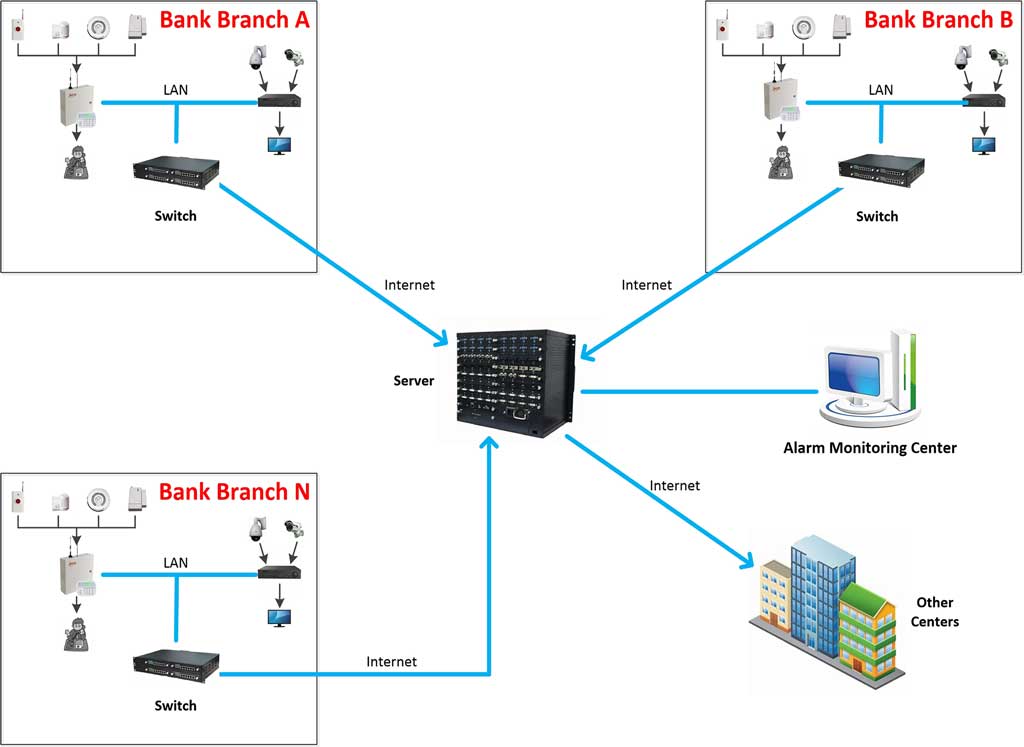
5.1 Network Alarm Server Architecture Options
Network alarm systems require a server infrastructure to run the alarm management software and store event data. The cost profile varies significantly depending on the deployment model chosen:
Cloud/SaaS deployment:
- Monthly or annual subscription fees to a cloud provider
- No upfront server hardware investment
- Scalable — pay for capacity as needed
- Maintenance and security handled by the cloud provider
Private server deployment:
- Upfront CAPEX for server hardware ($2,000–$20,000+ depending on capacity)
- Ongoing operating costs (power, cooling, IT management)
- Full control over data and security policies
- One-time software license rather than ongoing subscription
Hybrid deployment:
- Local server for primary operations
- Cloud backup for redundancy and remote access
- Balances control with flexibility
Additional cost factors to account for:
- Data storage costs (event logs, alarm recordings, video clips)
- Redundancy infrastructure (backup power, failover servers for critical applications)
- Cybersecurity infrastructure (firewalls, intrusion detection, encryption certificates)
5.2 How to Control Server Costs (Step-by-Step)
Controlling server costs in a network alarm deployment is not complicated if you plan deliberately from the start.
Step 1: Choose the right deployment model for your scale
- Small projects (1–10 sites): Cloud SaaS is almost always more cost-effective. No upfront investment, and monthly fees are predictable.
- Medium projects (10–50 sites): Evaluate private vs. cloud based on data volume and regulatory requirements. Private servers become competitive at this scale.
- Large enterprise deployments (50+ sites): Private or hybrid servers generally deliver better per-site economics and give IT teams full control.
Step 2: Optimize data storage architecture
- Configure the system to store only event-triggered recordings, not continuous video
- Set auto-deletion policies (e.g., retain event clips for 30 days, routine logs for 90 days)
- Compress stored data — modern codecs reduce video file sizes by 60–80% without meaningful quality loss
Step 3: Implement edge computing at the panel level
- Use alarm panels with onboard processing capability to filter raw sensor data locally
- Only confirmed events are transmitted upstream, dramatically reducing server load and storage requirements
- Pre-processed alarm data requires far less server capacity than raw streams
Step 4: Select platforms with scalable, non-restrictive licensing
- Avoid vendors whose software licensing model charges per-device or per-zone fees that escalate as you expand
- Look for platforms where additional sites or devices can be added without disproportionate license cost increases
Step 5: Build redundancy into your architecture from day one
- Single-point-of-failure server architectures create both security exposure and unexpected cost when failures occur
- Plan for database backups, UPS power protection, and failover capabilities before they become urgent
5.3 The Traditional Alarm “No Server” Cost Myth
Traditional systems are often marketed as having “no server costs” — and technically, this is true. But that framing conceals the indirect operational costs that substitute for a proper server infrastructure:
- Without centralized control, every location requires individual management — doubling or tripling the labor required at scale
- Without data analytics, there is no way to identify patterns, optimize performance, or predict failures proactively
- Without remote management capability, every operational decision requires physical presence
- Without a unified database, auditing, reporting, and compliance documentation requires manual compilation from disparate records
The absence of a server doesn’t eliminate the cost. It redistributes it — into labor hours, missed optimizations, slower incident response, and higher long-term operational overhead.
You pay indirectly, and typically more than you would have paid for a well-architected server infrastructure.
Part 6: Hidden Cost #4 — False Alarm Costs (The Silent Profit Killer)
6.1 The Real Cost of False Alarms
False alarms are not merely annoying — they are a measurable, recurring financial drain that most buyers fail to account for in procurement decisions.
Direct costs of false alarms:
- Security dispatch fees: many monitoring centers charge $25–$75 per dispatch
- Police or emergency response fines: in many jurisdictions, repeated false alarms trigger fines ranging from $50 to $500+ per incident
- On-site response costs: security guard callouts, management time, and operational disruption
- Wasted manpower: every false alarm investigation pulls staff away from productive activity
Indirect costs of false alarms:
- Alarm fatigue: when alarms trigger frequently without real events, staff begin ignoring them — creating a genuine security vulnerability
- Reduced trust in the system: users who distrust their alarm start bypassing or disabling zones, defeating the purpose of the installation
- Slower verified response times: monitoring centers deprioritize accounts with high false alarm histories
- Insurance complications: some insurers penalize facilities with documented false alarm patterns
Industry benchmark: In large commercial facilities with poorly calibrated traditional alarm systems, false alarm costs can exceed $5,000–$15,000 per year when all direct and indirect costs are tallied.
6.2 Why Traditional Alarms Have Higher False Alarm Rates
The architecture of traditional alarm systems creates structural vulnerability to false alarms:
- Basic sensors with limited intelligence: A single-technology PIR sensor cannot distinguish between a human intruder and a large animal, a swinging curtain, or HVAC airflow. It simply detects infrared radiation change and triggers.
- No AI or data analysis: The panel cannot cross-reference multiple data points to determine whether an event is genuinely threatening.
- No cross-verification: Traditional systems lack the ability to require confirmation from a second sensor or camera before generating an alarm signal.
- Environmental sensitivity: Temperature changes, insects on sensor lenses, and radio frequency interference all cause false triggers that the system cannot filter intelligently.
The result is a false alarm rate that industry professionals routinely observe at 80–95% of all alarm activations in poorly configured traditional systems — meaning the vast majority of dispatches respond to non-events.
6.3 How Network Alarm Systems Reduce False Alarms
Modern network alarm systems use layered intelligence to dramatically improve signal accuracy:
Multi-sensor verification: Before generating an alarm signal, the system cross-references data from multiple detectors. A PIR trigger must be confirmed by a door contact, a vibration sensor, or a second PIR before dispatching. Single-sensor false triggers are filtered at the panel level.
AI-based motion analysis: Integrated with video surveillance, network alarm systems can apply motion analysis algorithms that distinguish human silhouettes from animals, vehicles, or environmental movements. The camera confirms what the sensor detected before the alarm escalates.
Behavioral pattern recognition: Advanced platforms learn baseline activity patterns for each protected zone. An event that falls within normal behavioral parameters (e.g., a cleaner arriving at the usual time) is flagged differently from an anomaly at 3 AM.
Video verification integration: The Athenalarm network alarm monitoring system automatically pops up real-time video of the alarm zone the moment an alarm triggers. The monitoring center operator can visually verify the situation before dispatching a response — converting an unverified alert into a confirmed event.
Practical result: Facilities transitioning from traditional systems to network alarm systems typically see false alarm rates drop by 60–80% within the first three months of operation. The direct and indirect cost savings from that reduction alone often justify the entire technology upgrade.
Part 7: Hidden Cost #5 — Scalability and Expansion Costs
7.1 Traditional Alarm Expansion Challenges
When a business grows — adding a new floor, a new warehouse, a new retail location — the traditional alarm system becomes an obstacle rather than an asset.
Typical expansion challenges include:
- Rewiring requirements: Adding new zones almost always requires new cable runs. In an occupied building, this means disruption, patching, painting, and potential structural work.
- Panel capacity limits: Traditional panels support a fixed number of zones. Exceeding capacity requires adding a new panel, which then needs its own communication path and management.
- Zone expansion modules: Even where expansion modules exist, they require physical installation and on-site programming.
- System downtime during expansion: The existing zones often need to be temporarily disabled during expansion work, creating security exposure windows.
Cost impact example: Expanding a traditional alarm system from 16 zones to 32 zones in a commercial facility typically costs $1,500–$5,000 in labor alone — before hardware — and requires a half-day to full-day shutdown of existing coverage.
Multiply this across a growing chain of locations, and the cumulative expansion cost becomes a significant recurring burden.
7.2 Network Alarm Scalability Advantage
Network alarm systems are architected to scale without proportional cost increases:
- Plug-and-play device addition: New detectors, panels, or cameras are registered to the central software platform with minimal configuration. There is no rewiring of the existing system.
- Remote configuration: A technician can commission a new site’s alarm panel remotely through the software, without being physically present for most of the setup process.
- Multi-site centralized control: All locations — whether 2 or 200 — are managed from the same AS-ALARM software interface. Adding a new site does not add management complexity proportionally.
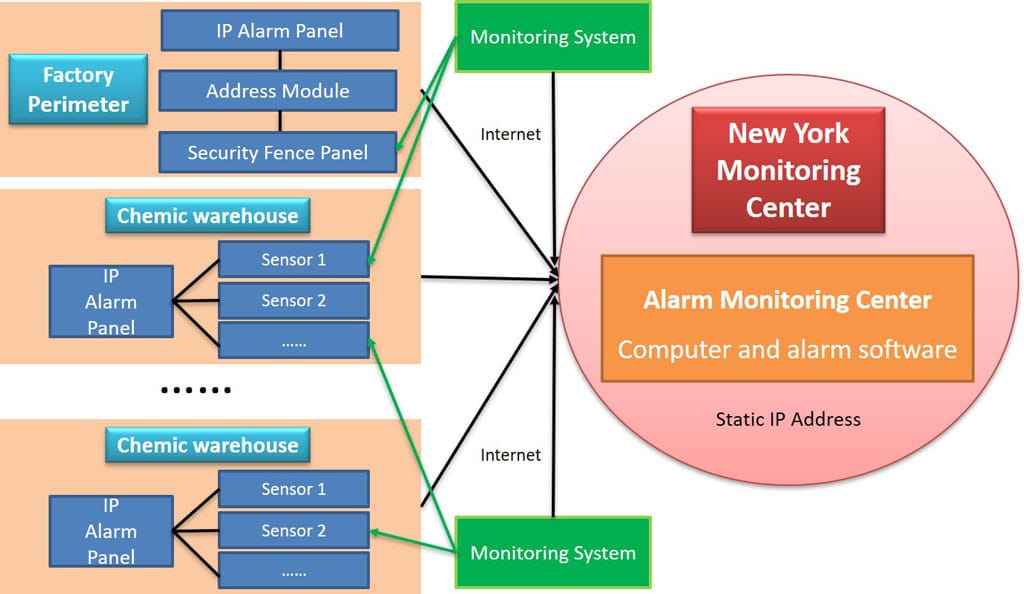
- Address module architecture: Systems using bus-based address modules (single-zone or 8-zone address modules) allow the same cable run to support additional detection points simply by adding modules — no new cable infrastructure required.
Economic advantage: Where traditional system expansion costs scale roughly linearly with each additional zone, network alarm expansion costs scale sublinearly. The 50th site costs significantly less per zone to add than the 5th site would have under a traditional model.
Part 8: Hidden Cost #6 — Integration Limitations and Costs
8.1 Traditional Systems: The Cost of Isolated Operation
Traditional alarm systems operate as closed, standalone systems. They generate alarm signals but share nothing with the broader security and building management ecosystem.
What traditional alarms typically cannot do:
- Trigger CCTV recording at the moment of alarm
- Lock down access control doors automatically when an intrusion is detected
- Interface with building management systems for environmental monitoring
- Feed alarm event data into enterprise security dashboards or analytics platforms
- Communicate with fire or life safety systems in a unified response
The practical consequence: you end up running parallel, disconnected systems — a separate CCTV platform, a separate access control system, a separate alarm system — each requiring its own management interface, its own maintenance contract, and its own trained operator.
Hidden cost of siloed systems: Operating three separate security systems where one integrated platform would suffice typically costs 40–60% more in combined licensing, maintenance, and management overhead. In large facilities, this redundancy runs to tens of thousands of dollars per year.
8.2 Network Alarm Systems: The Integrated Security Ecosystem
A properly architected network alarm system functions as the hub of an integrated security platform:
- CCTV integration: When the alarm system detects an event, it automatically triggers CCTV cameras in the affected zone to begin recording and streams real-time video to the monitoring center interface. The Athenalarm network alarm monitoring system implements exactly this — operators see live video from the alarm point within seconds of trigger.
- Access control linkage: Intrusion detection can automatically trigger door lockdown, preventing a perpetrator from moving between secured zones. Access logs can be cross-referenced with alarm event times for post-incident analysis.
- Smart IoT device integration: Network alarm systems with open API architecture can interface with smoke detectors, gas sensors, panic buttons, environmental monitors, and other IoT devices — all managed from a unified platform.
- Multi-center alarm forwarding: The Athenalarm system supports forwarding alarm information from one monitoring center to other centers or to public security authorities, enabling coordinated response across organizational boundaries.
Cost benefit quantified: Replacing three separate systems (alarm, CCTV, access control) with one integrated network alarm platform typically reduces combined software licensing costs by 30–50%, reduces the number of separate maintenance contracts by two, and eliminates the need for separate operator training on multiple platforms.
Part 9: Hidden Cost #7 — Security and Cyber Risk Costs
9.1 Traditional Systems Are Not “Safe by Default”
A persistent misconception holds that offline or analog systems are inherently more secure because they present no internet-facing attack surface. In practice, traditional alarm systems carry significant security vulnerabilities that create real financial exposure:
- No encryption: Traditional systems transmit alarm signals over telephone lines or radio frequencies with little or no encryption. Signal interception is a known attack vector used by sophisticated burglars.
- Communication jamming: GSM-based traditional systems are vulnerable to cellular jammers — devices that cost under $100 on gray markets — that block alarm signal transmission entirely. The panel thinks it has sent an alarm; the monitoring center receives nothing.
- Physical tampering: Traditional alarm panels are often installed in accessible locations. A perpetrator who can reach the panel can defeat the system by cutting power or opening the tamper-resistant (but not tamper-proof) enclosure.
- No audit trail: Without digital logging, it is impossible to reconstruct a timeline of events after an incident for insurance claims or legal proceedings.
These vulnerabilities represent a hidden cost that surfaces only after a security breach — at which point the financial consequences include loss of assets, business interruption, insurance claim complications, and potential liability.
9.2 Network Alarm Cybersecurity: Managed Risk, Not Unlimited Risk
Network alarm systems introduce a different threat model — cyber vulnerabilities — but these are manageable, known risks with well-established mitigation strategies:
Core cybersecurity requirements for a network alarm system:
- End-to-end encryption for all alarm data transmission (TLS 1.2 or higher)
- Secure user authentication (strong passwords, ideally two-factor authentication for the management software)
- Regular firmware updates to patch known vulnerabilities — delivered OTA in modern systems
- Network segmentation: alarm system devices should operate on a dedicated VLAN, isolated from general office IT infrastructure
- Access logging: all configuration changes and remote access sessions should be logged with timestamps and user identification
Cost of cybersecurity vs. cost of a breach: The annual cost of proper cybersecurity measures for a network alarm system at a commercial facility — firewall licensing, certificate management, firmware update cycles — typically runs $500–$2,000 per year. A single physical security breach at a retail facility averages $5,000–$50,000+ in direct losses, before insurance premiums, business interruption, and reputational damage are counted.
The math strongly favors investing in proper network security rather than choosing an analog system to avoid cyber risk.
Part 10: Hidden Cost #8 — Compliance and Documentation Costs
10.1 Regulatory and Insurance Compliance Costs in Traditional Systems
An often-ignored cost category: the administrative burden of compliance with insurance requirements, industry security standards, and regulatory mandates.
Many commercial insurance policies now require verified alarm monitoring — meaning a central station must confirm an alarm before dispatch. Traditional systems without video verification capability often fail to meet this standard, resulting in:
- Higher insurance premiums for facilities deemed inadequately protected
- Claim denials or partial settlements when a security breach occurs and the system cannot provide verifiable evidence of the intrusion timeline
- Compliance audit costs for industries with regulatory security requirements (banking, healthcare, retail chains)
10.2 How Network Alarm Systems Simplify Compliance
Network alarm systems generate comprehensive, tamper-evident digital records that satisfy insurance and regulatory requirements:
- Timestamped event logs: Every alarm trigger, arming/disarming action, system test, and configuration change is logged with precise timestamps
- Video evidence: Integrated CCTV recordings linked to alarm events provide visual documentation of incidents for insurance claims and legal proceedings
- Automated reporting: The alarm management software generates compliance reports — inspection records, maintenance logs, alarm response statistics — on demand, without manual compilation
- Remote audit capability: Insurance auditors and compliance officers can review system records remotely without requiring a site visit
The time saved by eliminating manual compliance documentation in large multi-site deployments can represent several days of management labor per quarter — a cost saving that rarely appears in procurement analysis but is very real in operations.
Part 11: Full Cost Comparison Summary
| Cost Category | Traditional Alarm | Network Alarm System |
|---|---|---|
| Upfront Hardware Cost | Lower | Medium |
| Installation Labor | Medium | Medium–High (initial) |
| Ongoing Maintenance Cost | High | Low |
| Communication Fees (telecom/SMS) | High (recurring) | Low–Medium |
| Server/Software Infrastructure | None visible (high hidden labor cost) | Medium (transparent and controlled) |
| False Alarm Cost | High | Low |
| Scalability Cost | High (non-linear) | Low (near-linear) |
| Integration Cost | High (siloed systems) | Low (unified platform) |
| Cybersecurity Cost | Low (but high breach risk) | Medium (managed) |
| Compliance and Documentation | High (manual) | Low (automated) |
| 3–5 Year Total Cost of Ownership | High | Low–Medium |
| Long-Term ROI | Low | High |
The table above reflects typical outcomes across commercial deployments. Actual figures vary by site complexity, geographic location, and system configuration — but the directional cost advantage of network alarm systems at the three-to-five-year horizon is consistent across deployment contexts.

Part 12: How to Choose the Right System — An Actionable Decision Guide
Step 1: Define Your Use Case and Scale
The right answer depends on where you are deploying and how large your footprint is:
- Single residential property: A lightweight network alarm with cloud connectivity and mobile app control provides most of the benefits at minimal server cost.
- Single commercial site (retail, office, hotel): An integrated network alarm system combining intrusion detection with CCTV and access control delivers the best security and the most manageable maintenance profile.
- Multi-site commercial chain (retail, banking, hospitality): A centralized network alarm management platform with a private or hybrid server is the only architecture that manages multi-site complexity without proportional cost scaling.
- Industrial or high-security facility: A hybrid system with redundant communication paths (TCP/IP primary, 4G backup), edge computing at the panel level, and integration with environmental monitoring provides the resilience that industrial operations require.
Step 2: Calculate Your True 3–5 Year Total Cost of Ownership
Build a complete TCO model before making a procurement decision. Include every line item:
- Hardware (panels, sensors, keypads, sirens)
- Installation labor (wiring, configuration, commissioning)
- Software licensing (one-time or annual subscription)
- Server infrastructure (cloud hosting fees or private server CAPEX)
- Annual maintenance (planned visits, OTA updates, reactive repairs)
- Communication fees (broadband, 4G data plan)
- False alarm costs (dispatch fees, fines, staff time) — estimate based on expected false alarm frequency
- Expansion costs (projected for 3 years based on business growth plans)
- Compliance and documentation overhead
Run this calculation for both a traditional and a network alarm option. In the majority of commercial deployments, the network alarm system’s 5-year TCO is lower — sometimes dramatically so.
Step 3: Evaluate Your False Alarm Risk Profile
Before finalizing your system choice, quantify the false alarm risk:
- What is the environment like? High foot traffic, animals, environmental factors (HVAC, temperature variation) all increase false alarm frequency in basic sensor systems.
- What are the dispatch fees in your jurisdiction?
- Does your local authority issue fines for repeated false alarm responses? At what threshold?
- What is the productivity cost of an average false alarm investigation at your facility?
If your risk profile suggests more than 3–4 false alarms per month, the difference in false alarm costs alone will justify the premium of a network alarm system with multi-sensor verification.
Step 4: Assess Your Scalability and Integration Requirements
Answer these questions honestly before committing to a platform:
- Will you expand to additional sites or zones in the next three years?
- Do you need CCTV, access control, or building management system integration?
- Do your insurance or regulatory requirements mandate verified monitoring or digital audit trails?
- Do your operators need remote access to arm, disarm, and monitor the system?
If you answer yes to two or more of these questions, a traditional alarm system will create operational friction and additional cost within your planning horizon.
Step 5: Choose a Platform Built for the Future
When evaluating network alarm platforms, look for:
- Open API architecture: The ability to integrate with third-party systems without proprietary lock-in
- Dual-path communication: TCP/IP primary with 4G failover for communication resilience
- OTA firmware updates: Security patches and feature improvements deploy remotely
- Scalable software licensing: Adding sites or devices does not trigger disproportionate licensing cost increases
- Multi-level monitoring center support: The software should support alarm forwarding between monitoring centers and to public security authorities
- Video verification integration: Native or API-based integration with CCTV systems for visual alarm confirmation
Part 13: Real-World Procurement Insights — What Buyers Typically Regret
From deployment experience across diverse industries, buyers who choose traditional alarm systems based on lower upfront price consistently report the same regrets at the 12–24 month mark:
What they didn’t anticipate:
- Maintenance labor costs that exceeded their entire hardware budget within two years
- Inability to respond to alarm events remotely — requiring physical presence at every incident
- False alarm frequency that created operational fatigue and strained relationships with monitoring center operators
- Expanding the system to new zones or sites was far more expensive and disruptive than expected
- Insurance audits revealed that the system did not generate the digital records required for claim substantiation
What network alarm adopters typically gain:
- A monitoring center that can visually verify every alarm before dispatching a response
- Remote management capability that eliminates routine site visits for minor issues
- A scalable platform that grows with the business without proportional cost increases
- Unified management of alarm, CCTV, and access control from a single software interface
- Digital evidence — timestamped logs and linked video — that supports insurance claims and legal proceedings
Conclusion: The Real Cost Winner Depends on Your Time Horizon
If your goal is the lowest possible number on a purchase order this month, a traditional alarm system will appear to win. The hardware is cheaper, the installation is simpler, and the complexity is lower on day one.
But if your goal is:
- Long-term cost efficiency over three to five years
- Operational scalability as your facility or portfolio grows
- Minimized false alarm frequency and its cascading costs
- Centralized, remote management across multiple sites
- Verified alarm monitoring that satisfies insurance and regulatory requirements
- Integration with CCTV, access control, and building systems
Then a network alarm system is the clear strategic choice — not as an expense, but as a cost control infrastructure that pays for itself through reduced maintenance, fewer false alarms, and avoided operational inefficiencies.
Final Thought: The Cost Is Not What You Pay — It’s What You Keep Paying
The single biggest mistake in alarm system procurement is focusing on the purchase price rather than the lifecycle cost. A $2,000 traditional alarm system that generates $8,000 in annual maintenance and false alarm costs is far more expensive than a $4,000 network alarm system with $1,500 in annual operating costs.
The math is straightforward. The decision should be, too.
A well-designed network alarm system is not an overhead expense. It is a cost control infrastructure that protects your assets, reduces your operational burden, and generates a measurable return on investment over its operational life.
Take the Next Step
If you are evaluating alarm systems for your next project and want a customized cost breakdown — including maintenance modeling, bandwidth analysis, server architecture options, and false alarm cost projections — work with a professional team that understands both the technology and the real-world economics of security deployment.
The right decision today, made with full visibility into lifecycle costs, can save you thousands — and in large multi-site deployments, potentially hundreds of thousands — over the operational life of your security infrastructure.