

I. Introduction
In today’s enterprise security landscape, network-based intrusions are rapidly increasing: one recent study found that over 60 % of organisations experienced a malicious event that began on their network within the past year. With threats shifting from isolated physical break-ins to hybrid cyber-physical attacks, enterprises can no longer rely solely on standalone alarm panels or CCTV systems. Instead, they need a fully integrated solution that offers real-time detection, remote oversight, and seamless connectivity across devices and sites.
Enter Athenalarm’s Network Alarm Monitoring System — a robust, scalable solution designed to meet the needs of modern enterprise environments. This system blends hardware, software and cloud monitoring to deliver real-time threat detection and response across networked sites. In this blog we will explore:
- Overview of Athenalarm’s Network Alarm System (architecture, components, evolution)
- Key features of the Network Alarm Monitoring System (real-time monitoring, scalability, integrations, analytics)
- Solutions provided by Athenalarm (installation, deployment, remote management, reliability)
- Applications in enterprise security (office, industrial, retail/hospitality, cross-industry)
- Benefits and ROI for enterprises
- Real-world insights & best practices
By the end of this post you’ll have a clear understanding of how the Network Alarm Monitoring System can enhance enterprise security posture, reduce risk, and support future-proof operations.
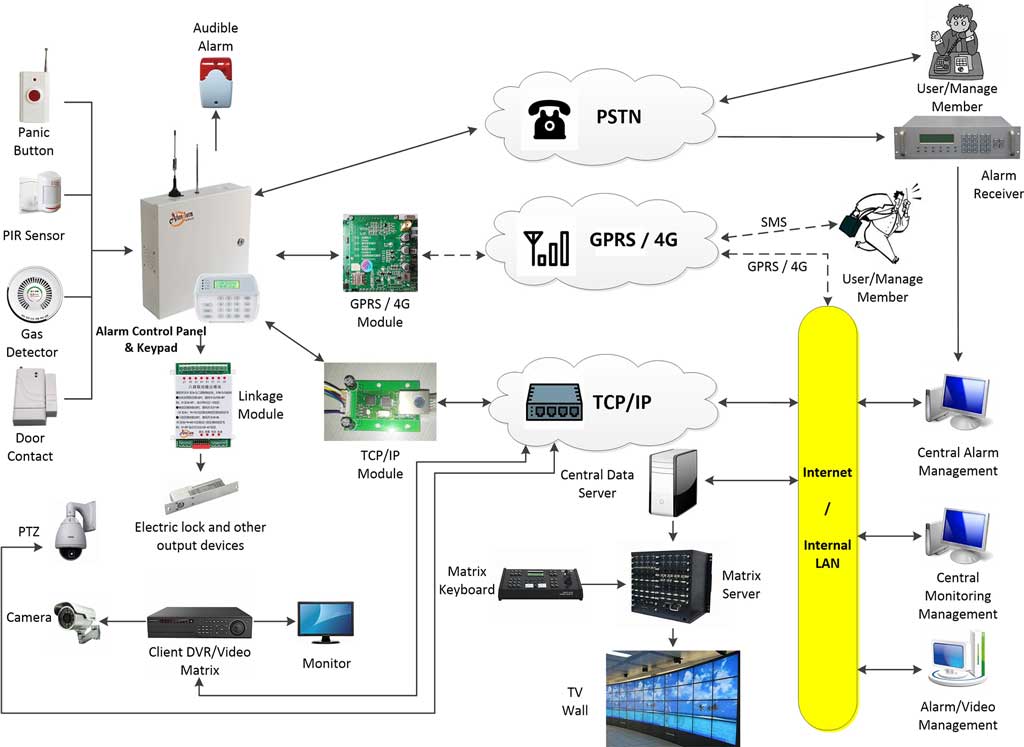
II. Overview of Athenalarm’s Network Alarm System
Athenalarm’s offering begins with a foundation built on hardware, software and cloud connectivity. According to their product site, the system uses a 4G network module and TCP/IP network module (via the “4G & TCP/IP alarm control panel”) plus a network alarm-centre management software platform.
Background & Architecture
The architecture is designed for comprehensive coverage: sensors detect intrusion or physical threat events, then a central control unit (alarm control panel) interfaces via network (TCP/IP or 4G) to a central monitoring centre. On the software side, the network alarm management software enables live event logging, visualisation, and remote control. For example, one Athenalarm description highlights: “the alarm control panel uploads the signal … and the network monitoring alarm centre management software sends out an alarm sound … the computer in the network monitoring alarm centre will accurately display the name, address, and alarm type of the household where the alarm occurred.”
Core Components
Key elements include:
- Sensors & detectors – e.g., door contacts, panic buttons, infrared beam sensors, smoke or gas detectors.
- Alarm control unit / central panel – for example, the AS-9000 series alarm panels referenced in their community alarm solution.
- Network modules – The system supports TCP/IP, 4G, GPRS, GSM, PSTN communication modes, giving flexibility for sites with different connectivity conditions.
- Management software / network alarm centre – The software platform at the back end allows real-time alerts, device status monitoring, mapping of events, multi-site coordination.
Evolution & Innovation
Rather than relying on traditional closed-loop wired alarm systems, Athenalarm positions this system as an advancement towards IP-based, networked, cloud-capable alarm systems. The ability to integrate sensors via TCP/IP or 4G modules, to support large numbers of zones, and to unify alarm data with video feeds, marks a shift in enterprise security infrastructure. For example, they describe their system as integrating “alarm and monitoring systems, offering real-time alarms, video surveillance, and remote management” in their solution page. This approach aligns with enterprises’ needs for scalability, centralised oversight and rapid response in geographically-dispersed operations.
III. Key Features of the Network Alarm Monitoring System
Real-Time Monitoring
The system offers continuous surveillance: when a sensor triggers, the event is uploaded via the network, the monitoring software notifies on-duty personnel, and the relevant video feed can automatically pop up. Athenalarm’s application examples emphasise that “after an alarm occurs… the alarm information and on-site video are transmitted to the bank’s alarm monitoring centre.” The live logging of alarms, their location, event type, and timestamp allow security teams to respond rapidly.
Scalability & Customisation
Athenalarm’s architecture supports modular scaling. For example, the system is described as “easy to expand: 1 alarm control panel can be expanded to 200 programmable defence zones at most.” Whether a small office or a multi-site enterprise facility, the system can be configured to match the size and complexity of the deployment. Customisable alert thresholds, zoning, bypass features (e.g., bypassing non-critical zones), and flexible communications support give enterprises control over how the system grows.
Integration & Compatibility
One of the major advantages is seamless integration with existing enterprise security ecosystems: CCTV, access control, perimeter sensors, third-party tools. The system bridges previously separate alarm and video systems into one platform. For instance: “The Athenalarm network alarm monitoring system integrates the intrusion alarm system and the monitoring system (CCTV) in one solution.” Open protocols (TCP/IP, 4G, etc.) and network-integration mean that enterprises aren’t locked into proprietary silos; rather, they can leverage existing infrastructure and manage centrally.
Advanced Analytics
While Athenalarm’s publicly-available pages emphasise features like automatic video pop-up, zone partitioning, bus-type wiring for expansion, and 24-hour anti-sabotage functions, the broader notion of analytics can be extrapolated: (a) anomaly detection (via sensors and linked video) (b) false-alarm reduction (e.g., sensors that trigger required linkage to camera to verify) and (c) predictive maintenance (monitoring sensors, communications, panel health). The networked nature yields richer data, enabling analysis of event patterns, sensor health, and potential vulnerabilities ahead of breaches.
IV. Solutions Provided by Athenalarm
Comprehensive Solution Framework
Athenalarm offers an end-to-end solution: from site assessment and installation, configuration of control panels and sensors, network integration, to the establishment of a monitoring centre and software platform. Their “Network Alarm Monitoring System Solution” emphasises this integrated offering. Enterprises benefit from a one-stop vendor who delivers both hardware and software and supports the full lifecycle of deployment.
Risk Assessment & Deployment
When deploying across enterprise environments, Athenalarm emphasises tailoring the solution to specific threats: perimeter breaches (via beam sensors, electric security fences), internal network vulnerabilities (door contacts, panic buttons, room sensors) and site-specific requirements (industrial hazards, server-rooms, remote facilities). Their application page notes integration across multiple locations and centralised monitoring. The risk assessment phase determines defense zones, sensor types, communication mode (4G, TCP/IP) and escalation workflows.
Remote Management Tools
Athenalarm’s system supports remote access and management: alarm control panels connect via network; the monitoring software allows centralised dashboard of events, remote firmware updates, and compliance reporting. One feature set noted: “When an alarm occurs … the computer in the network monitoring alarm centre will accurately display … prompt the security personnel to quickly confirm the alarm and rush to the scene.” The networked architecture means that enterprises can manage multi-site operations, push updates, monitor health/status of panels, and generate compliance logs (helpful for standards such as ISO 27001 or GDPR where applicable).
Reliability & Redundancy
Operational reliability is a cornerstone: Athenalarm emphasises features like anti-sabotage (tamper detection), bus-based wiring to reduce fault-domains, and multiple communications modes (TCP/IP, 4G, GPRS, GSM, PSTN) so failure of one channel won’t disable the system. For enterprise use, this means high-availability, minimal downtime, and resilience against network or power failures.
V. Applications in Enterprise Security
Commercial & Office Spaces
In office or commercial settings, the Network Alarm Monitoring System is ideal for monitoring entry/exit points, server rooms, meeting rooms, collaborative areas, and high-value asset storage. When an access sensor is triggered or a panic button pressed, the system routes the alarm to the central monitoring station, automatically pops associated video, and allows rapid dispatch of security. As noted in the application material: “integrating alarms and CCTV for centralized security across multiple locations.”
Industrial & Warehouse Settings
Industrial/warehouse facilities often have high-risk zones: large open spaces, material yards, heavy-duty perimeter fencing, asset tracking. The bus-based expansion (up to 200 zones per control panel) suits large footprint sites. Via perimeter beam sensors and electric fences, the system can detect both intrusion and environmental hazard. The network alarm centre supports large scale multi-zone deployments (as described).
Retail & Hospitality
In retail/hospitality, where both public access and secure areas coexist, the system provides point-of-sale security, back-office protection, guest area surveillance and loss-prevention support. Real-time integration of alarms and CCTV allows security teams to verify events without rushing blind to scenes. The ability to centralise across venues makes it efficient for hospitality groups with distributed properties.
Cross-Industry Adaptability
Because the architecture supports seamless scaling and customisation, the system can be deployed across sectors: education campuses, healthcare, finance, government, logistics. For example, one application discussed is banks: “after an alarm occurs, the alarm information and on-site video are transmitted to the bank’s alarm monitoring centre … the bank’s alarm monitoring centre on-duty staff can check and deal with the alarm site without visiting the scene.” The minimal disruption, networked management and adaptability mean enterprises can reuse infrastructure and apply best practices across multiple sites.
VI. Benefits and ROI for Enterprises
Enhanced Security Posture
By combining real-time alarm detection with live video verification and centralised oversight, enterprises reduce response time, improve situational awareness and reduce the window of vulnerability. For example, when sensors trigger and the monitoring software auto-flags the event and routes video, security teams can act immediately rather than after a manual check. Users of network-alarm systems often report measurable reductions in incident frequency and faster resolution times.
Cost-Effectiveness
Although initial investment in networked alarm systems may be higher than basic standalone systems, the long-term savings are significant: fewer false alarms (thanks to integrated video verification), lower manpower requirements (central monitoring rather than onsite guard-only model), and centralised licensing/maintenance for multi-site deployments. The bus-based wiring reduces cabling cost in large installations and the multi-zone control panel reduces hardware count (“1 panel up to 200 zones”).
User-Friendly Implementation
Athenalarm emphasises simplicity of operation: the alarm interface shows location, event type, and time; zones can be partitioned and bypassed; bus wiring simplifies installation and maintenance; on-duty staff can manage from a central dashboard. This means security teams can adopt the system with minimal training, and maintenance burden is lower.
Future-Proofing
With enterprise threats increasingly involving IoT devices, cyber-physical attacks, and distributed operations, a network-based alarm monitoring system is better-positioned to evolve. Because the Athenalarm solution supports TCP/IP, 4G, multi-site centralisation, and integrates with video and other sensors, it gives enterprises a platform that can adapt to tomorrow’s threats (for example, perimeter intrusion triggered by robotic drones, or server-room fire detection triggered via IoT). Investing in this architecture means lower reinvestment risk.
VII. Real-World Insights and Best Practices
Case Study Teaser
While specific case study details are not published publicly by Athenalarm, one example mentions a bank scenario: alarms and on-site video are transmitted to the bank’s monitoring centre, enabling staff to verify and respond without physically going to the scene. Enterprises deploying the system often see reduction in false alarms, faster incident resolution, and better centralised oversight across multiple facilities.
Implementation Tips
- Sensor placement: Ensure perimeter detectors (beam, electric fence) cover external access points; door/window contacts for internal zones; panic buttons in high-risk or remote areas.
- Network segmentation: Place alarm control panels and management software on a dedicated VLAN or secure network segment to isolate from general enterprise traffic and reduce latency or interference.
- Integration testing: Prior to full deployment, validate that alarm → panel → network → monitoring centre flows correctly, including video pop-up, correct zone labelling, correct mapping of site location.
- Maintenance schedule: Use bus-based diagnostics to monitor sensor health; schedule periodic firmware updates for panels via remote management; test failover communications (e.g., 4G fallback if TCP/IP link fails).
- Training and usage: Provide security staff with dashboards showing event history, timestamped logs, ability to query by zone; train them to interpret video verification and act accordingly.
Common Pitfalls to Avoid
- Bandwidth limitations: If network links are weak (especially for remote sites), the video feed or alarm transmission may lag; ensure sufficient bandwidth or use 4G fallback.
- Integration hurdles: If third-party systems (CCTV, access control) use proprietary protocols, ensure interface compatibility or plan for gateway/adapter.
- Sensor over-triggering: Poorly placed or overly sensitive sensors can cause frequent alarms and desensitise staff; calibrate thresholds appropriately.
- Neglecting redundancy: Failing to enable backup communications (GPRS/4G) or not having power backup can create single points of failure; design for resilience from the outset.
VIII. Conclusion
In today’s threat-filled enterprise environment, deploying a sophisticated Network Alarm Monitoring System is not a luxury — it’s a strategic necessity. Athenalarm’s solution delivers depth in detection (sensors, video, analytics), reliability in response (networking, centralised monitoring, redundancy) and value in enterprise protection (scalability, cost-effectiveness, future-proof design).
If you’re responsible for the security posture of a multi-site organisation, collaborating with third-party vendors, or supporting large-scale facility operations, I encourage you to explore Athenalarm’s offerings further. Visit their site, schedule a demo, and consider how their system could integrate into your enterprise architecture.
Stay tuned to the System Knowledge channel for more in-depth analyses of security technologies and best practices. The future of enterprise safety is networked — let’s make it intelligent, proactive and resilient.
Thank you for reading.