
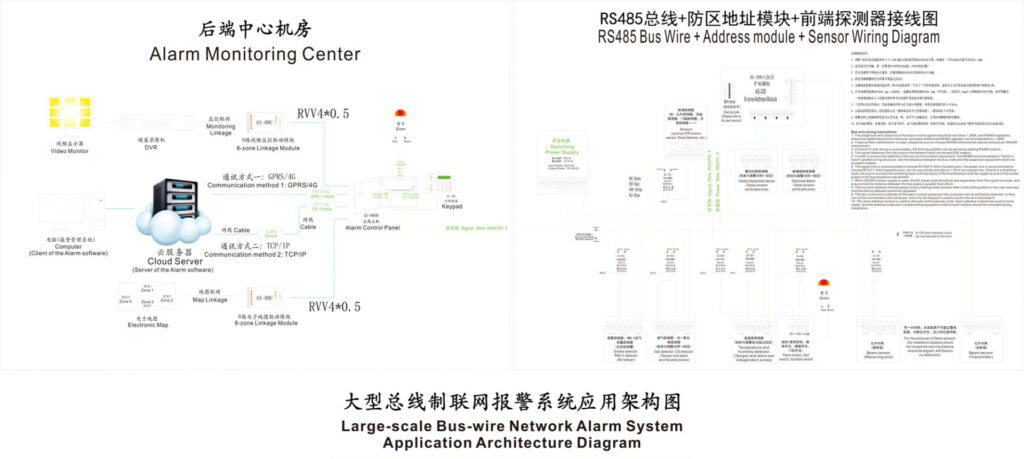
Enterprise intrusion alarm deployments across multi-site, distributed infrastructures face severe vulnerabilities—not from basic hardware failures, but from systemic vendor risk. In large-scale operations, selecting an alarm manufacturer or cloud platform platform involves navigating proprietary protocol lock-in, opaque firmware lifecycles, and fragmented support Service Level Agreements (SLAs).
For procurement teams and corporate security managers, evaluating a vendor must go beyond a standard hardware datasheet. It requires an engineering-grade assessment of the vendor’s communication stack (such as MQTT vs. TCP/IP SIA DC-09), cybersecurity posture, API extensibility, and supply-chain resilience. This framework establishes an objective, technical vetting process to mitigate operational downtime, prevent security debt, and guarantee long-term system maintainability across enterprise-scale security networks.
1. Why Vendor Risk Matters in Enterprise Alarm Infrastructure
In an enterprise environment, a security system failure is rarely isolated to a single broken sensor. Instead, systemic failures stem from vendor dependencies that degrade over time. Large-scale customers often maintain systems for 10 to 15 years. If a vendor discontinues a hardware line, shifts their cloud subscription model, or delays critical CVE patches, the enterprise faces immediate compliance vulnerabilities and capital expenditure spikes.
1.1 Systemic Risks in Commercial Security Ecosystems
- Proprietary Protocol Lock-In: Vendors utilizing closed, non-standard communication protocols prevent third-party integrations, forcing customers into single-source procurement paths for all future expansions or replacements.
- Cloud Platform Dependency: Modern cloud alarm infrastructure introduces runtime risks. If a vendor’s proprietary cloud platform experiences an outage or changes its API architecture without backward compatibility, physical site monitoring is compromised.
- Firmware Lifecycle Abandonment: Hardware remains functional long after software support ceases. Legacy edge panels that do not receive firmware updates become un-patchable network liabilities.
[Vendor Risk Drivers]
  ├── Operational Risk  --> Proprietary Protocol Lock-In & Cloud Platform Outages
  ├── Cybersecurity Risk --> Legacy Unpatched Firmware & Vulnerable Communication Stacks
  └── Financial Risk     --> Sudden Hardware End-of-Life & Arbitrary License Escalations
2. Core Evaluation Criteria for Alarm Supplier Reliability
Vetting an enterprise alarm vendor requires an objective scorecard that balances engineering integrity with commercial stability. Procurement teams must validate four key operational pillars before signing multi-year contracts.
| Evaluation Pillar | Critical Technical Metric | Operational Target | Enterprise Risk Mitigated |
| Manufacturing & Supply Chain | Component sourcing diversity; manufacturing MTBF (Mean Time Between Failures) documentation. | $>100,000$ hours certified hardware MTBF; dual-sourced critical microcontrollers. | Hardware lead-time delays and premature component failure. |
| Protocol Openness | Native support for non-proprietary transport and application layer formats. | Unencrypted or TLS-encrypted SIA DC-09, Contact ID, or documented MQTT topics. | Vendor lock-in and high-cost custom software integration. |
| Cybersecurity Posture | Penetration testing frequency; firmware signing; vulnerability disclosure policy. | Annual third-party black-box audits; mandatory SHA-256 firmware signature validation. | Edge-device exploitation and corporate network pivot points. |
| SLA & Support Escalation | Tier-3 engineering access; critical bug patch response times. | 4-hour response for critical platform bugs; 24/7 dedicated enterprise technical support. | Extended site vulnerabilities during multi-node system crashes. |

3. Technical Infrastructure & Protocol Compatibility
The core of any distributed intrusion system is its communication architecture. Enterprise networks must evaluate how vendors handle telemetry, alarm routing, and state synchronization from the edge panel to the central monitoring station (CMS) or cloud platform.
3.1 Protocol Comparison: MQTT vs. TCP/IP SIA DC-09 vs. Proprietary Stacks
+---------------------------------------------------------------------------------+
|                                APPLICATION LAYER                                |
|        SIA DC-09 (ANSI/SIA)      |       MQTT (OASIS Standard)      |Proprietary|
+----------------------------------+----------------------------------+-----------+
|                                 TRANSPORT LAYER                                 |
|            TCP / UDP             |         TCP (with TLS 1.3)       |  Closed   |
+----------------------------------+----------------------------------+-----------+
1. SIA DC-09 (TCP/IP)
An open international standard for transmitting alarms over IP networks.
- Engineering Advantages: Broad compatibility across different central monitoring software automation platforms; highly structured data frames ensure uniform event logging.
- Tradeoffs: High overhead for frequent polling (keep-alives) compared to modern event-driven protocols; lacks native complex data structure support without heavy packet customization.
2. MQTT (Message Queuing Telemetry Transport)
An open, lightweight, publish-subscribe network protocol.
- Engineering Advantages: Ideal for high-density, low-bandwidth edge-to-cloud communication. Uses persistent TCP connections with minimal payload overhead; provides native support for bi-directional state synchronization via JSON payloads over custom topics.
- Tradeoffs: Requires a robust, highly available MQTT broker infrastructure. If the vendor hosts the broker, the customer must carefully evaluate broker clustering, load-balancing mechanisms, and failover capabilities.
3. Proprietary Stacks
Closed communication architectures unique to a single manufacturer.
- Engineering Advantages: Can be highly optimized for specific hardware features and specialized edge-device capabilities.
- Tradeoffs: Total architectural lock-in. Any custom software integration requires expensive, vendor-developed SDK modules, restricting the platform’s agility.
3.2 Compatibility Matrix for Enterprise Integration
An enterprise-ready alarm panel must act as an open edge gateway. Vendors should be evaluated on their ability to ingest edge data and expose it to corporate ecosystems without intermediate translation layers.
- Physical Layer Versatility: Panels must feature onboard RJ-45 Ethernet ports, integrated 4G/5G cellular modules (with dual SIM cards for carrier redundancy), and legacy RS-485 terminals for backwards compatibility with existing multi-drop sensor loops.
- Northbound API Ecosystem: The vendor’s cloud or on-premise head-end must expose documented RESTful APIs and Webhooks. This ensures that physical security information management (PSIM) systems, video management systems (VMS), and corporate identity provider (IdP) systems can programmatically arm, disarm, and audit system state configurations.
4. Support Systems, SLA Architecture, and Lifecycle Risks
When a multi-site retail or critical infrastructure deployment encounters a widespread configuration glitch or firmware crash, standard consumer helpdesk queues are insufficient. Enterprise security managers need direct pathways to the engineering teams responsible for writing the underlying code.
4.1 Support Escalation and Operational SLA Requirements
Contracts must specify rigorous Support Level Agreements with explicit penalties for non-compliance. Escalation workflows must be clearly defined from initial contact to definitive resolution:
- Tier 1 (Help Desk): Basic installation verification, hardware replacement RMA processing, and initial log gathering. Maximum response window: 1 hour.
- Tier 2 (Advanced Technical Support): Network diagnostics, database configuration adjustments, and protocol analysis. Maximum response window: 2 hours.
- Tier 3 (Core Engineering / Product Team): Source-code review, firmware patch creation, and deep database debugging. Maximum response window for critical outages: 4 hours.
4.2 Firmware Lifecycle & Patch Governance
A critical point of vendor failure is the unannounced termination of security patches for operational hardware. Procurement contracts must enforce a Minimum Supported Lifecycle (MSL) clause, ensuring that any deployed hardware model receives security patches for at least 7 years post-discontinuation.
4.2.1 Patch Propagation Workflows
Vendors must provide automated, cryptographically validated firmware deployment utilities. The platform must support staged, ring-based deployment strategies rather than all-or-nothing updates. This allows security operations teams to push updates to a single test facility, validate stability over a 48-hour period, and then safely scale the rollout across the remaining global enterprise footprint.
5. Cybersecurity Posture & Firmware Governance
Alarm panels are increasingly targeted as initial access vectors into enterprise corporate networks. Because these systems occupy a unique space—connected simultaneously to local physical security loops, corporate internal subnets, and external monitoring endpoints—their security integrity cannot be assumed.
5.1 Firmware Hardening Standards
Enterprise customers must demand documentation verifying that the vendor’s engineering workflow adheres to secure coding standards such as OWASP and IEC 62443.
- Cryptographic Verification: Every edge panel must execute a Secure Boot sequence. The panel’s bootloader must cryptographically verify the digital signature of the firmware payload using a public key securely stored within a hardware Root of Trust (RoT) module or Trusted Platform Module (TPM) chip on the motherboard. If the signature fails validation, the panel must halt execution and trigger a physical tamper alert.
- Encryption of Data in Transit: All telemetry, configuration commands, and alarm transmissions must be encrypted using TLS 1.3 for TCP connections or DTLS for UDP transport layers. The system must completely deprecate legacy, unencrypted plain-text protocols like standard Contact ID over analog copper phone lines or raw unencrypted SIA over port 10001.
5.2 Vulnerability Management and Incident Response
Vendors must operate a transparent Vulnerability Disclosure Program (VDP). When a zero-day vulnerability is identified, the vendor must commit to a strict mitigation schedule:
[Vulnerability Identified]
       │
       ▼ (Max 24 Hours)
[Initial Triage & Customer Advisory Issued]
       │
       ▼ (Max 72 Hours)
[Temporary Configuration Mitigation Provided]
       │
       ▼ (Max 14 Days)
[Validated Firmware Patch Released via Staged Rollout]
6. Scalability & Redundancy for Distributed Deployments
For organizations managing hundreds of physical facilities across continents, the infrastructure must be resilient against local ISP outages, regional cloud datacenter crashes, and component-level degradation.
6.1 Distributed Alarm Architecture and Edge Autonomy
The system architecture must prioritize edge autonomy over continuous cloud connectivity. A truly resilient enterprise alarm panel must function as a self-contained compute node.
If a localized backhaul network connection drops or a regional cloud provider experiences a major routing failure, the edge panel must transition seamlessly into Autonomous Local Survivability Mode.
During this disconnected state, the panel must continue executing local access control policies, processing sensor inputs, and logging events to an internal, non-volatile FIFO (First-In, First-Out) memory buffer capable of holding at least 50,000 structured event logs. Upon network restoration, the system must execute a deterministic state synchronization protocol to update the central database without dropping chronological event records or overwriting critical security entries.
+-------------------------------------------------------------------------+
|                  NORMAL MODE: ACTIVE CONNECTIVITY                       |
|  [Edge Sensors] ---> [Local Edge Panel] --- (TLS 1.3) ---> [Cloud/CMS]  |
+-------------------------------------------------------------------------+
                                     │
                        [WAN / Cloud Connection Fails]
                                     │
                                     ▼
+-------------------------------------------------------------------------+
|                AUTONOMOUS LOCAL SURVIVABILITY MODE                      |
|  [Edge Sensors] ---> [Local Edge Panel] ---> (Buffer to Local FIFO NVRAM)|
|                           *Cloud Offline*                               |
+-------------------------------------------------------------------------+
                                     │
                        [WAN / Cloud Connection Restored]
                                     │
                                     ▼
+-------------------------------------------------------------------------+
|                DETERMINISTIC STATE SYNCHRONIZATION                      |
|  [Edge Panel FIFO] --- (Bulk Chronological Replay) ---> [Cloud/CMS]     |
+-------------------------------------------------------------------------+
6.2 High Availability and Cloud Redundancy Models
If the vendor relies on a cloud backend, that infrastructure must mirror carrier-grade availability standards ($99.999\%$ uptime, excluding scheduled maintenance windows). The architecture must feature active-active multi-region clustering distributed across geographically distinct cloud availability zones. Load balancers must utilize continuous, automated health probes to dynamically reroute edge traffic within milliseconds if a specific regional cluster goes dark.

7. Enterprise Procurement Best Practices & Deployment Checklist
To standardize vendor risk management, enterprise procurement teams should execute the following technical evaluation checklist prior to final hardware selection and deployment authorization.
- [ ] Protocol Openness Verification: Confirm the panel natively transmits standardized SIA DC-09 or fully documented MQTT packets without requiring intermediate proprietary translation hardware.
- [ ] Hardware Root of Trust Evaluation: Verify that the hardware architecture incorporates an onboard TPM chip or Secure Element to manage encryption keys and enforce secure boot sequences.
- [ ] API Access & Integration Audit: Validate that complete, RESTful API documentation is available and that the system supports outbound Webhooks for real-time integration with corporate SIEM/VMS engines.
- [ ] Firmware Lifecycle Contractual Commitment: Secure a signed contractual agreement confirming a minimum of 7 years of security patch availability post-hardware discontinuation.
- [ ] Escalation SLA Verification: Ensure the vendor’s enterprise support contract specifies Tier-3 core engineering access with a guaranteed response time of 4 hours or less for critical issues.
- [ ] Regulatory & Compliance Certification: Confirm that all edge components hold valid, independent certifications relevant to the operating jurisdiction (e.g., UL 1023/UL 2610 for the US, EN 50131 Grade 3 for Europe).
- [ ] Local Edge Autonomy Validation: Physically disconnect the WAN backhaul network cable during active operation to confirm the panel successfully buffers data without freezing, dropping local events, or crashing.
8. Architectural Decision Logic: Choosing the Right Infrastructure
                                  [Select Protocol Stack]
                                             │
                      ┌──────────────────────┴──────────────────────┐
            [Is Multi-Vendor Compatibility Required?]    [Is Ultra-Low Bandwidth/Cloud Priority?]
                      │                                             │
                      ▼ (Yes)                                       ▼ (Yes)
              [Deploy SIA DC-09]                            [Deploy MQTT Architecture]
                      │                                             │
        ┌─────────────┴─────────────┐                 ┌─────────────┴─────────────┐
 [Pros: Open standard,       [Cons: Higher     [Pros: Low payload    [Cons: Requires robust
  broad CMS support]         keep-alive line    overhead, rich state   broker infrastructure
                             overhead]          synchronization]       management]
9. Frequently Asked Questions (FAQ)
1. How do you assess alarm vendor reliability?
Alarm vendor reliability is assessed by analyzing structural metrics: manufacturing MTBF figures (which should exceed 100,000 hours), the openness of their communication protocols (avoiding proprietary lock-in), historical firmware patch frequencies, and their financial stability to support hardware lines over a 10-to-15-year operational lifecycle.
2. What certifications should enterprise alarm vendors have?
Enterprise vendors must maintain independent, third-party laboratory certifications matching their regional deployment footprint. This includes UL 2610 (Central-Station Alarm Units) or UL 1023 in North America, EN 50131 Grade 3 (or Grade 4 for high-security facilities) in Europe, and global manufacturing standards such as ISO 9001 and ISO 27001 for data security management.
3. How important is protocol compatibility?
Protocol compatibility is vital for long-term system maintainability. Utilizing open standards like SIA DC-09 or well-documented MQTT payloads ensures that the hardware can communicate with any modern Central Monitoring Station or enterprise PSIM software platform. This design prevents single-vendor dependency and reduces the total cost of ownership during future infrastructure upgrades.
4. What causes vendor lock-in in alarm systems?
Vendor lock-in is typically caused by the manufacturer deploying proprietary, encrypted application layers or closed wireless protocols. When an enterprise installs panels that only communicate with the vendor’s own monitoring head-end or cloud platform, they lose the leverage to negotiate competitive pricing and are forced to buy proprietary replacement components.
5. How does cloud architecture affect vendor evaluation?
Cloud architecture shifts the risk profile from local hardware components to service availability and API stability. When evaluating cloud vendors, check for active-active multi-region redundancy, documented data residency compliance, and a clear API deprecation policy. Crucially, verify that the edge hardware can maintain local operation if the cloud connection is lost.
Evaluate Your Next Infrastructure Deployment
Navigating vendor compliance, cryptographic firmware hardening, and complex protocol architecture requires deep alignment between procurement and technical security engineering.
If you are currently drafting RFP/RFI requirements or evaluating vendors for an upcoming multi-site enterprise alarm system deployment, our technical security architecture team can help validate your network specifications and redundancy models.