

Introduction
In today’s interconnected world, businesses rely on digital networks not only for operations but also for security. Imagine a logistics warehouse where an intruder attempt is instantly detected by IP-based motion sensors, triggering alerts across multiple devices — preventing loss before it occurs. Such real-time protection is made possible by network alarm monitoring systems.
A network alarm monitoring system integrates multiple alarm devices through network communication protocols, enabling centralized surveillance, automated alerts, and intelligent decision-making. These systems are essential for enterprises managing large or distributed facilities, as they ensure fast, accurate, and scalable security responses.
As a seasoned security technology expert with over 15 years of experience in alarm system design and network integration, I will break down the core functional modules that define modern network alarm monitoring systems. Each module contributes to operational reliability, efficiency, and safety — the foundation of every advanced business security infrastructure.
Core Functional Modules of Network Alarm Monitoring Systems
1. Sensor and Detection Module
The sensor and detection module is the first line of defense in any alarm monitoring network. It continuously scans for abnormal activities or environmental changes, ensuring early threat identification.
- Overview: This module encompasses sensors such as motion detectors, door/window contacts, vibration sensors, smoke detectors, and temperature sensors.
- Technical details: Modern IP-based sensors use network protocols like TCP/IP or MQTT for fast and reliable data transmission to the central controller.
- Key features:
- Real-time data acquisition and status monitoring
- Sensitivity calibration to minimize false alarms
- AI-enhanced pattern analysis for noise reduction
- Benefits: Improved detection accuracy across diverse scenarios — from data centers and office complexes to industrial warehouses.
2. Central Processing and Control Module
Often referred to as the brain of the system, this module processes and interprets signals from multiple sources to determine actionable events.
- Overview: It handles data aggregation, decision logic, and alarm prioritization.
- Technical details:
- Implemented via embedded controllers, edge devices, or cloud-based servers
- Uses rule-based engines or AI-driven analytics to identify genuine security threats
- Features:
- Event correlation across multiple zones
- Real-time prioritization and filtering of critical alarms
- Integration with databases for trend analysis and audit logs
- Benefits: Ensures scalable, intelligent monitoring that adapts to both small facilities and large enterprise networks.
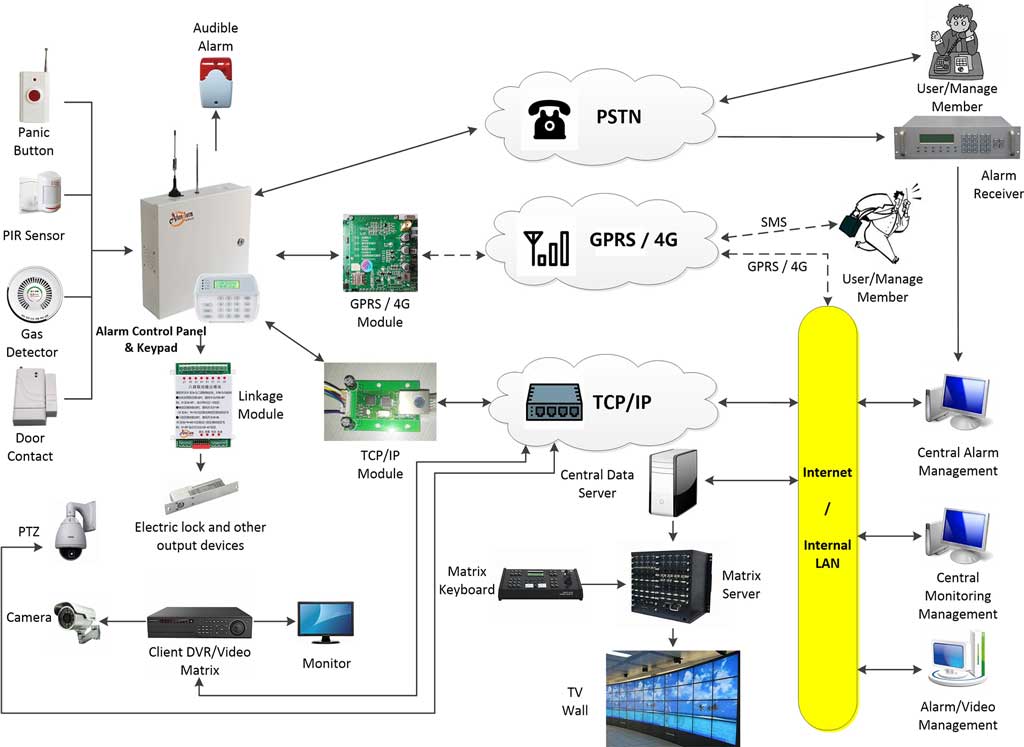
3. Network Communication Module
The network communication module ensures that alarm signals are transmitted reliably across the entire system, regardless of location.
- Overview: It connects sensors, control units, and user interfaces through wired or wireless networks.
- Technical details:
- Supports protocols like SNMP, HTTP/HTTPS, and MQTT
- Employs AES-256 encryption and SSL/TLS for data security
- Uses LAN/WAN and 4G/5G networks for remote monitoring
- Incorporates failover mechanisms for uninterrupted communication
- Features:
- Bandwidth optimization and traffic prioritization
- Secure VPN tunnels for remote access
- Encrypted data logs for compliance
- Benefits: Enables centralized monitoring and fast response across geographically distributed assets.
4. Alert and Notification Module
Once an alarm event is validated, this module ensures that the right people are notified immediately and appropriately.
- Overview: The alert and notification system manages multi-channel delivery to ensure rapid human response.
- Technical details:
- Integrates with SMS, email, mobile push notifications, sirens, or voice calls
- Uses APIs for external integrations (e.g., dispatch centers or management platforms)
- Features:
- Tiered escalation and scheduling logic
- Customizable templates for message content
- Audit logging for traceability and compliance
- Benefits: Guarantees instant awareness and action, reducing response times during emergencies — a proven advantage in high-security environments like data centers or logistics hubs.
5. User Interface and Management Module
The user interface (UI) defines how operators interact with the monitoring system, combining accessibility with analytical power.
- Overview: Provides real-time dashboards and configuration tools for administrators and responders.
- Technical details:
- Web-based GUIs and mobile-compatible control panels
- Role-Based Access Control (RBAC) for secure multi-user management
- Features:
- Interactive visualization tools (heat maps, timelines, charts)
- Customizable reporting and analytics
- Configuration wizards for system setup
- Benefits: Simplifies system management for non-technical users while offering deep analytics for professional IT and security teams.
6. Integration and Expansion Module
A modern alarm monitoring system must be flexible enough to integrate with other security and enterprise systems.
- Overview: This module allows seamless interoperability across platforms.
- Technical details:
- Supports open APIs, ONVIF, BACnet, and IoT standards
- Integrates with CCTV, access control, and ERP systems
- Allows firmware upgrades and third-party plugins
- Features:
- Modular architecture for easy scalability
- Hybrid deployment options (cloud + on-premise)
- Future-ready compatibility with AI or 5G networks
- Benefits: Ensures long-term value and adaptability as technology evolves and organizational needs grow.
Advanced Considerations and Best Practices
1. Security Enhancements
Network alarm systems are only as strong as their cybersecurity posture. Implementing zero-trust models, conducting regular vulnerability scans, and using end-to-end encryption are essential to prevent cyber exploitation.
2. Performance Metrics
Key indicators for evaluating system performance include:
- Mean Time to Detect (MTTD)
- Mean Time to Respond (MTTR)
- False Alarm Rate (FAR)
These metrics help optimize response strategies and validate system reliability.
3. Real-World Implementations
In an industrial case study, a manufacturing firm achieved a 30% reduction in security incidents after deploying a network-based alarm system with AI-based detection and centralized monitoring. Similar outcomes are echoed across logistics and energy sectors.
Conclusion
Each module — from detection to data transmission and human notification — plays a crucial role in the network alarm monitoring ecosystem. Together, they form an intelligent, interconnected framework that ensures faster responses, fewer false alarms, and greater operational control.
Organizations should regularly review and upgrade their monitoring infrastructure to align with current technologies such as AI analytics, 5G communication, and cloud-based management.
For enterprises seeking to optimize their alarm systems, consulting a certified security technology expert can ensure proper design, deployment, and compliance with industry standards like UL, ISO 27001, and NIST SP 800-53.