

In today’s evolving landscape of alarm monitoring systems, security professionals often grapple with the trade-offs between traditional on-premises setups and modern cloud-based solutions. Hybrid alarm monitoring emerges as a balanced approach, blending the reliability of local hardware with the scalability of remote cloud infrastructure. This model addresses key challenges in intrusion detection and response, allowing system architects and IT security teams to optimize performance while mitigating risks. By combining cloud and on-site alarm control, organizations can achieve robust protection without fully committing to one paradigm.
Understanding Hybrid Alarm Monitoring
Hybrid alarm monitoring integrates on-premises alarm systems—such as local control panels, sensors, and sirens—with cloud-based platforms for data processing, storage, and remote access. In essence, critical alerts are handled locally for immediate action, while non-urgent data flows to the cloud for analysis and archiving. This setup is particularly valuable in commercial buildings, warehouses, or high-security facilities where downtime is unacceptable.
For instance, in a retail environment, on-site components might trigger instant lockdowns during a breach, while cloud integration enables real-time notifications to off-site security personnel via mobile apps. This combination ensures continuity even during network outages, a common pain point in fully cloud-dependent systems.
Advantages of Hybrid Models
One major benefit of hybrid security monitoring is enhanced reliability. On-premises elements provide low-latency responses, crucial for time-sensitive alarm events like unauthorized entry. According to a 2023 report by the Security Industry Association (SIA), hybrid systems reduce false alarm rates by up to 25% through local verification before cloud escalation.
Cost efficiency is another strong pro. Organizations avoid the high upfront costs of full cloud migrations by leveraging existing on-site infrastructure. A case study from ISC West 2024 highlighted a manufacturing plant that saved 30% on operational expenses by adopting a hybrid approach, combining legacy alarm panels with cloud analytics for predictive maintenance.
Scalability stands out as well. Cloud components allow seamless expansion, such as adding AI-driven video surveillance without overhauling local hardware. For IT security teams, this means easier integration with enterprise tools like SIEM (Security Information and Event Management) systems, addressing the pain of fragmented monitoring.
Data privacy also improves in hybrid setups. Sensitive information can remain on-premises to comply with regulations like GDPR, while anonymized data benefits from cloud-based threat intelligence. This dual-layer approach minimizes exposure to cyber threats, a growing concern in alarm monitoring networks.

Drawbacks of Hybrid Models
Despite these strengths, hybrid alarm monitoring isn’t without challenges. Complexity in deployment can be a hurdle, as integrating on-site and cloud elements requires careful configuration to avoid compatibility issues. System architects may face extended setup times, potentially delaying rollout by weeks.
Security vulnerabilities arise at integration points. If not properly secured, the bridge between local and cloud systems could become a weak link, susceptible to attacks like man-in-the-middle exploits. A 2022 NIST study on cybersecurity in IoT devices emphasized the need for encrypted tunnels in hybrid environments to prevent such risks.
Maintenance demands increase too. Teams must manage both physical hardware and cloud subscriptions, leading to higher ongoing costs in training and updates. For smaller operations, this dual oversight can strain resources, exacerbating the pain of limited IT budgets.
Finally, dependency on internet connectivity for cloud features can introduce latency in remote monitoring. In areas with unreliable networks, this might compromise the effectiveness of combining cloud and on-site alarm control, forcing reliance on local backups.
Real-World Deployment Case Studies
To illustrate, consider a mid-sized office complex in urban settings. The security team implemented hybrid intrusion alarm systems by retaining on-premises motion detectors and integrating them with a cloud platform like Honeywell’s Total Connect. This allowed for local siren activation during intrusions while enabling remote arming/disarming via apps. The result? A 40% faster response time to alerts, as per internal audits.
In another example, a logistics warehouse combined Bosch on-site panels with AWS cloud storage for video feeds. This hybrid setup reduced data loss during power outages and provided scalable storage, cutting costs by 20% annually. These cases demonstrate how hybrid models solve scalability issues in growing operations.
| Aspect | On-Premises Only | Cloud Only | Hybrid Model |
|---|---|---|---|
| Reliability | High (no network dependency) | Variable (internet reliant) | High (local failover) |
| Scalability | Limited (hardware-bound) | Excellent (elastic resources) | Strong (best of both) |
| Cost | High upfront, low ongoing | Low upfront, subscription-based | Balanced (leverage existing assets) |
| Security | Strong local control | Potential data exposure | Enhanced with layered protections |
| Maintenance | Hardware-focused | Software updates | Dual but manageable with tools |
This table compares key factors, helping teams evaluate based on their needs.
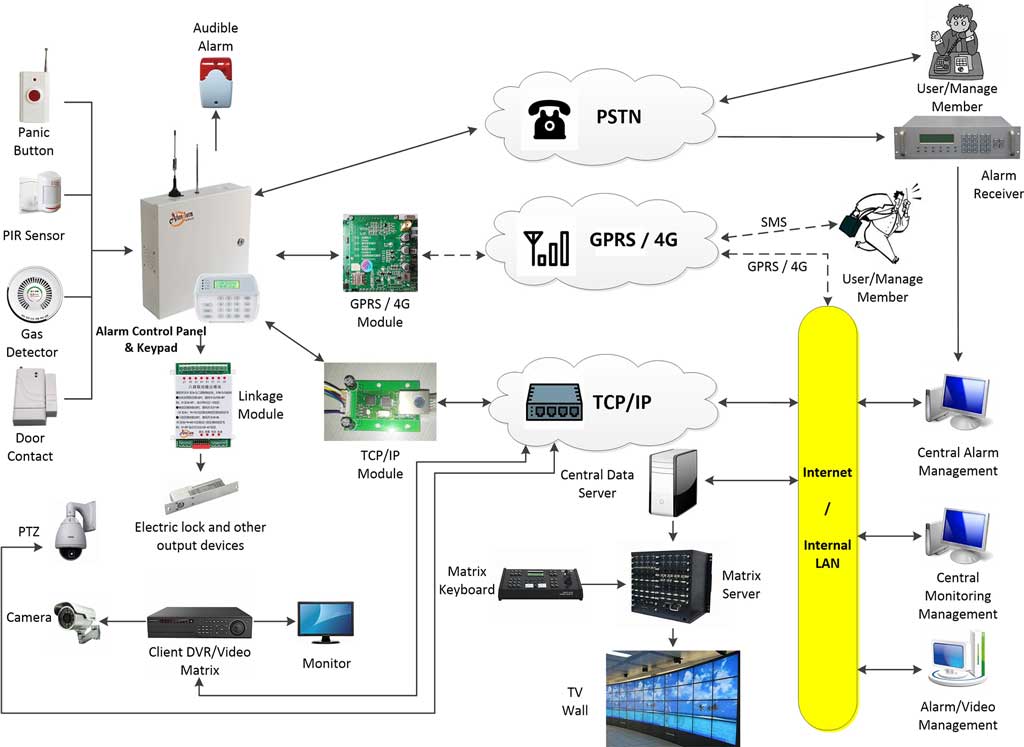
Implementing a Hybrid Alarm Monitoring System: Step-by-Step Guide
For those ready to deploy, here’s a practical walkthrough tailored for system architects and IT teams, even if you’re new to the process:
- Assess Current Infrastructure: Inventory your existing on-premises alarm systems, including control panels (e.g., DSC or Paradox models) and sensors. Identify compatibility with cloud platforms—check manufacturer APIs or use tools like IFTTT for integration testing.
- Select Cloud Provider: Choose a secure platform like ADT Pulse or Verkada, ensuring it supports hybrid protocols such as ONVIF for cameras. Verify compliance with standards like UL 827 for central station monitoring.
- Configure Local Network: Set up a secure gateway device (e.g., a Raspberry Pi with VPN software) to bridge on-site and cloud. Install firmware updates and enable encryption—use commands like
openssl req -new -key private.key -out csr.pemfor certificate generation if handling manually. - Integrate Components: Link sensors to the cloud via the gateway. In software like Blue Iris, add cloud endpoints: Go to Settings > Cloud > Add Account, input credentials, and test connectivity. For alarms, program the panel (e.g., via keypad: Enter *8 + installer code, then zone definitions) to send signals to both local sirens and cloud servers.
- Test and Monitor: Simulate breaches—trigger a sensor and verify local response (e.g., alarm sounds within 2 seconds) and cloud alerts (push notifications arrive). Use monitoring tools like Wireshark to inspect traffic for vulnerabilities. Adjust thresholds in the cloud dashboard to minimize false positives.
- Train and Maintain: Document procedures in a shared wiki. Schedule monthly checks: Update cloud firmware via app and inspect on-site hardware for wear. If issues arise, rollback to full on-premises mode as a failover.
This process ensures a smooth transition, resolving common implementation pains like integration errors.
Key Takeaways for Optimal Security
Hybrid alarm monitoring offers a pragmatic path forward, weighing the steadfastness of on-premises systems against the agility of cloud solutions. While pros like reliability and cost savings often outweigh cons such as complexity, success hinges on tailored deployment. For system architects and IT security teams, embracing this model can elevate overall alarm system performance, provided integration is handled with precision.
By addressing real-world concerns like rapid response and data security, hybrid approaches empower organizations to stay ahead in an increasingly connected threat landscape.
Key Citations
- Security Industry Association (SIA). (2023). State of the Industry Report. Retrieved from https://www.securityindustry.org/report/state-of-the-industry-report-2023/
- ISC West. (2024). Case Studies in Security Deployment. Presented at ISC West Conference, Las Vegas.
- National Institute of Standards and Technology (NIST). (2022). Cybersecurity Framework for IoT Devices. NISTIR 8259A. Retrieved from https://nvlpubs.nist.gov/nistpubs/ir/2022/NIST.IR.8259A.pdf
- Honeywell. (2023). Total Connect Integration Guide. Honeywell Security Documentation.
- Bosch Security Systems. (2022). Hybrid Alarm Solutions Whitepaper. Retrieved from https://www.boschsecurity.com/us/en/solutions/intrusion-alarm-systems/