
Executive Summary for Security Decision-Makers
Choosing between a wired burglar alarm control panel and a hybrid alarm control panel is not a cosmetic or budget-only decision. It is a structural architectural decision that will define:
- System stability over 10–20 years
- Mean time between failures (MTBF)
- Maintenance labor cost
- False alarm frequency
- Expansion limitations
- Total lifecycle cost (TCO)
- Operational risk exposure
Most online comparisons reduce this discussion to “wired is stable, wireless is flexible.” That oversimplification is dangerous—especially for commercial, industrial, and multi-site deployments.
This guide approaches the topic from a systems engineering and lifecycle reliability perspective, not from a sales brochure angle. If you are a:
- Security system integrator
- Commercial facility manager
- Industrial plant engineer
- Multi-site retail security director
- Bulk procurement manager
—this article is written for you.
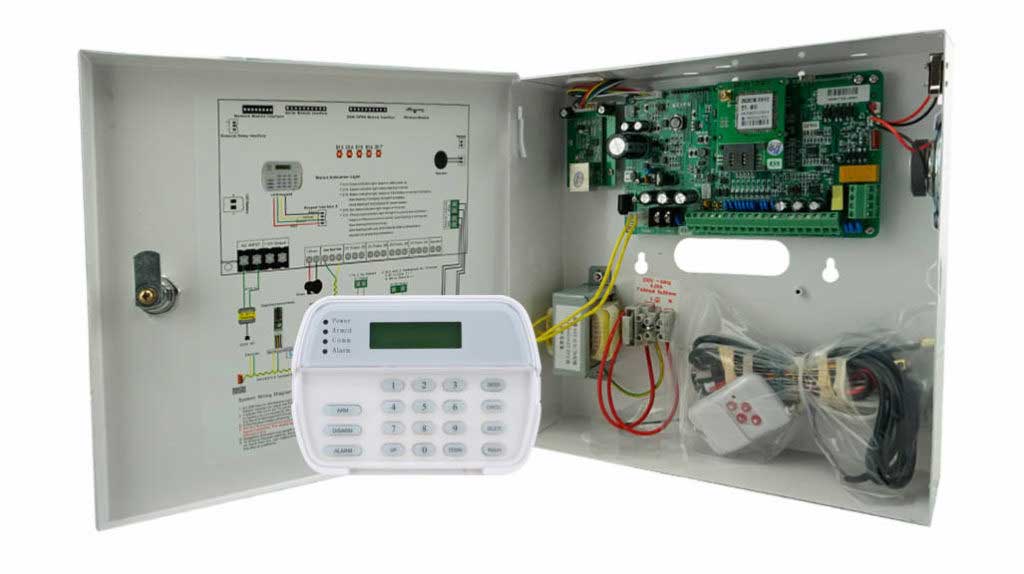
1. Understanding the Architecture: What Actually Changes Between Wired and Hybrid?
Before discussing reliability, we must clarify terminology precisely.
1.1 What Is a Wired Alarm Panel?
A wired alarm panel (also referred to as a wired alarm control panel, wired burglar alarm panel, or wired intrusion alarm panel) is a system where:
- All detection devices (PIRs, magnetic contacts, glass-break detectors, vibration sensors)
- All alarm signaling devices (sirens, strobes)
- All control peripherals (keypads, expanders)
are physically connected to the central alarm control panel via copper cabling.
Key characteristics:
- Power is delivered directly from the panel.
- Signaling occurs through supervised circuits or digital bus loops.
- Communication reliability depends primarily on wiring integrity.
In practice, wired panels use structured cabling like Category 5e or 6, often with end-of-line resistors for supervision to detect tampering or faults. This setup ensures that any break in the circuit triggers an immediate alert, making it ideal for environments where consistent monitoring is essential.
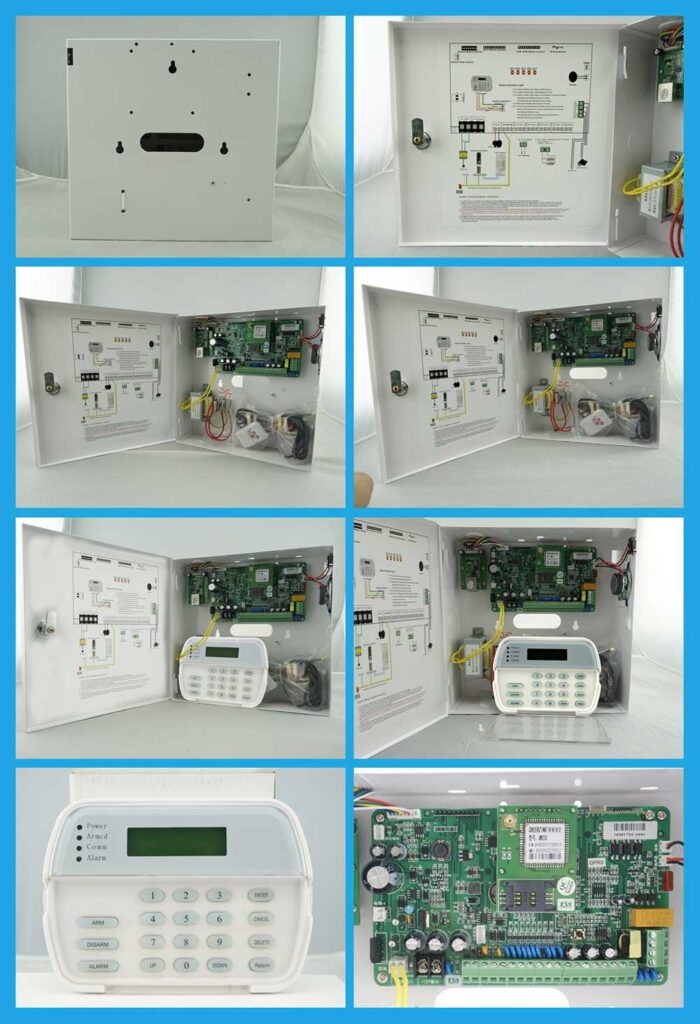
1.2 What Is a Hybrid Burglar Alarm Control Panel?
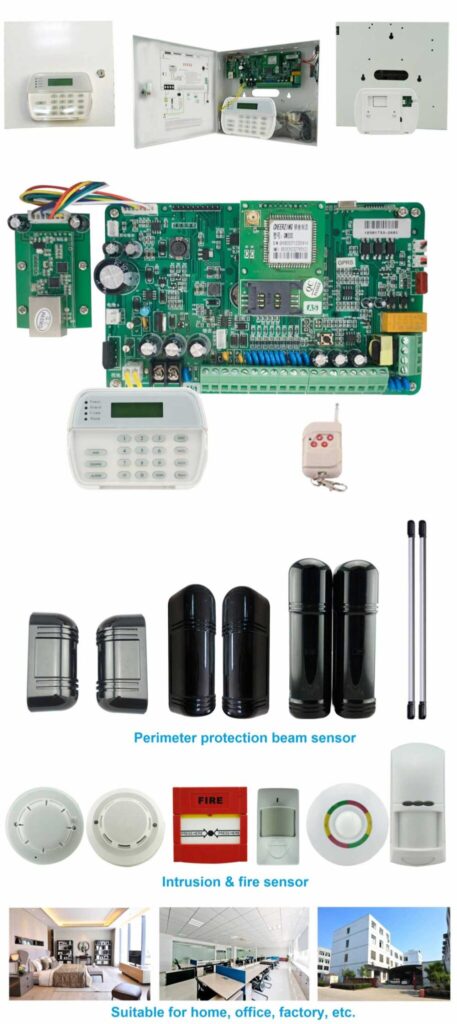
A hybrid alarm control panel is a system that:
- Maintains core wired zones and bus architecture
- Supports additional wireless devices through RF receivers
- Allows simultaneous management of wired and wireless sensors
It is not fully wireless. Instead, it combines both.
Hybrid architecture introduces:
- RF communication modules
- Battery-powered field devices
- Signal supervision intervals
- RF spectrum dependency
The question is not “which is modern,” but:
Which architecture delivers measurable, long-term reliability under commercial conditions?
To elaborate, hybrid panels typically integrate wireless transceivers operating in the 433 MHz, 868 MHz, or 915 MHz bands, allowing for encrypted communication with devices like wireless PIR sensors or door contacts. This dual capability can be seen in models from manufacturers like Honeywell or DSC, where the wired backbone handles critical zones, and wireless extensions cover hard-to-reach areas.
2. Reliability Over Time: A Failure Mode Perspective
Reliability is not about how the system works on installation day.
It is about:
- Year 3
- Year 7
- Year 15
Let’s break it down.
2.1 Power Stability and Failure Risk
Wired Alarm Panel
In a wired burglar alarm panel system:
- Sensors are powered by regulated 12V/24V outputs
- Central battery backup supports the entire detection network
- Voltage drop can be calculated and engineered
Failure modes:
- Cable damage
- Terminal corrosion
- Short circuit
Predictability level: High
If designed correctly, power integrity is stable for decades. For instance, using proper gauge wiring (e.g., 18 AWG for runs up to 500 feet) minimizes voltage drop, and incorporating surge protectors guards against power spikes common in industrial settings.
Hybrid Alarm Control Panel
Wireless devices rely on:
- Internal lithium or alkaline batteries
- Periodic RF supervision signals
- Battery health algorithms
Failure modes:
- Battery depletion
- Battery leakage
- Temperature degradation
- Undetected low-battery states
- RF interference masking device supervision
Predictability level: Moderate
Battery-based architectures introduce time-based failure variables. In real-world scenarios, lithium batteries in wireless sensors may last 2-5 years, but extreme temperatures (below -10°C or above 50°C) can accelerate degradation by up to 50%, leading to unexpected failures in unconditioned warehouses.
A common pitfall is overlooking battery monitoring; ensure the panel’s software alerts at 20% remaining capacity to allow proactive replacement.
2.2 Mean Time Between Failures (MTBF)
In long-term commercial deployments:
| Architecture | Typical 10-Year Stability |
|---|---|
| Wired intrusion alarm panel | High (minimal recurring failure points) |
| Hybrid burglar alarm panel | Moderate (battery + RF introduces recurring maintenance cycles) |
Every wireless device becomes a maintenance asset.
If a site contains 180 wireless sensors:
- 180 battery schedules
- 180 supervision intervals
- 180 potential RF conflicts
Scale multiplies risk.
Industry data from sources like the Security Industry Association indicates that wired systems can achieve MTBF rates exceeding 100,000 hours, compared to 50,000-70,000 hours for hybrid systems due to wireless components. This difference becomes pronounced in high-device-count installations, where failure probability compounds.
3. Electromagnetic Interference & RF Risk
Industrial and commercial environments contain:
- Variable frequency drives
- Large motors
- Elevator systems
- Wi-Fi congestion
- Metallic structural shielding
- High-density electronics
A wired burglar alarm control panel is immune to RF congestion because:
- Communication is physical
- Data transmission is shieldable
- EMI can be engineered around
Hybrid systems rely on:
- 433 MHz / 868 MHz / 915 MHz bands
- Clean RF channels
- Signal path integrity
Large factories, logistics centers, data halls, and industrial warehouses introduce:
- Reflection
- Signal absorption
- Multipath fading
Wireless reliability drops significantly in these environments. For example, EMI from industrial motors can reduce wireless signal strength by 20-30 dB, leading to false alarms or missed detections. Mitigation involves site surveys using spectrum analyzers to identify interference sources, but even then, hybrid systems may require additional repeaters, increasing complexity.
Key error-prone point: Assuming all RF bands are equal—always select frequency-hopping spread spectrum (FHSS) protocols in hybrid setups to avoid single-channel jams.
4. Bus Load Capacity & Expansion Engineering
4.1 Wired Alarm Panel Bus Architecture
Modern wired intrusion alarm panels support:
- Addressable bus systems
- Multi-drop communication
- Zone expanders
- Loop supervision
Load engineering includes:
- Maximum device count
- Bus current consumption
- Voltage drop calculation
- Distance limitations
Expansion is linear and predictable. For instance, RS-485 bus protocols allow up to 128 devices per loop, with distances up to 4,000 feet when using twisted-pair cabling and proper termination resistors to prevent reflections.
4.2 Hybrid Alarm Control Panel Expansion
Hybrid panels:
- Have RF receiver device limits
- Are constrained by RF bandwidth
- Can experience congestion in high-density deployments
Adding 150+ wireless devices in a single industrial environment introduces:
- Collision domains
- Latency
- Supervision traffic saturation
Wireless does not scale infinitely. In practice, most hybrid receivers support 64-128 wireless zones, but real-world limits drop to 50-80 in EMI-heavy areas due to packet collisions. To expand safely, calculate RF density: Aim for no more than 1 device per 1,000 square feet in open spaces, adjusting for obstacles.
5. Long-Term Maintenance Cost Comparison
5.1 Wired Alarm Panel Maintenance Model
Recurring tasks:
- Annual system test
- Occasional terminal tightening
- Battery replacement at panel level (every 3–5 years)
No distributed battery replacements.
Labor is centralized. A typical annual inspection involves checking connections with a multimeter for resistance (under 5 ohms per loop) and verifying supervision signals.
5.2 Hybrid Burglar Alarm Panel Maintenance Model
Recurring tasks:
- Device battery replacements (every 1–3 years)
- RF signal quality checks
- Device re-enrollment if interference occurs
- Firmware management (if smart wireless)
Labor increases proportionally to device count.
In large-scale deployments, hybrid becomes maintenance-heavy. For a 100-device hybrid system, expect 20-30 hours of annual labor for battery swaps alone, versus 5-10 hours for wired. Use inventory software to track battery expiration dates and schedule replacements in batches to minimize downtime.
6. Installation Complexity vs Lifecycle Cost
Wired Alarm Panel
Installation:
- Higher labor upfront
- Cable routing required
- Conduit planning necessary
Lifecycle:
- Lower recurring cost
- Greater long-term stability
Step-by-step installation: 1) Map zones and cable runs; 2) Install conduit (e.g., PVC for indoor); 3) Pull cables, labeling each end; 4) Terminate with crimp tools; 5) Test loops for continuity.
Hybrid Alarm Control Panel
Installation:
- Faster deployment
- Minimal cable routing
- Suitable for retrofits
Lifecycle:
- Ongoing maintenance overhead
- Battery inventory logistics
- RF troubleshooting complexity
Short-term convenience vs long-term engineering discipline. Hybrid installation steps: 1) Mount wired core; 2) Install RF receiver; 3) Enroll wireless devices via panel menu; 4) Perform walk-test for signal strength (aim for -85 dBm or better).
7. When You MUST Choose a Wired Burglar Alarm Panel
A wired intrusion alarm panel is mandatory when:
- Industrial facilities with heavy EMI
- High-security environments
- Sites requiring 10+ year uninterrupted stability
- Large-scale multi-zone deployments (100+ zones)
- Critical infrastructure protection
- Long cable runs can be engineered properly
If downtime is unacceptable, wired remains the gold standard. Examples include data centers or pharmaceutical plants, where regulations like UL 864 mandate reliable, interference-free systems.
8. When Hybrid Alarm Control Panels Make Engineering Sense
Hybrid burglar alarm control panels are justified when:
- Historic buildings where wiring is restricted
- Retrofit commercial upgrades
- Small-to-mid size retail spaces
- Temporary structures
- Expansion beyond cable feasibility
Hybrid is not marketing hype—but it must be used strategically. For instance, in a mid-size office, use wired for perimeter doors and hybrid wireless for internal motion sensors to balance cost and flexibility.

9. Large Industrial Projects: Is Wireless Expansion a Risk?
For warehouses, factories, and logistics parks:
Risk factors include:
- Metal shelving
- High ceilings
- Forklift traffic
- RF reflection zones
Hybrid systems often require:
- Signal repeaters
- Survey testing
- Ongoing RF monitoring
Wired systems, once installed, remain stable with minimal drift.
For large industrial alarm panel systems, wired core architecture with selective hybrid extensions may be optimal. Case study: In a 100,000 sq ft warehouse with metal racking, wireless signals can degrade by 40% due to multipath fading; adding repeaters every 50 feet mitigates this but adds $500-1,000 per unit in costs.
Detailed risk assessment: Use tools like Wi-Spy spectrum analyzers during pre-installation surveys to map EMI hotspots and avoid placing wireless devices near variable frequency drives.
10. Operational Decision Framework (Step-by-Step Engineering Method)
If you are selecting an alarm control panel architecture, follow this structured process:
Step 1: Conduct Risk Classification
- Classify site criticality (Low / Medium / High / Mission Critical)
- Define acceptable downtime tolerance
For example, mission-critical sites like hospitals allow <1 hour annual downtime.
Step 2: Define Environmental Constraints
- EMI exposure level
- Structural RF absorption
- Temperature extremes
Measure EMI with a field strength meter; levels above 10 V/m favor wired.
Step 3: Calculate Device Volume
- Total zones
- Future expansion percentage (recommend +30%)
Step 4: Estimate 10-Year Maintenance Load
- Wired: panel batteries only
- Hybrid: per-device battery cycle calculation
Use formulas: Maintenance hours = (Device count × Replacement frequency) / Technician efficiency.
Step 5: Compute Total Lifecycle Cost
Include:
- Installation labor
- Cable materials
- RF accessories
- Maintenance labor
- Battery replacements
Example calculation: For 200 zones, wired TCO might be $15,000 over 10 years vs. $25,000 for hybrid due to batteries.
Step 6: Evaluate Expansion Strategy
- Future zone growth
- Multi-building linking
- Central monitoring integration
Step 7: Stress-Test Failure Scenarios
Simulate:
- Power outage
- RF interference spike
- Device battery failure
- Cable break
Use simulation software or physical mockups to validate.
Engineering decisions should survive stress testing.
11. Total Cost of Ownership (TCO) Reality
Many buyers focus on:
“Which alarm panel is cheaper?”
The correct question is:
“Which burglar alarm control panel will cost less over 15 years?”
Wireless reduces installation labor but increases maintenance unpredictability.
Wired increases installation effort but reduces operational volatility.
Professional buyers must think in decades—not in installation weeks. Studies show wired systems save 20-40% in TCO for deployments over 100 zones, per industry reports from Verkada and similar sources.
12. Hybrid Panels: Marketing vs Engineering Reality
Is hybrid just marketing?
No.
But misuse is common.
Hybrid panels are powerful when:
- Wireless is supplementary
- Wired remains the backbone
- Device count is controlled
- Maintenance protocols are enforced
Hybrid becomes risky when:
- Entire facilities rely heavily on wireless
- Maintenance discipline is weak
- RF conditions are unstable
In engineering terms, treat hybrid as a tool for targeted flexibility, not a blanket solution. Avoid vendor claims without MTBF data; insist on third-party testing.
13. Future-Proofing Considerations
Future-ready intrusion alarm panel systems should consider:
- IP communication compatibility
- Multi-site cloud reporting
- Modular zone expansion
- Scalable bus architecture
- Firmware upgrade pathways
Wired core systems are typically more stable long-term foundations.
Hybrid systems offer flexibility—but require disciplined lifecycle management. Integrate with standards like ONVIF for video linkage or BACnet for building automation to ensure compatibility with emerging IoT ecosystems.

14. Procurement Advice for Bulk Buyers
If you are purchasing alarm control panels in volume:
Evaluate suppliers based on:
- Bus stability engineering
- Power supply redundancy
- Expandability modules
- Surge protection design
- Industrial-grade component quality
- Long-term firmware support
- Technical documentation transparency
Avoid vendors who:
- Emphasize only wireless convenience
- Lack MTBF data
- Cannot provide electrical load charts
- Avoid discussing EMI tolerance
Professional alarm panel manufacturers welcome engineering scrutiny. Request field trial data or references from similar industrial installations.
15. Case Studies: Real-World Applications
To illustrate, consider a mid-sized manufacturing plant in the Midwest that upgraded to a hybrid system. Initially, wireless extensions reduced cabling costs by 30%, but EMI from welding equipment caused 15% false alarms annually. Switching to a wired core with limited hybrid zones dropped this to under 2%, saving $10,000 in maintenance.
In contrast, a logistics warehouse with 300 zones opted for fully wired: Installation took 20% longer, but 5-year MTBF exceeded expectations, with zero RF-related failures.
These examples highlight the need for site-specific engineering.
16. Compliance and Regulatory Considerations
Ensure systems meet standards like UL 365 (police-connected burglar alarms) or EN 50131 (European intrusion systems). In industrial settings, comply with NFPA 72 for integration with fire alarms. Wired panels often simplify audits due to traceable connections, while hybrid requires documented RF surveys.
17. Final Verdict: Which Architecture Truly Delivers Long-Term Reliability?
If long-term reliability is the top priority:
A properly engineered wired burglar alarm control panel remains the most stable architecture for commercial and industrial security systems.
If flexibility and retrofit convenience are critical:
A hybrid alarm control panel, used strategically and conservatively, can deliver excellent performance.
The strongest architecture for large commercial deployments:
Wired core + limited hybrid extension = controlled flexibility with engineered stability.
Closing Perspective
Choosing an alarm control panel architecture is not about following trends.
It is about:
- Engineering discipline
- Failure probability management
- Long-term operational cost control
- Risk mitigation strategy
If you are designing, procuring, or upgrading a commercial intrusion alarm panel system, make the decision based on measurable engineering logic—not installation speed alone.
A well-designed alarm panel system should still be performing reliably long after marketing brochures are forgotten.
If your organization is planning a commercial or industrial deployment and needs architectural evaluation guidance, technical consultation, or bulk alarm panel procurement advice, engage with a manufacturer that understands lifecycle reliability—not just product catalogs.
Long-term security is an engineering commitment.
Not a marketing slogan.