

Traditional security setups—standalone intrusion alarms, CCTV video surveillance, and access control systems—often create fragmented operations in anti-theft alarm environments. Engineers and product managers frequently encounter multiple dashboards, manual event correlation, high false alarm rates, and delayed responses during perimeter breaches or unauthorized entries. Unified PSIM (Physical Security Information Management) platforms integrate these components into a single intelligent system, delivering faster verification, reduced nuisance alarms, and more effective protection. This comparison examines why many organizations now evaluate PSIM vs traditional security for superior intrusion detection and overall physical security performance.
Limitations of Traditional Alarm + CCTV + Access Control Systems
In conventional setups, intrusion alarms (such as PIR motion sensors, door contacts, or perimeter detectors), CCTV cameras, and access control readers operate independently. Operators must switch between separate interfaces to correlate events—for example, matching a triggered alarm with nearby camera footage or access logs.
This leads to several critical pain points in anti-theft applications:
- High false alarm rates — Up to 99% of traditional intrusion alarms are false positives caused by environmental factors like wind, animals, or debris. Without automated correlation, operators waste time on verification, leading to alarm fatigue.
- Slow incident response — Piecing together data manually can take minutes, allowing intruders extra time during a break-in.
- Operational inefficiency — Multiple systems require separate maintenance contracts, training, and software updates. Scalability becomes challenging for multi-site facilities.
- Limited intelligence — Basic systems lack event correlation or policy-driven workflows, so real threats (e.g., forced door + motion in restricted area) get buried among noise.
These issues directly increase operational costs, security gaps, and compliance risks in intrusion-heavy environments.
What Is a Unified PSIM Platform?
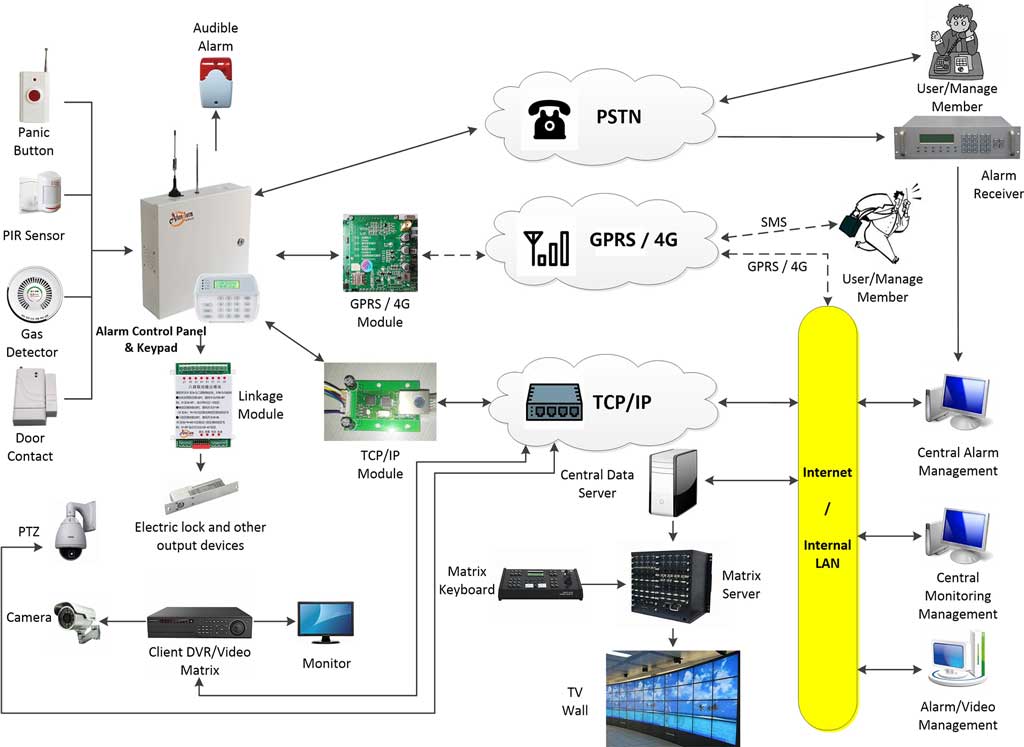
PSIM is middleware software that collects, analyzes, verifies, resolves, reports, and audits events from disparate physical security devices. It integrates intrusion alarms, CCTV (including video analytics), access control, perimeter sensors, and other systems into one common operating picture—typically with GIS mapping, prioritized alerts, and automated workflows.
Core PSIM functions include:
- Collection — Vendor-agnostic ingestion via open standards (ONVIF, PSIA, etc.).
- Analysis & Correlation — Automatically links related events (e.g., alarm trigger + video verification + invalid access attempt).
- Verification — Presents relevant camera feeds, maps, and context instantly.
- Resolution — Guides operators with predefined SOPs and automated actions (notifications, lockdowns, PTZ camera positioning).
- Reporting & Audit — Generates compliance reports and tracks operator response times.
Unlike simple integrations, true PSIM operates at the data level for deep correlation and policy enforcement.

Key Benefits of Integrated Physical Security Management Platform Solutions
Organizations adopting unified PSIM typically see measurable improvements in anti-theft alarm effectiveness:
- Dramatic false alarm reduction → Intelligent correlation and video analytics can cut nuisance alarms by 70-90% (some AI-enhanced deployments report up to 30%+ further gains). Real threats receive immediate priority.
- Faster response times → From minutes in traditional setups to seconds. An intrusion alarm automatically pulls up verified video and access logs on a unified map.
- Lower long-term costs → Reduced hardware redundancy, fewer service contracts, streamlined training, and higher operator efficiency. ROI often comes from avoided losses and productivity gains.
- Improved situational awareness & compliance → Single pane of glass with audit trails supports regulatory requirements and post-incident analysis.
- Scalability & future-proofing → Easily add new sensors, AI analytics, or sites without rip-and-replace.
The global PSIM market reflects strong adoption, valued at approximately USD 3.4 billion in 2023 and projected to grow at a CAGR of 21.3% through 2030, driven by the need for integrated platforms in complex security environments.
Real-World Performance Comparison
Traditional systems might generate hundreds of daily alarms with manual verification averaging 3-5 minutes per event.
PSIM correlates data in real time: A perimeter intrusion detector triggers → nearest PTZ camera auto-positions + video analytics confirms human movement + access control shows no valid badge → prioritized alert with SOP pops up. Response often drops below 30 seconds, and false alarms fall sharply.
In one industrial facility deployment, traditional perimeter alarms suffered ~95% false positives. After PSIM integration with video verification and rules-based filtering, operators reported over 80% reduction in nuisance calls and significantly faster confirmed breach handling.
Step-by-Step Guide: Evaluate or Migrate to PSIM (For Engineers & Product Managers)
Here is a practical, beginner-friendly process to assess your current traditional setup and consider a unified platform:
- Audit Current Pain Points (1-2 weeks)
Document false alarm rates over 30 days, average response time, number of systems/interfaces, and annual maintenance costs. Interview operators about daily frustrations (e.g., “Which camera covers Door 7?”). - Inventory Systems & Integration Needs
List all devices (alarm panels, CCTV brands, access control protocols). Note compatibility—prioritize vendors supporting ONVIF/PSIA. - Define Requirements & Success Metrics
Specify must-haves: alarm-video-access correlation, false alarm filters, mapping, SOP workflows, reporting. Set KPIs like “reduce false alarms by ≥70%” and “response time <60 seconds.” - Select & Pilot a PSIM Solution (4-8 weeks)
Choose open-architecture platforms (e.g., those from major vendors supporting legacy systems). Start with a proof-of-concept on one site or zone: connect intrusion alarms + 5-10 cameras + access logs. Test real scenarios like simulated forced entry. - Implement Policies & Train Staff (2-4 weeks)
Build rule sets (e.g., “Alarm + no video verification = low priority”). Train operators on the single interface (usually 1-2 days vs. weeks for multiple systems). Run parallel operation initially. - Go Live, Monitor & Optimize
Measure KPIs for 1-3 months. Refine rules based on data. Add AI analytics if available for further false alarm reduction.
Most organizations complete a basic pilot in under 3 months and see ROI within the first year through reduced losses and efficiency.
Final Thoughts: Making the Switch to Unified PSIM
For engineers and product managers responsible for anti-theft alarm performance, the choice is clear: Traditional Alarm + CCTV + Access Control systems work for simple sites but fall short in reliability, speed, and cost-effectiveness as threats and scale increase. A well-implemented PSIM delivers an integrated physical security management platform that correlates events intelligently, verifies threats quickly, enforces consistent policies, and scales efficiently—directly addressing the core pain points of fragmented security.
If your organization struggles with excessive false alarms, slow verification, or fragmented operations, start with the evaluation steps above. The data, industry standards (such as ASIS International Physical Asset Protection guidelines), and real deployments consistently show that unified PSIM platforms provide superior protection and long-term value in modern physical security environments.
Evaluate your current setup today—the benefits in reduced risk and operational efficiency make PSIM a strategic investment for serious security operations.