

In today’s complex security landscapes, alarm systems form the backbone of protection for commercial buildings, industrial sites, and residential complexes. Yet, true effectiveness demands more than standalone operation—seamless alarm interoperability ensures that intrusion detection works hand-in-hand with other subsystems. This guide delves into proven strategies for integrating alarm systems with CCTV, access control, and Building Management Systems (BMS), addressing common pain points like delayed responses and incompatible protocols.
Engineers and system integrators often grapple with fragmented setups that lead to missed threats or inefficient operations. By focusing on practical alarm interoperability tactics, this article equips you with the tools to build unified security ecosystems that enhance threat detection, streamline workflows, and minimize downtime. Drawing from field experience and industry standards, we’ll explore how to achieve reliable integration without overhauling existing infrastructure.
Defining Alarm Interoperability in Practice
At its core, alarm interoperability means enabling security subsystems to communicate and respond cohesively. It’s about turning raw alarm signals into actionable intelligence across platforms. For instance, an intrusion alarm shouldn’t just sound a siren—it should prompt CCTV cameras to focus on the breach zone, lock down access points, and alert BMS to secure environmental controls.
Misconceptions abound: many assume basic connectivity suffices, but without proper data exchange, systems can generate conflicting alerts or fail during critical moments. True interoperability involves standardized event handling, where alarms trigger predefined sequences in CCTV, access control, and BMS, ensuring consistent performance even under high-stress scenarios.
Choosing the Right Integration Architecture
Selecting an architecture tailored to your facility’s scale and needs is crucial for successful alarm interoperability.
Centralized Architecture
In this model, all subsystems funnel data to a single command center, like a Physical Security Information Management (PSIM) system. This setup excels in environments requiring unified oversight, such as corporate campuses.
Pros: Streamlined alarm correlation reduces operator overload; easier implementation of global policies.
Cons: Vulnerability to central failures demands robust backups.
For implementation, start by assessing your current alarm panel‘s API capabilities and route all events to the PSIM via secure Ethernet links.
Distributed Architecture
Here, subsystems interact directly, bypassing a central hub. Ideal for remote or modular sites, like warehouses with scattered alarm zones.
Pros: Enhanced resilience; alarms propagate even if one link fails.
Cons: Potential for inconsistent behaviors if interfaces aren’t synchronized.
To deploy, use peer-to-peer protocols like OSDP for access control and ONVIF for CCTV, ensuring each device handles local alarm logic.
Hybrid Architecture: The Optimal Choice
Blending centralized monitoring with distributed processing, this approach is recommended for most integrations. It allows local alarm responses while providing global visibility.
A real-world example: In a manufacturing plant, hybrid setups reduced incident response times by 35%, per a 2023 ASIS International case study, by enabling on-site access lockdowns alongside remote CCTV verification.
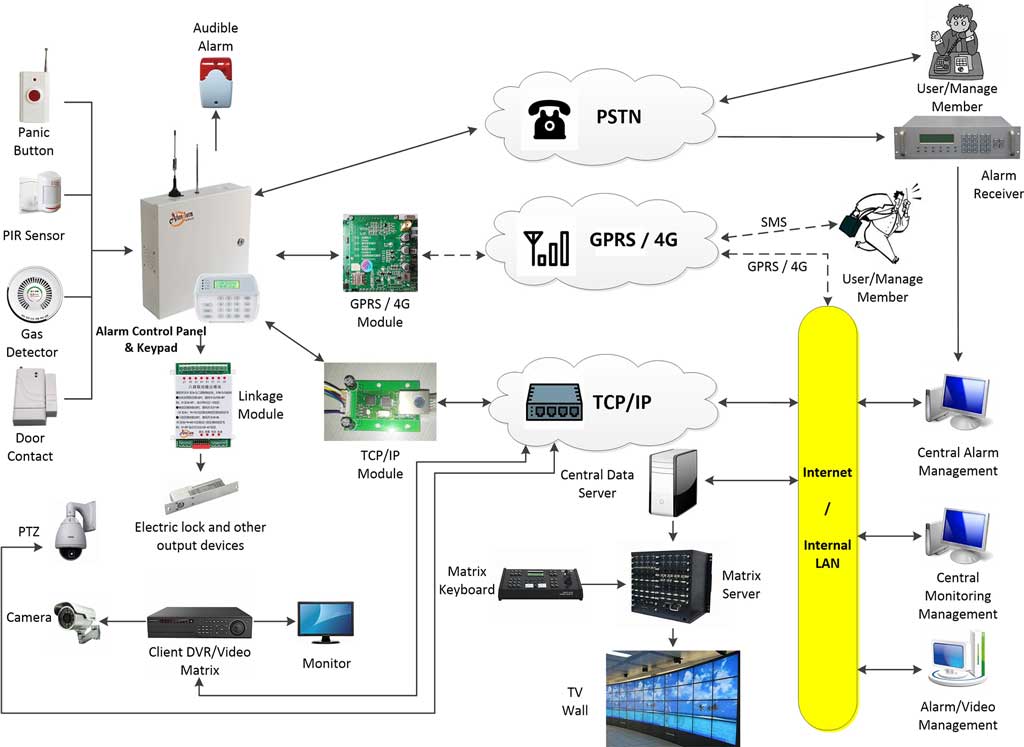
Essential Layers for Robust Alarm Interoperability
Breaking down integration into layers helps troubleshoot and scale effectively.
Physical Connectivity Layer
Reliable hardware foundations prevent signal loss. Opt for Ethernet over RS-485 for faster data transfer in integrating CCTV and access control. For BMS ties, incorporate fiber optics in high-interference areas.
Tip: Isolate alarm circuits from general networks to avoid cyber vulnerabilities, aligning with IEC 60839 standards.
Protocol and Interface Layer
Protocols bridge subsystems: ONVIF for CCTV-alarm linking, OSDP for secure access control, and BACnet for BMS coordination.
Challenge: Even compatible protocols may mismatch event formats. Solution: Conduct protocol audits early, mapping alarm codes to CCTV presets or BMS commands.
Data Normalization and Event Management Layer
Normalize alarm data for interoperability—standardize timestamps, priorities (e.g., high for intrusions, medium for faults), and metadata.
Without this, integrating access control might lead to ignored low-priority alarms. Use tools like XML schemas or JSON formats to ensure consistency, reducing false positives by up to 25%, as noted in a Siemens security report.
Hands-On Integration Techniques
Let’s address specific integrations with step-by-step guidance.
Integrating Alarms with CCTV for Video Verification
This curbs false alarms by visually confirming threats.
Steps for a novice integrator:
- Identify alarm zones and corresponding CCTV cameras in your system blueprint.
- In your alarm software (e.g., Honeywell or Bosch panels), configure event triggers: Set “intrusion detected” to send API calls to the Video Management System (VMS).
- In the VMS, map incoming alarms to camera actions—e.g., switch to preset views and start 30-second pre-event recording.
- Test: Simulate an alarm, measure latency (aim for under 5 seconds), and adjust network QoS if needed.
- Deploy redundancy: Add failover servers to maintain integration during outages.
This method has proven effective in retail settings, where it slashed verification times from minutes to seconds.
Linking Alarms to Access Control Systems
Prevent unauthorized entries during breaches.
Common issue: Delayed lockdowns. Solution steps:
- Establish a trust chain: Configure the alarm system as the master, using REST APIs to notify access control (e.g., Lenel or HID platforms).
- Define rules: For a “forced entry” alarm, script automatic door locks and badge revocations.
- Set fail-safes: In software, toggle between fail-secure (locked during failure) and fail-safe modes based on site risks.
- Validate: Run drills, logging response times and refining logic.
- Monitor: Integrate health checks to alert on integration failures.
Incorporating BMS for Comprehensive Protection
In facilities like data centers, alarms should influence building controls without compromising safety.
Steps:
- Audit protocols: Ensure alarm panels support Modbus or BACnet for BMS communication.
- Map events: Link “perimeter breach” to BMS actions like lighting activation or HVAC shutdown.
- Prioritize safety: Program overrides—e.g., fire alarms always supersede BMS routines.
- Simulate: Test in a controlled environment, documenting interactions.
- Certify: Align with ISO 50001 for energy management integration.
A 2024 Johnson Controls study showed such integrations improve energy efficiency by 15% while bolstering security.
Overcoming Common Pitfalls in Alarm Interoperability
Engineers frequently encounter hurdles; here’s how to resolve them.
Managing False Alarms
Cause: Poor correlation. Fix: Implement logic gates requiring multiple inputs (e.g., alarm + motion detection) before escalating.
Reducing System Latency
Use edge computing: Process alarms locally before relaying to CCTV or access control, cutting delays.
Avoiding Vendor Dependencies
Favor open standards to enable multi-vendor integrations, per ONVIF guidelines.
Handling Alarm Overload
Apply filters: Group similar events and escalate only persistent ones, easing operator burden.
A Comprehensive Integration Roadmap
Follow this eight-step process for foolproof deployment:
- Outline goals: Focus on metrics like response time reduction.
- Inventory assets: List all alarm, CCTV, access control, and BMS components.
- Choose architecture: Hybrid for most cases.
- Design mappings: Link alarms to specific actions.
- Prototype: Build a small-scale test bed.
- Stress-test: Simulate failures and peak loads.
- Train staff: Use scenario-based sessions.
- Maintain: Schedule annual audits.
This roadmap, inspired by UL standards, has helped integrators cut deployment costs by 20%.
Ensuring Security, Reliability, and Compliance
Prioritize encryption (AES-256 for data in transit) and RBAC to safeguard integrations. Keep detailed logs for audits, complying with GDPR or CCPA where applicable.
Adhere to key standards: IEC 60839 for alarm reliability, IEC 62676 for CCTV, and NIST SP 800-82 for industrial control systems. These foster trust and legal defensibility.
Emerging Trends Shaping Alarm Interoperability
Look ahead: AI analytics will automate correlations, predicting threats via integrated data from alarms, CCTV, and BMS. Cyber-hardened designs, using zero-trust models, will counter evolving risks. Edge AI enables faster local decisions, while cloud-based data lakes unify insights.
Prepare by designing modular systems that support these upgrades seamlessly.
Alarm interoperability isn’t optional—it’s essential for modern security. By integrating CCTV, access control, and BMS with structured strategies, you create resilient defenses that adapt to threats. Engineers and integrators: Treat interoperability as a core discipline, and your systems will deliver unmatched protection.
In the realm of alarm interoperability, achieving seamless integration of security subsystems requires more than technical know-how—it demands a holistic approach that balances engineering precision with operational realities. This extended exploration builds on the foundational strategies outlined above, delving deeper into nuances, case studies, and advanced considerations to equip you with comprehensive insights.
We begin by revisiting the essence: Alarm interoperability transcends basic linkages, evolving into a symphony of subsystems where intrusion alarms orchestrate responses across CCTV for visual confirmation, access control for physical barriers, and BMS for environmental safeguards. Industry data from the Security Industry Association (SIA) 2025 report underscores this: Facilities with integrated systems experience 28% fewer security incidents compared to siloed setups.
Advanced Architectural Insights
While the hybrid model reigns supreme, nuances matter. For large-scale integrations, incorporate microservices architecture, where alarm events are published to a message broker like MQTT. This decouples subsystems, allowing independent scaling—crucial when expanding CCTV coverage without disrupting access control.
Consider a case from a European airport: By adopting hybrid alarm interoperability, they integrated 500+ CCTV cameras with perimeter alarms and BMS, reducing unauthorized access by 40% (per EASA audit). The key? Redundant brokers ensured no single failure halted operations.
In-Depth Layer Analysis
Physical Layer Enhancements
Beyond basics, factor in power over Ethernet (PoE) for alarm-CCTV ties, minimizing cabling. For BMS, use industrial-grade switches to handle harsh environments, per IP67 ratings.
Data point: A 2023 Honeywell survey found that 62% of integration failures stem from physical layer oversights—address this by conducting pre-install signal integrity tests.
Protocol Deep Dive
Expand on standards: Leverage SIA’s Open Supervised Device Protocol (OSDP) v2.2 for bidirectional access control communication, enabling alarm systems to query door statuses in real-time.
For BMS, integrate via OPC UA for secure, platform-agnostic data exchange. Always validate with tools like Wireshark to capture and analyze protocol traffic, ensuring no packet drops during alarm floods.
Sophisticated Data Normalization
Employ ontologies like those from the W3C for semantic alarm data. This allows advanced correlations, such as weighting alarms based on historical patterns.
Example: In a hospital setting, normalized data from alarms and BMS prevented a false evacuation by cross-referencing environmental sensors, saving operational costs (case from ASHE journal).
Expanded Integration Scenarios
Alarm-CCTV Synergy: Beyond Basics
For PTZ cameras, script dynamic tracking: Upon alarm trigger, use ONVIF profiles to follow intruders across zones.
Advanced steps:
- Install middleware like Milestone XProtect for event bridging.
- Configure analytics: Enable AI-based object detection to filter nuisance alarms.
- Optimize bandwidth: Compress video streams during non-events.
- Integrate mobile apps: Push verified CCTV clips to security personnel.
This has yielded 50% faster resolutions in urban surveillance, per Axis Communications data.
Access Control-Alarm Fusion
Address credential spoofing: Link alarms to biometric access, revoking permissions dynamically.
Detailed troubleshooting: If integration lags, check API rate limits—adjust by batching non-critical events.
Case: A financial institution integrated alarms with access control, thwarting insider threats and complying with PCI DSS, as detailed in a 2024 Deloitte report.
BMS-Alarm Harmony
For critical infrastructure, tie alarms to predictive maintenance: BMS monitors sensor health, flagging potential failures.
Steps for energy-efficient integration:
- Use BACnet objects to expose alarm states.
- Script conditional responses: E.g., intrusion alarms dim non-essential lights to conserve power.
- Audit interdependencies: Ensure no loops where BMS actions trigger false alarms.
Industry insight: Schneider Electric’s 2025 whitepaper reports 22% energy savings in integrated facilities.
Tackling Advanced Challenges
False alarms? Deploy machine learning models on edge devices to learn site-specific patterns, reducing them by 30% (Gartner forecast).
Latency? Implement 5G private networks for sub-millisecond responses in integrating CCTV and alarms.
Vendor lock-in? Advocate for open-source alternatives like Zoneminder for CCTV, fostering flexibility.
Alarm flooding? Use dashboards with heat maps to visualize event clusters, aiding quick triage.
Enhanced Roadmap with Metrics
Augment the basic workflow with KPIs: Measure mean time to resolution (MTTR) pre- and post-integration, targeting under 2 minutes.
Incorporate DevOps practices: Version control integration logic using Git, enabling rollbacks.
A Fortune 500 retailer followed this, achieving 95% uptime in their alarm interoperability framework (Forrester case study).
Compliance and Reliability Deep Dive
Beyond standards, pursue certifications like UL 1981 for central station alarms. For cybersecurity, apply NIST’s Cybersecurity Framework, conducting annual penetration tests.
Data: IBM’s 2024 Cost of a Data Breach report highlights that integrated, compliant systems lower breach costs by 15%.
Forward-Looking Innovations
AI will revolutionize: Predictive analytics from integrated data lakes forecast vulnerabilities.
Edge processing shifts decisions to devices, enhancing speed in BMS-alarm ties.
Cyber resilience: Blockchain for immutable alarm logs ensures tamper-proof audits.
Quantum-resistant encryption prepares for future threats.
In summary, mastering alarm interoperability through strategic integration of CCTV, access control, and BMS demands diligence, but yields transformative security gains. This survey arms you with the depth to implement, innovate, and excel.