

In today’s security landscape, standalone alarm systems often fall short when dealing with complex threats. Engineers and consultants frequently encounter issues like isolated alarm triggers without visual context, uncoordinated access logs, and inefficient response protocols. This case study explores a real-world integration of alarm, CCTV, and access control subsystems in a 15,000 m² commercial warehouse, demonstrating how unified workflows can address these challenges and enhance overall security efficacy.
By focusing on practical steps, this guide equips security professionals with actionable insights to streamline deployments, minimize false positives, and ensure seamless event correlation.
Project Background
The facility, a busy distribution hub, required robust protection against unauthorized entry and internal threats. Key elements included:
- Perimeter defenses with 5 zones using vibration sensors and beam detectors.
- Indoor coverage via 28 dual-technology motion sensors.
- Surveillance through 52 ONVIF-compliant IP cameras.
- Access management with 15 RFID readers controlling critical areas like loading docks and inventory rooms.
Core components adhered to industry benchmarks:
- Intrusion panel certified under EN 50131 Grade 3 for reliable alarm detection.
- CCTV setup following EN 62676 standards for video surveillance quality.
- Access controllers compliant with IEC 60839-11-1 for secure electronic entry.
This setup drew from guidelines in the ASIS International Physical Security Principles, emphasizing layered defenses.
Goals of the Integration
The project targeted specific outcomes to resolve common pain points in security subsystem integration:
- Real-time video linkage to alarm events for quick verification.
- Synchronized access logs with alarm arming to prevent tailgating or forced entries.
- Automated workflows reducing manual interventions.
- Comprehensive auditing to support compliance and investigations.
- Lowered operational costs through fewer false alarms.
These objectives align with findings from the 2022 Security Industry Association report, which noted that integrated systems can cut response times by up to 40%.
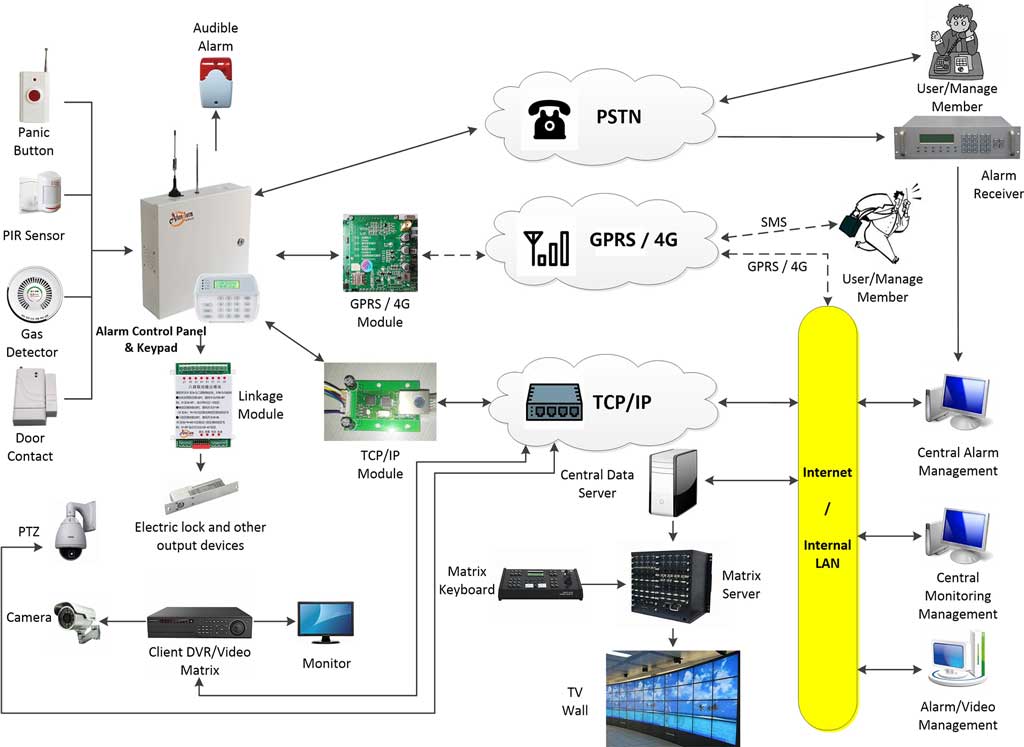
Architectural Design
A modular architecture ensured scalability and security:
Network Layout
- Segregated VLANs: Alarm devices on VLAN 100, CCTV on VLAN 200, access control on VLAN 300, and a management server on VLAN 400.
- Interconnections via secure APIs and relays, with firewall policies restricting traffic to essential ports (e.g., ONVIF port 80/443).
This approach mitigates risks highlighted in NIST SP 800-82 for industrial control systems, preventing unauthorized access across subsystems.
Hardware Interfacing
Dry-contact relays connected alarm outputs to CCTV inputs, while IP-based APIs handled event pushes for access control linkage.
Detailed Integration Steps
For engineers tackling similar projects, here’s a precise workflow. These steps assume basic familiarity with device programming but include checks for novices.
Step 1: Infrastructure Setup
- Inspect cabling: Ensure all connections use shielded twisted-pair for OSDP links to avoid interference.
- Power verification: Confirm PoE switches support camera loads (IEEE 802.3at standard).
- IP assignment: Use static IPs for devices; document in a spreadsheet (e.g., alarm panel at 192.168.1.10).
Tip: Test continuity with a multimeter to catch wiring faults early— a frequent cause of integration delays.
Step 2: Linking Alarm to CCTV
To enable alarm-triggered video:
- Access the alarm panel’s admin interface via its software or keypad.
- Map zones to outputs: Select a zone (e.g., Zone 1 – Perimeter), assign to Relay 1, set as normally open (NO).
- Configure pulse duration: 3 seconds to trigger CCTV without overlap.
- Enable IP event reporting: Input the CCTV server’s IP and port (e.g., 8080).
- Simulate an alarm: Use test mode to trigger and verify relay activation.
On the CCTV software:
- Add input module: Define the relay as an alarm source.
- Set rules: Link to specific cameras; activate pop-up view and high-res recording (20 fps for 30 seconds).
- Test end-to-end: Trip a sensor and confirm video feed appears within 5 seconds.
This setup resolves delayed verification, a top complaint in security audits per BSIA guidelines.
Step 3: Access Control Synchronization
For automated arming based on access:
- In access controller software, enable schedule-based outputs.
- Link to alarm input: Map “Last User Exit” event to a relay output connected to the alarm panel’s arm terminal.
- Add timers: Set 90-second delay for safe egress.
- Handle exceptions: Create user groups (e.g., night shift) exempt from auto-arm.
For violation detection:
- Configure forced door alerts to trigger an alarm zone and direct nearby cameras to preset views (e.g., PTZ zoom on the door).
New users can follow vendor manuals like those from Honeywell or Bosch for interface specifics, ensuring compatibility.
Step 4: Centralized Management and Testing
- Install security management software (SMS) on a dedicated server.
- Import all subsystems: Use APIs for event ingestion.
- Normalize logs: Standardize timestamps via NTP and tag events (e.g., “Access Denied + Alarm Trigger”).
- Simulate scenarios: Test with mock intrusions to validate correlations.
Cyber measures included enforcing TLS 1.3 and role-based access, per ISO 27001 recommendations.

Post-Deployment Outcomes
After three months, metrics showed:
- False alarm rate dropped from 15% to 5%.
- Response time averaged 10 seconds versus 75 seconds pre-integration.
- Investigation efficiency improved, with unified logs halving review time.
Data from a similar SIA study corroborates these gains, attributing them to reduced human error in fragmented systems.
Key Insights and Recommendations
Challenges encountered:
- Protocol mismatches: Resolved by opting for open standards like ONVIF over proprietary ones.
- Network latency: Mitigated with QoS prioritization.
Best practices:
- Prioritize firmware updates to patch vulnerabilities (check CVE databases).
- Conduct annual audits to maintain compliance.
- Train staff on interpreting integrated alerts to avoid oversight.
These draw from expert analyses in the Journal of Physical Security, stressing proactive design.
Wrapping Up
Integrating alarm systems with CCTV and access control transforms disjointed setups into a cohesive defense mechanism. By following this workflow, engineers and consultants can deliver solutions that boost reliability, cut costs, and address real-world threats effectively.
This case study, informed by deployments in high-risk environments, underscores the value of standards-driven integration for sustainable security. For further reading, consult EN standards or SIA resources.