
Understanding Third-Party Risks in Security Deployments
Definition
Third-party risk in enterprise alarm deployments refers to the operational, technical, security, and compliance vulnerabilities introduced when external entities—such as security integrators, regional subcontractors, local installers, and cloud service providers—design, configure, deploy, or maintain an organization’s electronic intrusion detection infrastructure.
[Enterprise Owner] ──(Governance)──> [Alarm Integrator] ──(Subcontracts)──> [Local Installer]
                                                                                  │
                                                                       (Configures & Deploys)
                                                                                  ▼
[Central Station] <──(SIA DC-09 / MQTT)── [Cloud Platform] <──(TCP/IP)── [Enterprise Alarm Panel]
In multi-site enterprise rollouts, primary integrators frequently subcontract local execution to regional technicians. This distributed delivery model creates visibility gaps, where variations in technician skill directly impact the physical and digital integrity of the security edge.
Business Impact
For global enterprises, decentralized monitoring networks, and critical infrastructure operators, a single failure in the third-party deployment chain can cascade into catastrophic operational losses. If an external technician misconfigures an edge gateway or implements flawed zone mapping, the integrity of the entire life-safety and asset-protection loop is compromised.
The business impacts of unmanaged third-party deployment risks include:
- Undetected Intrusions: Misconfigured dual-path signaling or suppressed zone zones can lead to total system blindness during a breach.
- Severe Financial Liability: Undocumented infrastructure alterations can void insurance policies, leading to unrecoverable losses after an incident.
- Regulatory Penalties: Non-compliance with EN 50131, UL 1023, or local fire and life-safety ordinances can result in immediate operational shutdowns or heavy fines.
- Sustained Operational Downtime: System-wide communication failures caused by unverified firmware upgrades can stall facility operations, demanding costly emergency remediation.
Alarm Deployment Ecosystem and Stakeholders
The enterprise alarm deployment ecosystem is a complex web of interdependent entities. Managing risk requires a granular understanding of each stakeholder’s role, operational boundaries, and technical handoffs.
| Stakeholder | Core Operational Responsibility | Primary Risk Vector |
|---|---|---|
| Enterprise Owner | Defines global security policies, risk tolerance metrics, and mandatory technical standards. | Lack of oversight; reliance on unverified vendor self-reporting. |
| Procurement Team | Executes vendor selections, negotiates service level agreements (SLAs), and manages contractual compliance. | Prioritizing low procurement costs over technical competence and engineering capabilities. |
| Alarm Integrator | Designs the unified architecture, selects hardware platforms, and assumes primary contractual liability. | Poor subcontractor governance; inadequate verification of field-deployed assets. |
| Subcontractor | Supplies regional labor and field execution capabilities across distributed geographic zones. | Inconsistent technician training; deviation from the master engineering design blueprints. |
| Local Installer | Mounts physical hardware, pulls field wiring, terminates resistors, and programs local panel parameters. | High personnel turnover; lack of formal training on enterprise network security protocols. |
| Cloud Platform Provider | Hosts the alarm signaling, device management, and event routing infrastructure (e.g., via AWS, Azure). | Inadequate tenant isolation; flawed API management; unannounced changes to keep-alive intervals. |
| Monitoring Center (ARC) | Receives, parses, and acts upon incoming alarm signals via automation software. | Outdated receiver line-cards; protocol incompatibility; failure to audit event acknowledgment times. |
[Enterprise Owner] ── Sets Standards ──> [Procurement Team] ── Evaluates Contracts ──> [Alarm Integrator]
                                                                                              │
                                                                                     Directs Execution
                                                                                              │
                                                                                              ▼
[Monitoring Center] <── Receives Events ── [Cloud Infrastructure] <── Forwards Data ── [Subcontractor/Installer]
Technical Risk Categories in Networked Alarm Systems
Installation Errors
At the physical and logical edge, installation errors committed by unverified subcontractors represent the highest volume of deployment failures. A common issue is the incorrect deployment of End-of-Line (EOL) resistors.
Technicians looking to save time often install resistors directly across the control panel zones rather than terminating them at the furthest point of the sensor circuit. This practice completely defeats line supervision, leaving the system vulnerable to undetected wire tampering or short circuits.
CORRECT SUPERVISION (Resistor at Sensor):
Panel Zone [─── Line Resistance ───] Sensor [EOL Resistor]

INCORRECT SUPERVISION (Resistor at Panel - Vulnerable to short-circuit bypass):
Panel Zone [EOL Resistor] [─── Line Resistance ───] Sensor
Furthermore, improper physical placement of passive infrared (PIR) sensors—such as positioning them directly opposite HVAC vents or uninsulated windows—introduces chronic thermal turbulence. This leads to frequent false alarms that desensitize monitoring personnel and erode operational trust.
Communication Failures
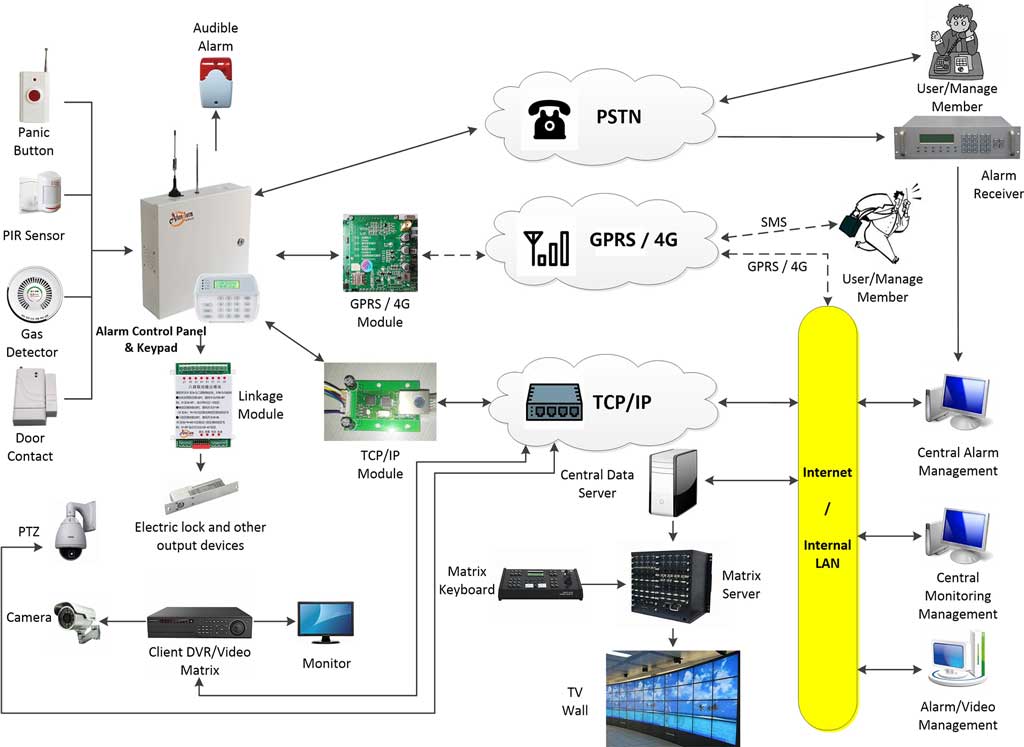
Modern security systems rely on network alarm infrastructures. Here, communication failures often stem from poor coordination between the installer and the corporate IT department. Subcontractors frequently install edge panels using default DHCP profiles without reserving static IP addresses or configuring Domain Name System (DNS) fallbacks.
If a local DHCP lease expires during a WAN outage, the panel may fail to re-bind its network interface upon physical link restoration. This creates an extended communications blackout until the on-site system is manually power-cycled.
Cloud Connectivity Issues
Enterprise systems utilizing a hybrid intrusion architecture depend heavily on stable cloud alarm platforms. If an installer fails to correctly configure local firewall policies—such as failing to whitelist specific outbound TCP ports (e.g., 8883 for secure MQTT, 443 for HTTPS)—the edge gateway will cycle its connection repeatedly.
This behavior triggers continuous connect and disconnect loops that flood the cloud platform’s event router, resulting in delayed alarm distribution across the rest of the enterprise network.
Cloud Alarm Infrastructure Risks
Cloud-native alarm architectures introduce unique risk vectors that traditional, closed-loop POTS (Plain Old Telephone Service) systems never encountered. When enterprise owners migrate to cloud-centric models, they shift their reliance from physical media to virtualized, multi-tenant infrastructures managed by third parties.
[Edge Panel / Gateway] ──(Outbound TCP 8883/443)──> [Enterprise Firewall]
                                                             │
                                                    (Public Internet / WAN)
                                                             │
                                                             ▼
                                                [Cloud Load Balancer]
                                                             │
                                                  (Event Routing Fabric)
                                                             │
                                                             ▼
                                                [Virtualized Alarm Broker]
                                                             │
                                                (Multi-Tenant Database)
The core vulnerability in this model lies in the virtualization layer. Without strict logical separation, a high-volume event surge from one tenant can exhaust the shared processing resources of the cloud event router. This creates an infrastructure bottleneck that delays critical alarm transmissions for all other tenants on the same host system.
Furthermore, cloud deployments require robust identity and access management (IAM) frameworks. Third-party installers often demand high-level administrative access to cloud platforms during the commissioning phase.
If these administrative accounts are not tightly controlled, time-bounded, and subjected to Multi-Factor Authentication (MFA), they become prime targets for supply-chain cyber attacks. A breach of a single integrator’s master cloud credentials could grant unauthorized access to the intrusion profiles of every enterprise client under their management.
Engineering Warning: Never allow an integration partner to use a single, shared administrative login across multiple customer cloud tenants. Compromising that single set of credentials gives attackers immediate access to bypass security controls across your entire facility portfolio.
Communication Protocol Risks
[Alarm Panel Node] ──(SIA DC-09 / TCP)──> [Carrier Core] ──(No QoS / High Latency)──> [Central Station Receiver]Protocol Analysis: SIA DC-09 vs. MQTT
The choice of alarm communication protocol directly governs the speed, reliability, and security of enterprise event routing. The two primary protocols used in modern distributed alarm networking are SIA DC-09 (over TCP/IP or UDP) and MQTT (Message Queuing Telemetry Transport over TLS).
| Protocol Property | SIA DC-09 (over TCP/IP) | MQTT (over TLS / TCP) |
|---|---|---|
| Architecture | Point-to-Point (Panel to Receiver) | Publish-Subscribe (Panel to Broker to Client) |
| Transport Overhead | Medium (Structured ASCII/Binary Frames) | Very Low (Optimized Variable Byte Header) |
| Heartbeat Efficiency | Low (Requires full connection overhead) | High (Native Keep-Alive Pingreq/Pingresp) |
| Security Layer | Optional AES-128/256 per frame | Mandatory TLS 1.2/1.3 Certificate Auth |
| Network Traversing | Requires explicit inbound port routing | Outbound only; simplifies firewall policies |
| State Awareness | Periodic (Based on poll timers) | Real-time (via Last Will and Testament) |
Real-World Failure Modes
When managing third-party risks, engineers must audit how installers configure protocol-level parameters. A common point of failure in SIA DC-09 deployments is setting the polling interval (heartbeat) too low or too high without adjusting the receiver’s supervisory window.
If a contractor sets a 90-second heartbeat on a volatile cellular connection without matching the receiver’s line-supervision timer, the central station will fill with false “Line Fault” events during brief network handovers. This noise distracts operators and leads to missed real alarms.
Conversely, in MQTT-based deployments, third-party technicians often fail to implement the protocol’s Last Will and Testament (LWT) feature. If an edge panel loses power or encounters an unhandled routing drop, the MQTT broker continues to report the device as online until the standard keep-alive timer expires. This creates a dangerous window of system unresponsiveness where an enterprise facility sits unprotected without alerting the central monitoring station.
Cybersecurity Risk: Remote Access and Credential Management
The intersection of physical security and corporate cybersecurity is where third-party deployments are most vulnerable. Third-party integrators regularly require remote access to enterprise alarm control panels to perform diagnostics, modify user access codes, and adjust system programming without deploying field technicians.
[Integrator Remote Laptop]
         │
  (Unencrypted Connection)
         │
         ▼
[Residential Router] ──(Public Internet)──> [Open Port 80/443] ──> [Enterprise Alarm Control Panel]
To facilitate this, technicians often configure insecure shortcuts that bypass enterprise network security policies:
- Configuring direct port-forwarding rules on local edge routers, exposing the panel’s management interface directly to the public internet.
- Disabling integrated cryptographic protections (such as SSL/TLS verification) to quickly resolve local certificate mismatch warnings during setup.
- Leaving vendor-default master programming codes (e.g.,
1234or9999) active on physical control panels after commissioning.
Automated threat scanners can easily identify these open communication interfaces. If an attacker gains access to an exposed management port using default credentials, they can compromise the system entirely. They can upload modified firmware, disable specific protection zones, or view internal event logs to map out facility occupancy schedules and security patrol patterns.

Operational Risk Mitigation: Managing SLA and Maintenance Failures
Operational risk management focuses on mitigating long-term system degradation after initial installation. A major source of operational risk is high technician turnover within regional third-party subcontracting firms.
When experienced, certified technicians leave, they are often replaced by uncertified personnel who lack deep training on enterprise-grade intrusion hardware. This skills gap manifests during routine maintenance calls and emergency troubleshooting workflows.
[Field Failure Occurs]
         │
         ▼
[Dispatched Untrained Subcontractor]
         │
         ├─ Scenario A: Bypasses faulty zone completely (Creates Blind Spot)
         │
         └─ Scenario B: Disables loop supervision resistors (Defeats Tamper Protection)
         │
         ▼
[System Vulnerable / Non-Compliant]
Without strict oversight, field technicians frequently resolve complex, intermittent circuit faults by implementing unauthorized workarounds. For instance, rather than tracking down a high-resistance fault on a long wiring run, a technician might clear the error by completely removing that zone from the active partition layout.
This fixes the trouble condition on the keypad but leaves a physical entry point entirely unprotected.
To mitigate this, enterprise operators must enforce a strict change-management policy. Security vendors must be contractually required to log all programming adjustments within a central, auditable repository. Every zone bypass, firmware update, or configuration change must be verified by an internal security administrator before the technician is permitted to leave the site.
Compliance and Governance Frameworks
Enterprise alarm deployments must comply with stringent regulatory frameworks and industry standards to maintain liability protection and ensure operational safety.
[Enterprise Security Policy]
         │
         ▼
┌────────────────────────────────────────────────────────┐
│             Mandatory Compliance Engine                │
├──────────────────────────┬─────────────────────────────┤
│  EN 50131 (Europe)       │  UL 1023 / 1610 (US)        │
│  - Grade 3 Requirement    │  - Dual-Path Transmission   │
│  - Anti-Masking Sensors  │  - Line Supervision Timers  │
└──────────────────────────┴─────────────────────────────┘
         │
         ▼
[Third-Party Contractor Audit and Enforcement]
Key Regulatory Frameworks
- EN 50131 (Grades 1–4): European standard governing intrusion systems. Commercial enterprises typically require Grade 3 compliance, which mandates high resistance to tampering and the use of anti-masking motion detectors.
- UL 1023 / UL 1610: Standards from Underwriters Laboratories governing household and central-station burglar alarm units. Compliance requires specific line-supervision response times and dual-path signaling infrastructure.
- NFPA 72 (Chapter 26): National Fire Alarm and Signaling Code. While primarily focused on fire protection, it dictates the strict monitoring and routing mechanics for joint fire/intrusion systems in commercial properties.
The Role of Independent Audits
Relying solely on an installation contractor’s self-certification creates a clear conflict of interest. To maintain true deployment governance, organizations must institute independent, third-party technical audits.
An independent audit involves hiring an unaligned engineering firm to inspect a random sample of completed installations. The auditors physically open control panels, verify end-of-line resistor values, test battery backup run-times under full load, and intentionally introduce line faults to confirm the central station receives accurate alerts within the contractually mandated times.

Contractor Qualification and Procurement Framework
To prevent third-party deployment risks from entering your environment, you must build robust verification steps into the initial procurement process. The matrix below serves as an objective evaluation tool for assessing the capabilities of potential security integration partners.
Partner Qualification Matrix
| Assessment Domain | Minimum Acceptable Requirement | Critical Red Flags | Verification Methodology |
|---|---|---|---|
| Technical Certification | Lead technicians must hold current, tier-1 vendor factory certifications for the specific panel architecture (e.g., Honeywell, Bosch, DSC). | Submitting generalized electrical licenses or expired training credentials in place of specialized certifications. | Demand direct verification of certification numbers via the manufacturer’s portal. |
| Network Competency | In-house engineering teams must include certified networking professionals (e.g., CCNA, CompTIA Network+). | Outsource firewall and network routing tasks to external subcontractors. | Review candidate resumes and professional certification registries. |
| Cybersecurity Maturity | Vendor must provide documented adherence to an established security framework (e.g., SOC 2 Type II, ISO 27001). | Use of unencrypted, public remote-access tools or a complete lack of an internal patch management policy. | Require the formal submission of current SOC 2 audit reports. |
| Financial Stability | Positive credit ratings with sufficient cash flow to support multi-site equipment acquisitions. | Legal liens from suppliers or a history of frequent payment disputes with sub-tier labor providers. | Conduct formal financial discovery via credit reporting agencies. |
| SLA Responsiveness | Contractual commitment to a 4-hour on-site response time for critical, system-wide outages. | Refusal to accept liquidated damages for missing critical SLA windows. | Audit past performance through reference checks with current enterprise clients. |
Deployment Governance Model and Remote Commissioning Workflow
To maintain absolute quality control across multi-site enterprise rollouts, organizations should adopt a formal, data-driven deployment governance model. Relying on an installer’s verbal confirmation that a site is complete introduces unacceptable risk. Instead, teams should implement a multi-stage, remote commissioning workflow to verify system configuration data objectively.
[Physical Installation Completed by Subcontracting Partner]
                           │
                           ▼
[Step 1: Automated Loop Resistance & Continuity Test]
                           │
                           ▼
[Step 2: Automated Firmware Baseline & Hash Verification]
                           │
                           ▼
[Step 3: End-to-End Dynamic Signal Path Attenuation Test]
                           │
                           ▼
[Step 4: Cryptographic Handshake Validation (TLS Certificate Check)]
                           │
                           ▼
[Authorized Remote Release to Enterprise Central Station Automation]
Step 1: Loop Resistance and Continuity Verification
Before any zone is accepted, the installer must provide documented voltage and resistance readings for every supervised circuit. This data is collected using a calibrated digital multimeter at the panel terminals.
The resistance must match the expected nominal value of the specified EOL resistor loop within a strict $\pm 5\%$ tolerance. Any deviation indicates a poor termination, low-gauge wiring, or an incorrectly placed resistor.
Step 2: Firmware Baseline and Hash Verification
The deployment engineer must pull the active firmware version and cryptographic hash from the edge panel. This hash is compared against the enterprise’s authorized firmware baseline.
If a subcontractor has deployed unapproved or outdated firmware, the system is blocked from connecting to the production cloud broker until it is updated and re-verified.
Step 3: End-to-End Signal Path Attenuation Testing
This phase tests the system’s communication path resilience. If the primary path is an IP network, engineers simulate an outage by disabling the local network switch port. The panel must detect the link loss and switch to its secondary cellular path within the time limits set by UL 1610 or EN 50131.
Engineers also review the receiver logs to confirm the central station received the “IP Path Failure” event and subsequent cellular check-ins with correct timestamps.
Step 4: Cryptographic Handshake Validation
The deployment engineer verifies that the panel’s outbound connection uses mutual TLS (mTLS) authentication. The panel’s unique hardware security certificate is checked against the enterprise’s Certificate Authority (CA).
Any system attempting to connect using default credentials or unencrypted channels (like standard HTTP or unencrypted SIA) is immediately isolated to a quarantined provisioning network.
Empirical Case Studies: Real-World Deployment Failures
Case Study 1: The Multi-Site Logistics Facility Failure
- Context: A multinational logistics provider contracted a tier-1 system integrator to deploy a cloud-connected network alarm system across 45 regional distribution hubs. The tier-1 integrator subcontracted local installation duties to multiple regional alarm firms.
- The Breakdown: A local installer in one region misconfigured the MQTT keep-alive settings on 8 edge gateways. Instead of configuring a standard 60-second keep-alive window with an active Last Will and Testament frame, the technician left the parameters at a default 1-hour interval and omitted the LWT configuration.
- The Impact: During a regional telecom outage, a major distribution hub lost its primary WAN connection. Because the keep-alive window was excessively long and no LWT message was defined, the cloud enterprise platform showed the facility as completely healthy and online.
Three days later, a break-in occurred at the disconnected facility. The edge panel detected the intrusion and attempted to send alerts, but it could not reach the network.
The enterprise monitoring center received no alarms, resulting in an undetected theft that cost over $1.2 million in stolen inventory.
Case Study 2: The Distributed Retail Financial Network Breach
- Context: A retail banking firm upgraded 120 distributed ATM kiosks and branch offices to a hybrid intrusion architecture using TCP/IP communication pathways.
- The Breakdown: To speed up remote troubleshooting, a subcontractor’s technician enabled port-forwarding on the local routers. This exposed the master management web server of each branch alarm panel directly to the public internet on standard port 80.
Additionally, the technician failed to change the factory-default installer programming code across 34 of the deployed branches.
- The Impact: Automated threat scanners identified the exposed ports within 48 hours of deployment. Malicious actors accessed the web configuration interface of 4 separate branch panels using the default credentials.
The attackers downloaded internal system maps, identified blind spots in the motion detector layouts, and remotely disabled the physical tamper switches on the ATM enclosures.
The branches were subsequently burglarized with zero alarms generated at the central monitoring station. This led to massive financial losses and a severe regulatory investigation into the bank’s vendor governance policies.
Technical Appendix: Enterprise Alarm Deployment Checklist
This technical checklist serves as an objective verification tool for deployment engineers and project managers. Every step must be physically or logically verified and signed off before an alarm system is transitioned into production.
1. Physical Layer & Edge Hardware Supervision
- [ ] End-of-Line (EOL) Resistor Placement: Verify that all EOL resistors are terminated at the furthest physical point of the sensor circuit (e.g., inside the last contact switch housing), not inside the control panel enclosure.
- [ ] Loop Resistance Verification: Measure and document loop resistance for every zone; variance must be within $\pm 5\%$ of nominal resistor value.
- [ ] Tamper Protection: Confirm that enclosure tamper switches, wall tampers, and siren tampers are fully wired, supervised, and mapped to a non-bypassable 24-hour audible zone partition.
- [ ] Power Supply Load Testing: Test the standby battery backup capacity by disconnecting primary AC power for 15 minutes while running a full walk-test with all sounders active; battery voltage must remain above the manufacturer’s low-voltage threshold.
2. Network Layer & Protocol Configuration
- [ ] Static IP / DHCP Reservation: Ensure all edge panels use reserved, static IP bindings within the local network scheme, with primary and secondary DNS servers explicitly defined.
- [ ] Outbound Port Whitelisting: Verify local firewall rules restrict panel communications to outbound-only traffic on designated secure ports (e.g., TCP 8883 for MQTT, TCP 51472 for SIA DC-09 over TLS), completely disabling inbound port forwarding.
- [ ] Heartbeat Optimization: Confirm that the protocol-level keep-alive or polling interval matches the central station’s receiver supervision settings (e.g., 90-second poll for high-security profiles).
- [ ] Last Will and Testament (LWT) Configuration: For MQTT deployments, verify that the LWT payload is configured to send a “Device Offline” alert immediately if the network connection drops unexpectedly.
3. Cyber Security & Access Management
- [ ] Credential Demolition: Change all factory-default codes (including installer code, master code, and default download access codes) to unique, enterprise-managed values.
- [ ] Encryption Enforcement: Verify that all alarm transmission paths utilize AES-128 or AES-256 bit encryption, with key rotation intervals enabled at the receiver level.
- [ ] Management Interface Isolation: Confirm that all local web servers or programming interfaces on the panel are disabled or restricted to a secure management VLAN requiring VPN authentication.
4. Operational Readiness & Central Station Integration
- [ ] Zone Mapping Alignment: Conduct a full end-to-end walk test of every zone, confirming that the alphanumeric description received at the central station automation software perfectly matches the physical sensor location.
- [ ] Path Redundancy Verification: Intentionally disconnect the primary communication pathway (Ethernet/Wi-Fi) and confirm that the system successfully routes a backup signal over the cellular pathway within the contractually mandated SLA window.
- [ ] SLA Documentation Sign-Off: Verify that the integration partner has uploaded complete as-built wiring diagrams, panel programming sheets, and network configuration logs to the enterprise security repository.
Architectural Comparison Matrix: Enterprise Alarm Deployments
Choosing the right alarm architecture involves balancing security requirements against infrastructure complexity and third-party risk exposure. The matrix below compares three common architectural approaches.
| Architectural Pattern | Core Topologies | Third-Party Risk Profile | Infrastructure Overhead | Ideal Enterprise Use Case |
|---|---|---|---|---|
| Traditional Closed-Loop (POTS/Leased Line) | Point-to-point dedicated copper lines connecting edge panels directly to hardware-based central station receivers. | Low Digital Risk / High Physical Risk: Vulnerable to physical line-cutting and service discontinuations, but insulated from remote internet-based attacks. | High Cost / Low Flexibility: Extremely expensive to maintain; lacks dynamic data reporting capabilities. | Legacy defense facilities or remote locations lacking stable cellular or broadband infrastructure. |
| Hybrid Networked (TCP/IP + Dual-Path Cellular) | Multi-path communication using local enterprise WAN as primary path, with cellular networks (4G/5G LTE) as automated failover. | Moderate Risk: Requires strong technical coordination between installers and corporate IT teams to avoid firewall gaps and routing misconfigurations. | Medium Overhead: Leverages existing network infrastructure but requires regular local network monitoring and maintenance. | Multi-site retail, commercial corporate offices, and distributed banking networks. |
| Cloud-Native Infrastructure (MQTT/Edge-to-Cloud API) | Edge gateways publish real-time security events to an enterprise cloud platform, which processes and routes data to multiple endpoints. | High Supply-Chain Risk: Heavily dependent on third-party cloud configurations and IAM access controls; demands strict governance to prevent large-scale data breaches. | Low Local Overhead / High Scalability: Minimizes local hardware footprints and simplifies software updates across large portfolios. | Tech-forward enterprises, dynamic multi-tenant developments, and highly distributed logistics operations. |
FAQ Section
Technical Framework Questions
Q: Can subcontractors configure alarm communication protocols without oversight?
A: No. Allowing subcontractors to configure protocols without oversight introduces significant risk. Installers often prioritize clearing trouble codes quickly over system resilience. This can lead to unencrypted signal paths, mismatched polling intervals, and omitted failover configurations like MQTT Last Will and Testament payloads. All communication metrics must be explicitly defined in your master engineering spec and verified through independent automated testing.
Q: How can installation quality be verified remotely?
A: Quality can be verified remotely by pulling panel data into a centralized staging network before deployment. Engineers check parameters like loop resistance tolerances, firmware versions, cryptographic hashes, and mTLS connections. You can also simulate network dropouts remotely to verify that the system successfully switches to its backup paths within the required timeframe.
Q: What risks exist with cloud-connected alarm systems?
A: The primary risks include multi-tenant resource bottlenecks, supply-chain cyber attacks targeting vendor credentials, and unexpected cloud-broker disconnections. If an integrator uses a single administrative login across multiple customers without multi-factor authentication, a breach at the integrator level exposes all downstream enterprise systems.
Procurement & SLA Questions
Q: How should alarm vendors be evaluated?
A: Vendors should be evaluated using an objective qualification matrix that weights specialized technical certifications, in-house network engineering capabilities, internal cybersecurity posture (e.g., SOC 2 Type II), and past performance on multi-site projects over low procurement costs.
Q: What certifications should installers possess?
A: Lead technicians must hold current, tier-1 factory training certifications for the specific alarm panel platform being deployed. General electrical licenses are not sufficient for configuring advanced network architectures or protocol routing parameters.
Q: How should SLAs be structured?
A: Service level agreements must define clear parameters for critical system outages, including mandatory on-site response times (e.g., under 4 hours) and strict financial penalties for missed windows. SLAs should also require technicians to document all system adjustments within a central change-management portal before closing a service ticket.
Operational & Compliance Questions
Q: What happens if a local installer goes out of business?
A: If an installer closes down, systems can become un-maintainable if proprietary configuration passwords or encryption keys were left in their possession. Avoid this by ensuring your enterprise owns all master program codes, cryptographic certificates, and database backups from day one.
Q: How can multi-site consistency be maintained?
A: Consistency is maintained by enforcing a strict standardized configuration baseline. Implement uniform hardware selection policies, distribute standardized panel programming templates, and require field installers to complete an exhaustive technical checklist for every site.
Q: What documentation should deployment partners provide?
A: Partners must submit complete as-built wiring diagrams, terminal resistance logs, network topography maps (including MAC addresses and static IP assignments), and fully populated zone-correlation sheets.
Q: How often should alarm deployments be audited?
A: Enterprise-level deployments should undergo a comprehensive technical audit annually. Additionally, random sample audits should be conducted immediately following any major infrastructure changes, such as widespread firmware upgrades or provider transitions.