

1. Introduction
Imagine a commercial complex late at night. A motion sensor detects unusual activity in a restricted area. Within seconds, the alert is transmitted to a monitoring center, and security personnel respond immediately. This seamless chain of events demonstrates the power of alarm monitoring systems in modern security infrastructures.
As security threats become more sophisticated, the choice between Centralized Alarm Monitoring and Decentralized Alarm Monitoring has become a defining factor in how effectively organizations protect assets, data, and personnel.
This article provides a technical comparison between these two models — exploring their architectures, features, strengths, and limitations. It is designed to help security professionals, integrators, and IT managers make informed decisions when designing or upgrading alarm infrastructures.
As a seasoned security technology expert with over 15 years in alarm system design and implementation, I will unpack the real-world implications of each approach — backed by industry standards and field experience.
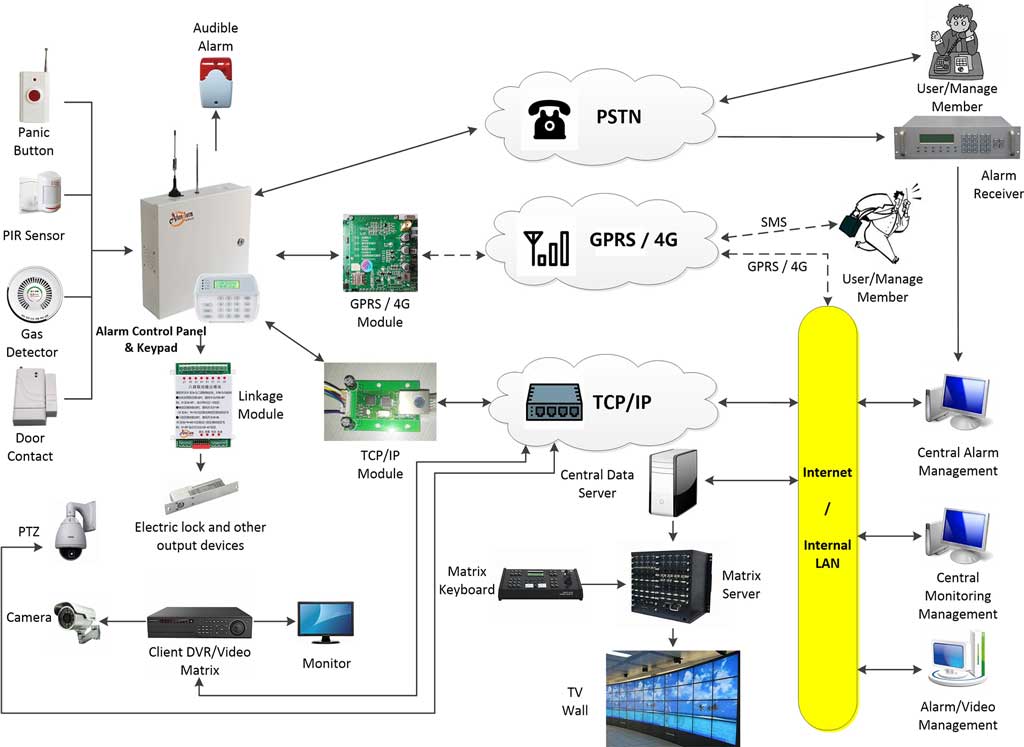
2. Understanding Centralized Alarm Monitoring
Definition
Centralized Alarm Monitoring is a system where all sensors, detectors, and control devices communicate with a single central monitoring station. This hub processes alarms, verifies events, and dispatches appropriate responses — often through professional monitoring services.
Technical Architecture
A centralized architecture typically includes:
- Central servers hosted at a monitoring facility or data center.
- Communication channels using PSTN, GSM, or IP-based networks for reliable data transmission.
- Alarm management software compliant with standards such as UL 827 (Central Station Alarm Services).
- Operator consoles where trained personnel handle alerts 24/7.
Data flows from field devices (sensors, panels, detectors) to the central hub, ensuring real-time aggregation, analysis, and action.
Key Features
- Centralized visibility: Operators view and manage alarms across multiple sites from one interface.
- Professional response: Immediate verification and dispatch through trained monitoring teams.
- System scalability: Ideal for large enterprises with thousands of devices.
- Integration-ready: Works with video surveillance, access control, and intrusion systems.
Pros and Cons Preview
Centralized systems excel in high-stakes environments requiring coordinated responses and compliance with industry standards. However, they also present a single point of failure risk if redundancy is not built into the design.
(Visual suggestion: Include a diagram showing the data flow from sensors → communication network → central monitoring hub.)
3. Understanding Decentralized Alarm Monitoring
Definition
Decentralized Alarm Monitoring distributes monitoring and decision-making across multiple nodes or devices. Each local unit — often a smart alarm controller or IoT gateway — can process data independently, making decisions without relying solely on a central hub.
Technical Architecture
A decentralized setup often leverages:
- Peer-to-peer or mesh networks for communication between devices.
- Edge computing for real-time local processing.
- AI-enabled analytics for detecting anomalies directly at the source.
- Cloud-based synchronization for optional central visibility and data redundancy.
- Blockchain or encrypted databases for secure and transparent event logging.
Key Features
- Autonomous operation: Local units can respond even if network connectivity to the cloud is lost.
- AI-driven insights: Machine learning algorithms detect abnormal patterns at the edge.
- User-centric control: Mobile app integration allows end users to receive alerts directly.
- Improved fault tolerance: A single device failure does not compromise the entire system.
Pros and Cons Preview
While decentralized systems offer resilience and flexibility, they can suffer from coordination challenges and inconsistent monitoring standards if not properly managed.
4. Technical Comparison: Key Differences
Below is a structured overview highlighting the technical distinctions between Centralized and Decentralized Alarm Monitoring systems.
| Aspect | Centralized Alarm Monitoring | Decentralized Alarm Monitoring |
|---|---|---|
| Architecture | Single central hub controlling all signals | Distributed network of nodes handling data locally |
| Data Processing | Aggregated and analyzed at a central server | Processed at the edge via local devices |
| Communication Protocols | Typically wired (PSTN, IP, or dedicated links) | Wireless or mesh-based IoT communication |
| Scalability | Vertical scaling with central resources | Horizontal scaling via node expansion |
| Redundancy | Requires secondary data centers | Built-in resilience through distributed architecture |
| Security Risks | Single point of failure if center compromised | Reduced risk through distributed control |
| Response Time | Dependent on central processing latency | Faster local decisions at the edge |
| Operational Cost | Higher (professional monitoring fees) | Lower (user-driven management) |
In-Depth Technical Insights
- Latency: Centralized systems may experience longer transmission paths, while decentralized setups use edge computing for sub-second responses.
- Encryption: Decentralized models often use AES-256 encryption for secure peer-to-peer communication.
- Bandwidth Efficiency: Local processing reduces data transmission load, improving network efficiency.
Benefits of Centralized Alarm Monitoring include high reliability and compliance with standards; decentralized models, on the other hand, emphasize agility and fault tolerance.
5. Advantages and Disadvantages
Centralized Alarm Monitoring
Advantages
- 24/7 professional monitoring and immediate response.
- Easier compliance with regulations (UL, NFPA 72).
- Unified reporting and analytics across facilities.
Disadvantages
- Expensive setup and recurring service fees.
- Vulnerable to outages or network disruptions.
- Limited flexibility for quick system updates.
Decentralized Alarm Monitoring
Advantages
- Resilient against network failures.
- Cost-effective and scalable for small to mid-sized environments.
- Enhanced privacy through local data control.
Disadvantages
- Requires more technical expertise for configuration.
- Inconsistent alert management if not standardized.
- Potential fragmentation across devices or vendors.
Hybrid Models now combine both: centralized command centers supported by decentralized edge intelligence — achieving both control and resilience.
6. Use Cases and Applications
Centralized Alarm Monitoring
Best suited for:
- Banks and financial institutions needing certified, 24/7 oversight.
- Hospitals and critical infrastructure where downtime is unacceptable.
- Government buildings requiring compliance-based security.
Decentralized Alarm Monitoring
Ideal for:
- Smart homes and small businesses that prioritize flexibility.
- Remote facilities with limited connectivity.
- Industrial IoT deployments leveraging local analytics for predictive maintenance.
Future Trends
The boundary between centralized and decentralized systems is blurring. AI, IoT, and cloud-edge integration are creating adaptive hybrid models capable of self-learning and automated response.
7. Conclusion
Both Centralized Alarm Monitoring and Decentralized Alarm Monitoring serve vital roles in today’s security ecosystem. The right choice depends on operational scale, budget, regulatory needs, and the desired level of autonomy.
Centralized solutions remain indispensable for enterprises demanding verified, professional oversight, while decentralized systems empower users through flexibility and cost efficiency.
As threats evolve and technology advances, hybrid configurations — combining centralized control with decentralized intelligence — represent the future of smart alarm management.
For further insights, explore related articles on the Security Insights channel or consult a professional integrator to tailor a system aligned with your organization’s goals.