
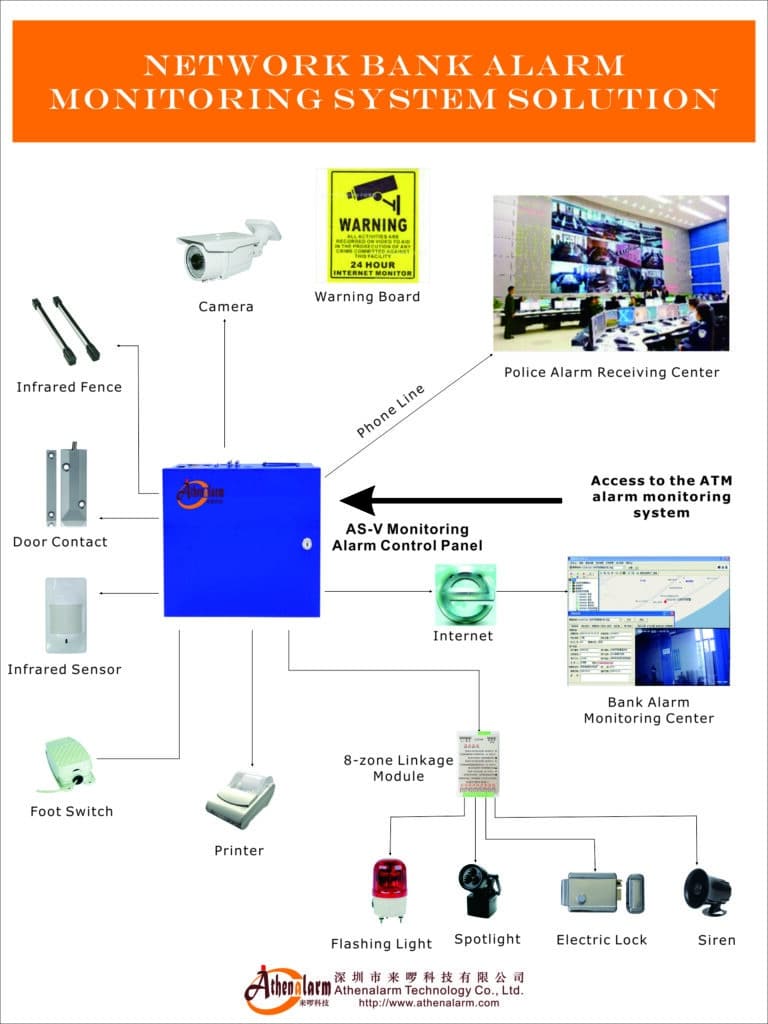
Executive Overview: Why “Fail-Safe” Matters More Than Features in Bank Alarm Systems
A security alarm system for banks is fundamentally different from ordinary commercial intrusion systems. Retail stores, offices, or warehouses can tolerate occasional alarm outages without catastrophic consequences. Banks cannot.
In a banking environment, the alarm system is not merely a convenience or compliance checkbox. It is a core risk-control infrastructure designed to detect, deter, and respond to criminal intrusion attempts targeting assets, vaults, ATMs, and cash handling areas.
However, many bank alarm system deployments fail at the exact moment they are needed most.
Real-world investigations into bank burglaries repeatedly show that intruders rarely rely on brute force alone. Professional criminals often attempt system neutralization before physical entry, targeting vulnerabilities such as:
- Cutting telephone lines
- Disrupting internet connectivity
- Triggering electrical outages
- Using GSM jammers
- Tampering with communication modules
- Exploiting weak system redundancy
When any of these tactics succeed, the alarm system becomes blind and silent.
This is why modern banking security architecture must focus on fail-safe alarm engineering.
A properly designed security alarm system for banks must continue detecting and reporting intrusion attempts even when multiple infrastructure layers fail simultaneously.
This article provides a comprehensive engineering-level guide explaining:
- How fail-safe bank alarm architectures are designed
- Multi-layer communication redundancy strategies
- Anti-tampering and anti-sabotage design principles
- Power resilience and battery backup planning
- Sensor redundancy and zone architecture
- Communication path supervision methods
- Real-world deployment steps used by professional security integrators
The goal is simple:
Ensure that a bank alarm system still sends an alarm when criminals try to disable it.
To achieve this, we must also consider regulatory compliance, such as adhering to standards like UL 681 for intrusion systems and EN 50131 in Europe, which mandate redundancy in high-risk installations. Additionally, integrating with other bank systems like CCTV and access control enhances overall resilience, creating a unified security ecosystem that shares data and triggers cross-system responses.
1. Understanding the Threat Model: How Criminals Disable Bank Alarm Systems
Before designing a fail-safe system, engineers must understand how alarm systems are typically defeated.
Security engineering always begins with a threat model.
For banks, the most common alarm neutralization techniques fall into four categories.
1.1 Power Infrastructure Attacks
Intruders may attempt to disable the alarm system by cutting electrical power to the building.
Typical methods include:
- Disabling external power distribution panels
- Triggering circuit breaker trips
- Cutting external power cables
- Exploiting maintenance access areas
If the alarm system depends entirely on grid power without adequate battery backup, the system shuts down immediately.
A key point here is that power attacks can be internal or external. For instance, insiders might sabotage transformers or use electromagnetic pulse (EMP) devices, though rare, to disrupt electronics. Engineers should assess site-specific vulnerabilities, such as exposed utility rooms, during initial surveys.
1.2 Communication Line Sabotage
Traditional bank alarm systems historically relied on PSTN telephone lines.
This creates a predictable weakness.
Criminals often cut telephone cables outside the building before entering.
Similarly, modern IP-based alarm systems can be neutralized by:
- Disconnecting internet routers
- Damaging fiber connections
- Disrupting internal switches
- Attacking network cabinets
Without alternative communication paths, alarm signals cannot reach the monitoring center.
An often-overlooked risk is hybrid attacks, where criminals combine line cuts with DDoS attacks on IP networks. To counter this, systems should incorporate diverse routing, such as using both wired and wireless backups from different providers.
1.3 Radio Frequency Jamming
Professional criminals sometimes use GSM signal jammers.
These devices transmit powerful radio noise across cellular frequencies, preventing communication modules from connecting to mobile networks.
If the alarm panel relies exclusively on GSM communication, the monitoring station receives nothing.
Jamming can extend to Wi-Fi or other frequencies, so anti-jamming measures like frequency-hopping spread spectrum (FHSS) in radio modules are essential. Real-world cases, such as the 2019 European bank heists, highlight how jammers delayed responses by up to 30 minutes.
1.4 Control Panel Tampering
Another tactic involves attacking the alarm control panel itself.
Examples include:
- Opening the panel enclosure
- Removing backup batteries
- Disconnecting key buses
- Physically destroying communication modules
Without tamper detection and protective architecture, the system can be disabled within seconds.
Additional threats include software exploits via unsecured ports or malware injection. Protecting against this requires hardened enclosures, encrypted firmware, and regular vulnerability scans.
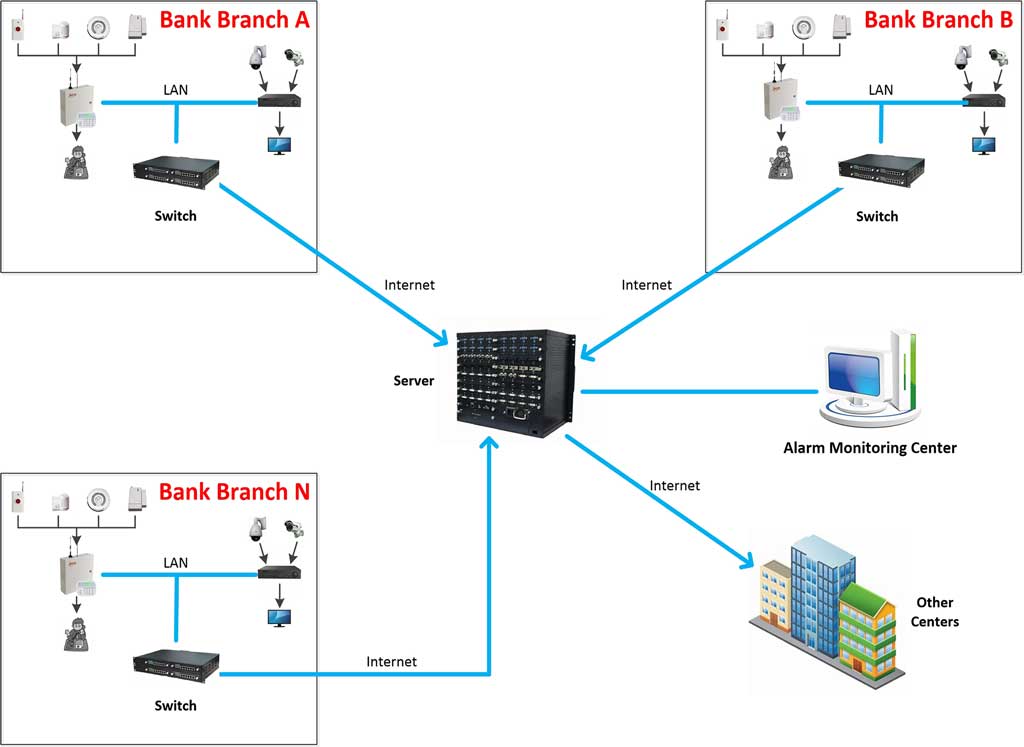
2. Core Principle of Bank Alarm Engineering: Fail-Safe Architecture
A fail-safe bank alarm system assumes that failures will occur.
The engineering objective is therefore not preventing all failures.
Instead, the goal is ensuring that no single failure disables the system.
This is achieved through redundancy and supervision.
A professional bank alarm system architecture typically includes redundancy across five layers:
- Power redundancy
- Communication redundancy
- Detection redundancy
- Hardware protection
- Signal supervision
Each layer contributes to overall system survivability.
To make this architecture truly robust, incorporate fault-tolerant design patterns like N+1 redundancy, where critical components have at least one backup. For example, dual control panels operating in hot-standby mode ensure seamless failover.
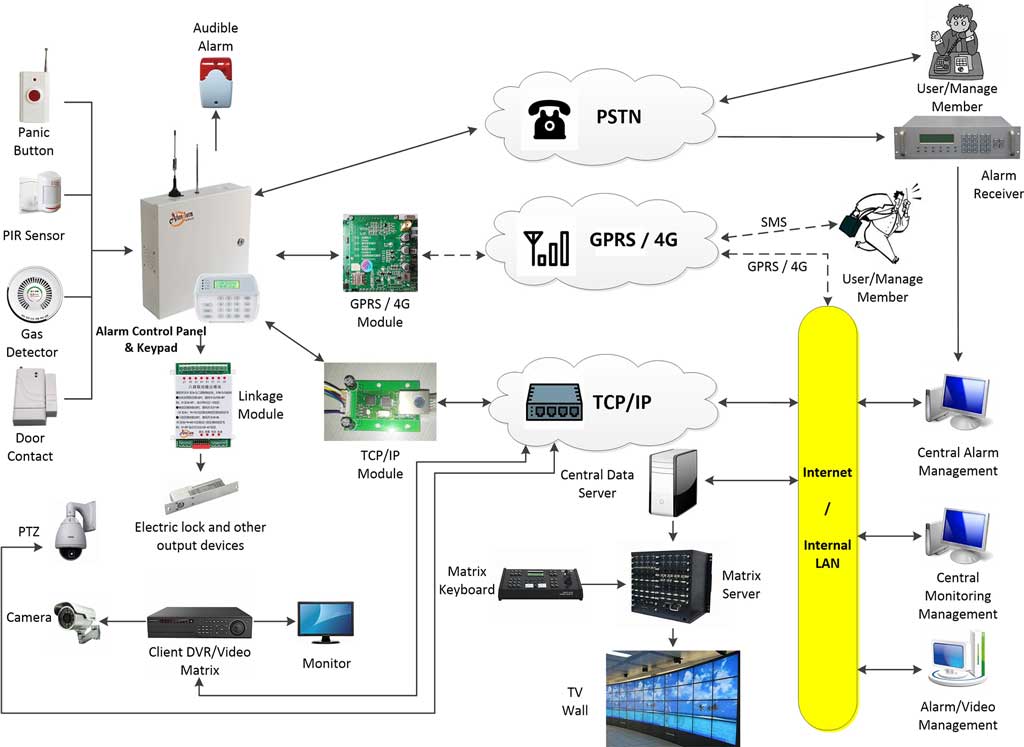
3. Designing Multi-Layer Communication Redundancy
Communication failure is the most common cause of alarm system outages.
Therefore, communication redundancy is the backbone of any security alarm system for banks.
A professional architecture typically includes three to four independent communication channels.
Key to this is prioritizing channels based on reliability and cost: start with wired options for stability, then add wireless for independence.
3.1 PSTN Communication (Legacy but Still Valuable)
Public Switched Telephone Network lines remain useful because:
- They operate independently of IP infrastructure
- They are less vulnerable to certain cyber attacks
- They provide an additional communication path
However, PSTN lines must include line-cut detection.
Alarm panels continuously supervise the line. If the line is cut, the system immediately generates a line fault alarm.
To implement: Connect the PSTN module to the alarm panel, configure dial-up sequences in the panel’s software, and enable voltage monitoring for integrity checks every 30 seconds.
3.2 IP Network Communication
Most modern bank alarm systems rely on encrypted IP communication to central monitoring stations.
Advantages include:
- Faster alarm transmission
- Lower communication cost
- Advanced encryption capabilities
- Remote diagnostics and firmware updates
However, IP communication must include heartbeat supervision.
Example:
- Panel sends a signal every 60 seconds
- Monitoring center confirms reception
- Missing heartbeat triggers communication fault alarm
For added security, use VPN tunnels and AES-256 encryption. A common mistake is relying on a single ISP; always contract dual providers with automatic failover routers.
3.3 Cellular Communication (GSM / LTE / 4G / 5G)
Cellular communication provides an independent path when wired networks fail.
Advantages include:
- Independence from building infrastructure
- Rapid deployment
- Reliable fallback communication
However, cellular modules must include:
- SIM redundancy
- Multi-network roaming
- Signal supervision
To counter jamming, opt for modules with anti-jamming detection that switch to alternative bands or alert on signal drop. Steps for setup: Install a dual-SIM module, program roaming priorities, and test signal strength in various bank locations using a site survey tool.
3.4 Long-Range Radio Backup
High-security banks often deploy private radio communication networks.
These systems connect alarm panels directly to monitoring stations using licensed frequencies.
Advantages include:
- Immunity from internet outages
- High reliability
- Strong signal penetration
Radio communication provides the fourth layer of redundancy.
For implementation, license frequencies through regulatory bodies like FCC, install antennas with clear line-of-sight, and integrate with the panel via serial interfaces. This is particularly useful in remote branches where cellular coverage is spotty.
3.5 Emerging Satellite Communication Options
As an additional layer for ultra-high reliability, consider satellite backups like Iridium or Starlink modules. These are immune to terrestrial disruptions but come with higher latency and costs. Use them as a last-resort channel, configured to activate only after other paths fail.

4. Detecting Communication Sabotage
Redundancy alone is not enough.
The system must also detect when communication channels are attacked.
This requires supervised communication paths.
A critical error is infrequent polling; aim for intervals under 90 seconds to minimize response delays.
4.1 Heartbeat Monitoring
Each communication channel sends periodic signals.
If signals stop arriving within the expected interval, the monitoring center raises a communication loss alarm.
Setup steps: In the panel software, set heartbeat intervals, define failure thresholds (e.g., 3 missed signals), and link to escalation protocols.
4.2 Line Integrity Monitoring
Telephone and network lines can be supervised using electrical resistance measurements.
If the line is cut or shorted, the system immediately detects the change.
Use end-of-line (EOL) resistors; a deviation from nominal resistance (e.g., 1kΩ) triggers an alert. Test by simulating cuts during commissioning.
4.3 Multi-Channel Path Verification
Professional alarm panels automatically test communication across all channels.
If one path fails, the system automatically switches to another path.
This ensures continuous connectivity.
To configure: Program priority lists in the panel (e.g., IP > Cellular > PSTN > Radio), with automatic retries every 10 seconds.
4.4 Anti-Jamming and Shielding Detection
For wireless paths, integrate detectors that monitor RF noise levels. If jamming is detected (e.g., signal-to-noise ratio drops below -10 dB), the system logs the event and attempts frequency shifts or alerts via wired paths.
5. Designing Power Resilience for Bank Alarm Systems
Power failure is another critical risk.
A bank alarm system must remain operational during extended power outages.
Focus on layered power sources to handle cascading failures, like grid outage plus generator sabotage.
5.1 UPS Protection
The first layer of protection is Uninterruptible Power Supply (UPS).
UPS systems provide immediate power during outages and prevent voltage fluctuations.
Select rack-mount UPS with at least 30 minutes runtime, scalable via external batteries. Installation: Connect UPS to the alarm panel and critical sensors, bypassing non-essential loads.
5.2 Battery Backup in Alarm Panels
Most professional alarm panels include internal battery support.
Typical battery runtime ranges from 24 to 72 hours depending on system size.
Use sealed lead-acid or lithium-ion batteries; calculate capacity based on load (e.g., 7Ah for small panels, 65Ah for large).
5.3 Battery Health Monitoring
Fail-safe systems continuously monitor battery status.
The system detects:
- Battery aging
- Voltage drop
- Disconnection
Maintenance alerts are sent before failures occur.
Steps: Enable smart charging in the panel, set low-voltage thresholds (e.g., 10.5V alarm), and schedule monthly deep-cycle tests.
5.4 Distributed Power Architecture
Large banks often distribute power across multiple subsystems.
This prevents a single power failure from disabling the entire alarm system.
Implement by zoning power supplies, with each zone having its own UPS and batteries, connected via isolated circuits.
5.5 Generator Integration and Fuel Management
For prolonged outages, integrate diesel generators with auto-start features. Ensure fuel storage for 72+ hours and monitor levels remotely to prevent dry runs, a common oversight in rural branches.
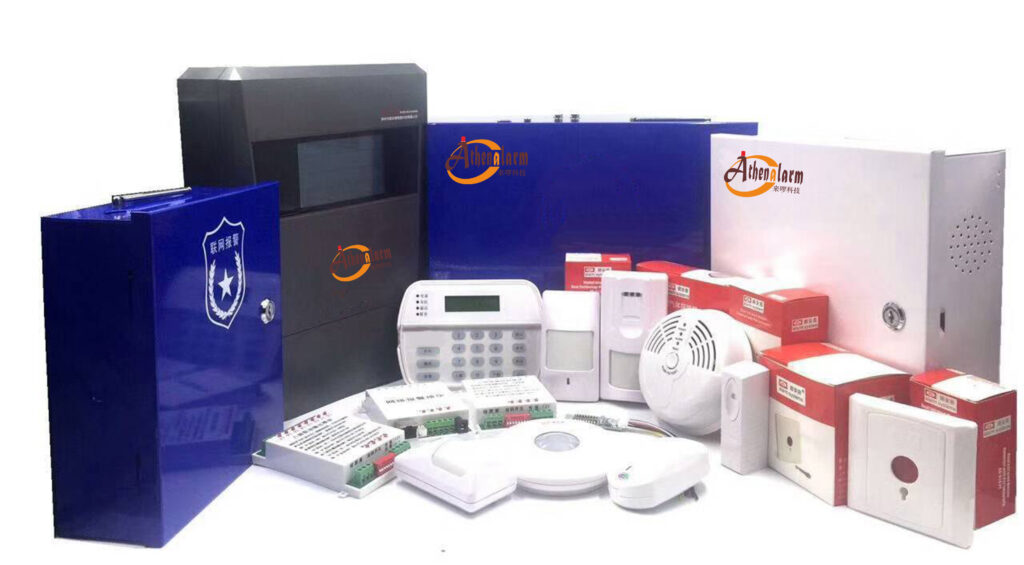
6. Anti-Tamper Hardware Protection
Physical tampering is a common attack method.
Therefore, alarm systems must detect unauthorized access.
Emphasize enclosure hardening to UL Level 1 standards, using steel cabinets with reinforced locks.
6.1 Tamper Switches
Alarm panel enclosures include tamper switches that trigger alarms when the panel door is opened.
Mount switches on both lid and base; wire to a dedicated tamper zone for instant alerting.
6.2 Sensor Tamper Protection
All detectors must include anti-tamper switches.
Removing or opening the device triggers an alarm.
Dual switches (wall and cover) are ideal; test by removing sensors during walkthroughs.
6.3 Cable Tamper Detection
Wired detectors use end-of-line resistors to detect cable cuts or short circuits.
Configure with series/parallel resistors; a short or open circuit changes resistance, triggering faults.
6.4 Encryption and Access Controls
Protect against digital tampering with role-based access codes and encrypted keypads. Log all access attempts for forensic review.

7. Intrusion Detection Layer Design
Even with robust infrastructure, detection sensors remain critical.
Bank alarm systems typically use multiple sensor technologies simultaneously.
A layered approach combines contact, motion, and environmental sensors for zero false negatives.
7.1 Motion Detection
Common sensors include:
- Passive Infrared (PIR)
- Dual-technology PIR + microwave detectors
Position PIR in high-traffic areas; dual-tech reduces false alarms from pets or HVAC. Calibration steps: Adjust sensitivity, walk-test zones, and mask lenses for blind spots.
7.2 Glass Break Sensors
Used to protect windows and glass entry points.
Audio-based sensors detect shatter frequencies; install within 25 feet of glass, test with simulated breaks using tools like glass break simulators.
7.3 Shock Sensors
Detect attempts to drill, cut, or break vault structures.
Piezoelectric types sense vibrations; calibrate thresholds to ignore traffic noise but catch hammer strikes.
7.4 Seismic Sensors
Used for vault protection.
They detect drilling, hammering, and cutting.
Mount directly on vault walls; integrate with analytics to differentiate threats from earthquakes.
7.5 Environmental and Hold-Up Sensors
Add duress buttons under counters and environmental monitors for fire/flood, which can mask intrusions. These expand detection beyond motion.
8. Zone Architecture in Bank Alarm Systems
Professional alarm design divides the system into security zones.
Typical bank zone structure includes:
- Public area zones
- Restricted office zones
- ATM zones
- Cash room zones
- Vault zones
- Roof access zones
Each zone has independent monitoring rules.
To optimize: Assign arming schedules (e.g., vault always armed), and use cross-zoning where two sensors must trigger for alarm confirmation, reducing false positives.
9. Designing Alarm Response Priorities
Not all alarms are equal.
Bank alarm systems categorize events into priorities.
Examples include:
- Intrusion alarm
- Tamper alarm
- Communication failure
- Power loss
- Sensor malfunction
High priority alarms trigger immediate response.
Define escalation: Intrusion = police dispatch; Tamper = on-site check. Use software to customize based on time/day.
10. Fail-Safe System Testing
Even the best system fails without testing.
Banks must perform regular alarm system verification tests.
Document all tests in logs for audits; involve third-party certifiers for objectivity.
10.1 Communication Path Testing
Each communication channel should be tested regularly.
Steps: Disable one path at a time, verify failover, and confirm signal receipt at the monitoring center.
10.2 Sensor Testing
All intrusion detectors must be tested for correct detection.
Walk-test motion sensors, simulate breaks for glass/shock, and check tamper switches.
10.3 Power Failure Simulation
Power should be deliberately disconnected to confirm battery operation.
Steps: Trip breakers, monitor runtime, and recharge batteries post-test.
10.4 Full Scenario Simulations
Simulate multi-failure scenarios, like power cut plus jamming, to validate overall resilience. Record response times and adjust as needed.
11. Step-by-Step Deployment Process for a Bank Alarm System
Security integrators typically follow structured deployment procedures.
This process ensures compliance and minimizes downtime.
Step 1 — Risk Assessment
Analyze:
- Building layout
- Entry points
- Vault locations
- ATM access points
- Infrastructure vulnerabilities
Conduct site walks, interview staff, and use tools like vulnerability scanners.
Step 2 — Alarm Architecture Design
Define:
- Detection zones
- Communication paths
- Redundancy layers
Draft blueprints, calculate budgets, and select vendors.
Step 3 — Hardware Selection
Choose:
- Professional alarm control panel
- Industrial communication modules
- Certified intrusion sensors
Prioritize UL-listed equipment; compare specs for runtime and compatibility.
Step 4 — Installation
Install sensors, panels, and communication equipment.
Steps: Mount panels in secure rooms, wire sensors with shielded cables, and ground all components.
Step 5 — System Programming
Configure:
- Zones
- Communication priorities
- Alarm responses
Use panel software: Input IP addresses, set heartbeats, and program user codes.
Step 6 — System Testing
Perform full functional testing.
Run end-to-end checks, debug issues, and certify performance.
Step 7 — Monitoring Integration
Connect system to central monitoring station.
Verify signals, set up accounts, and test dispatches.
Step 8 — Staff Training
Train security personnel on system operation.
Conduct hands-on sessions: Arm/disarm, respond to alarms, and handle faults.
Step 9 — Documentation and Handover
Compile manuals, as-built drawings, and maintenance plans for the bank team.
12. Maintenance Strategies for Long-Term Reliability
Fail-safe design requires long-term maintenance.
Banks should implement:
- Quarterly inspection
- Battery replacement schedules
- Firmware updates
- Communication testing
A common pitfall is neglecting updates; schedule annually to patch vulnerabilities. Use predictive maintenance tools like remote diagnostics to foresee issues.
12.1 Preventive Maintenance Checklist
- Inspect wiring for wear
- Test battery load
- Update software
- Clean sensors
- Log all activities
13. Common Mistakes in Bank Alarm System Design
Many failures result from poor design choices.
Examples include:
- Single communication path
- Inadequate battery capacity
- Unsupervised communication
- Poorly protected control panels
- Lack of tamper protection
Other errors: Overlooking environmental factors like humidity corroding batteries, or insufficient training leading to user errors. Always budget for ongoing support.
14. Future Trends in Bank Alarm System Engineering
New technologies are improving alarm resilience.
Examples include:
- AI-assisted intrusion analysis
- Encrypted IP alarm transmission
- Satellite communication backup
- Anti-jamming cellular modules
Emerging: Blockchain for tamper-proof logs, IoT integration for real-time health monitoring, and quantum-resistant encryption. These will address evolving threats like cyber-physical attacks.
Conclusion: Building Alarm Systems That Criminals Cannot Silence
A security alarm system for banks must never be designed as a simple intrusion detector.
It must be engineered as a resilient security infrastructure capable of surviving sabotage attempts.
A truly professional bank alarm system includes:
- Redundant communication paths
- Power backup systems
- Anti-tamper protections
- Supervised signal transmission
- Layered intrusion detection
When these principles are applied correctly, even sophisticated criminals cannot disable the system before an alarm is transmitted.
For banks, reliability is not optional.
The alarm must trigger — even when everything else fails.
To get started, consult certified integrators and review case studies from institutions like major U.S. banks that have thwarted attempts through such designs.