
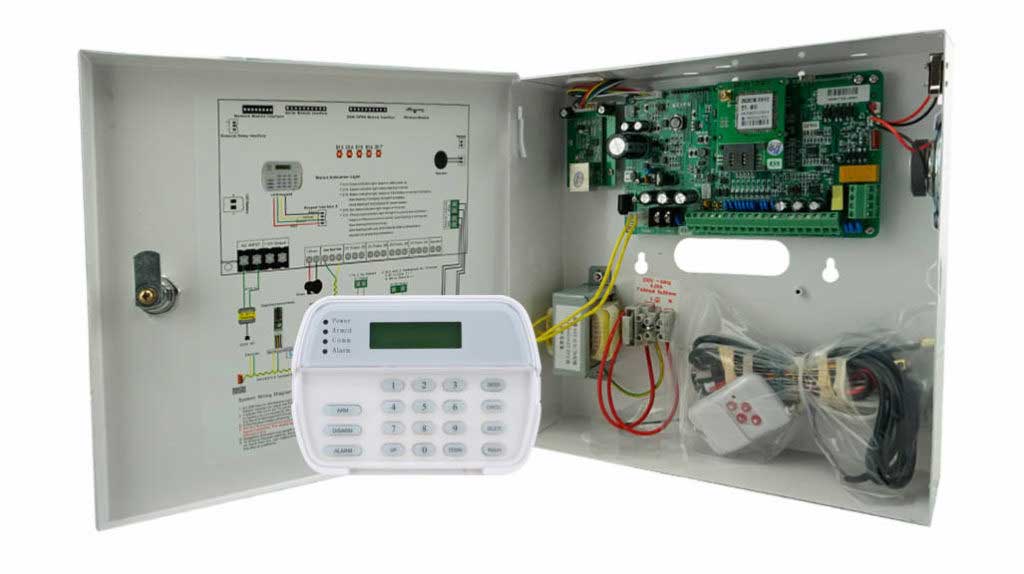
Executive Overview for Security Decision-Makers
In the commercial security industry, discussions about an alarm panel, alarm control panel, or burglar alarm control panel often revolve around feature lists—zones, outputs, communication methods, integrations. Yet seasoned security professionals know a critical truth:
Features do not determine real-world performance. Architecture does.
Two intrusion alarm panels may look identical on paper—same number of zones, same communication ports, same certifications—yet perform dramatically differently in the field. One generates persistent nuisance alarms, suffers communication latency, and struggles under multi-site deployments. The other operates quietly, predictably, and reliably for years.
The difference lies beneath the interface—within the control logic design, electrical topology, partitioning model, and communication architecture of the alarm control panel.
This in-depth technical guide dissects alarm panel architecture from four decisive layers:
- Circuit Structure & Hardware Topology
- Control Logic & Signal Processing Algorithms
- Partitioning, Zone Mapping & Permission Architecture
- Communication & Supervision Framework
This is not a product brochure. It is a field-level architectural analysis designed for:
- Security system integrators
- Commercial project consultants
- Procurement managers
- Technical directors
- Alarm panel distributors
- Large-scale end users
If you are responsible for specifying or purchasing burglar alarm control panels in bulk, this guide will help you avoid expensive architectural mistakes.
1. Why Alarm Panel Architecture Matters More Than Features
An intrusion alarm panel performs three essential functions:
- Signal acquisition
- Signal interpretation
- Event decision & output execution
Every performance issue—false alarms, missed alarms, delayed reporting, system instability—can be traced to architectural decisions made in those three areas.
Real-World Problems Caused by Weak Architecture
- Repeated false alarms from environmental noise
- Slow response to high-priority triggers
- System crashes during simultaneous zone activity
- Communication congestion during alarm bursts
- Partition leakage between departments
- Access level conflicts in multi-user environments
These are not “installation mistakes.” They are design consequences of the burglar alarm panel’s internal architecture.
Common Oversight in Procurement: Ignoring Compliance and Scalability
Beyond immediate performance, weak architecture can lead to non-compliance with industry standards like UL 985 for commercial intrusion systems or EN 50131 in international markets. For instance, inadequate surge protection in circuit design may violate requirements for reliable operation in lightning-prone areas, resulting in costly recalls or legal liabilities. Additionally, scalability issues arise when panels lack modular expansion capabilities, forcing expensive replacements as business needs grow—such as adding more zones or integrating with access control systems.
2. Layer One: Circuit Structure & Electrical Topology
2.1 Zone Input Circuit Design
A commercial-grade alarm control panel must handle:
- Long cable runs
- Voltage drop
- Electrical noise
- Induced interference
- Cross-talk from parallel wiring
- Ground potential differences
Key Architectural Differences
| Low-Tier Alarm Panel | High-Performance Alarm Panel |
|---|---|
| Basic voltage detection | Differential signal detection |
| Fixed threshold trigger | Adaptive threshold algorithm |
| No noise filtering | Multi-stage analog filtering |
| Shared ground reference | Isolated zone grounding |
Why This Matters
Poorly isolated zone inputs create:
- Intermittent triggers
- Ghost alarms
- Cross-zone interference
A properly engineered burglar alarm control panel uses:
- RC filtering
- Debounce circuitry
- Surge suppression
- Opto-isolated inputs in high-end models
These architectural decisions reduce nuisance alarms dramatically. For example, opto-isolation prevents ground loops, a common issue in large facilities where varying ground potentials from multiple power sources can induce false signals. In practice, this means fewer service calls for “mysterious” alarms triggered by nearby electrical equipment like HVAC systems.
2.2 End-of-Line (EOL) Supervision Design
A robust intrusion alarm panel must supervise:
- Open circuit
- Short circuit
- Tamper
- Normal state
Advanced alarm panel architecture supports:
- Single EOL
- Double EOL
- Triple-state supervision
- Programmable resistance values
The more granular the supervision model, the lower the chance of silent line compromise. Programmable EOL values allow customization for different sensor types, such as adjusting from 1kΩ to 5.6kΩ to match specific reed switches or PIR detectors, enhancing detection accuracy in noisy environments.
Potential Pitfalls and Solutions
A frequent error is using mismatched EOL resistors, leading to undetected tampering. To avoid this, during installation: 1) Verify resistor values match panel specifications via the programming menu. 2) Test each zone with a multimeter for continuity. 3) Simulate faults (e.g., cut wire) and confirm the panel logs a supervision error immediately.
2.3 Power Supply Architecture
Power design determines system stability.
High-performance burglar alarm panels feature:
- Separate regulated rails for logic and field devices
- Battery charging with temperature compensation
- Overcurrent protection per output group
- Smart load shedding during low voltage events
Poor architecture leads to:
- System resets during siren activation
- Battery overcharging
- Output instability
Temperature-compensated charging is crucial in variable climates; without it, batteries in cold warehouses may undercharge, causing failures during outages. Smart load shedding prioritizes critical functions like communication over non-essential outputs, ensuring alerts reach monitoring stations even under duress.

3. Layer Two: Control Logic & Signal Processing Algorithms
This is the heart of alarm panel performance.
3.1 Signal Filtering Algorithms
A basic alarm control panel reacts to threshold crossing.
An advanced intrusion alarm panel analyzes:
- Signal duration
- Frequency changes
- Edge slope
- Re-trigger timing
- Environmental baseline drift
Example: Motion Detector Input
Cheap logic:
If voltage change detected → Trigger alarmAdvanced logic:
If voltage change > threshold
AND duration > programmable time
AND not within ignore window
AND partition armed
THEN evaluate event priority
This multi-layer evaluation reduces false alarms significantly. Environmental baseline drift compensation adjusts for gradual changes like temperature fluctuations, preventing alarms from drafts or sunlight—common in glass-heavy commercial spaces.
3.2 Cross-Zone & Multi-Condition Logic
In high-security facilities, architecture must allow:
- Dual-zone verification
- Sequential confirmation logic
- AND / OR condition mapping
- Time-based conditional activation
Without this, a burglar alarm panel cannot function reliably in:
- Warehouses
- Industrial plants
- Multi-tenant buildings
Dual-zone verification requires two sensors to trigger within a set window (e.g., 30 seconds) before alarming, ideal for reducing pet-induced or debris-related false positives in loading docks.
Implementation Steps for Cross-Zone Logic
To configure: 1) Access the panel’s programming mode using the installer code. 2) Navigate to zone attributes and enable cross-zone for paired sensors (e.g., Zone 1 and Zone 2). 3) Set verification timer (typically 10-60 seconds). 4) Test by triggering one zone—ensure no alarm; then trigger both within the timer to confirm activation.
3.3 Interrupt Handling & Event Prioritization
High-end alarm panels use:
- Interrupt-driven architecture
- Event queues
- Priority stacks
Weak designs rely on sequential polling.
In real-world intrusion scenarios, simultaneous triggers must be processed instantly—not in queued delays. Priority stacks ensure life-safety events (e.g., panic buttons) override routine ones, critical in hospitals where delays could endanger patients.
4. Layer Three: Partition Logic & Multi-Level Access Architecture
For small homes, basic partitioning may suffice.
For commercial sites, poor partition architecture creates chaos.
4.1 What Is True Partition Isolation?
A robust burglar alarm control panel must support:
- Independent arming states
- Separate event logs
- Independent communication routing
- Zone-to-partition locking
- Permission-level mapping
Weak designs allow:
- Cross-partition interference
- Accidental global disarming
- Improper access hierarchy
True isolation means a fault in one partition (e.g., a tripped sensor in an office wing) doesn’t affect others, like a secure server room. This is vital for multi-tenant buildings, where tenants need autonomous control without compromising the whole system.
4.2 Multi-Level Authority Design
Professional alarm panel architecture supports:
- Installer level
- System admin level
- Department manager level
- Operator level
- Guard level
Each with:
- Command restrictions
- Zone limitations
- Time-based permissions
This is essential for:
- Hospitals
- Factories
- Logistics hubs
- Government buildings
Time-based permissions restrict access during off-hours, reducing insider threats. For example, guards might arm/disarm only during shifts, preventing unauthorized after-hours entry.
Common Errors in Partition Setup
A key pitfall is overlapping user codes across partitions, leading to unintended access. To mitigate: 1) Assign unique codes per partition in the user management menu. 2) Test by attempting cross-partition actions with lower-level codes—ensure denial. 3) Review event logs post-setup for anomalies.
5. Layer Four: Communication & Reporting Architecture
Communication design determines response time and reliability.
5.1 Communication Stack Architecture
Modern intrusion alarm panels may support:
- TCP/IP
- Cellular (4G/LTE)
- PSTN
- RS485
- Bus expansions
The question is not whether they support them. The question is: How are they architected internally?
High-performance alarm control panels feature:
- Dual-path redundancy
- Automatic failover
- Heartbeat supervision
- Event compression during burst transmission
Dual-path (e.g., IP primary, cellular backup) ensures continuity if one fails, as in remote sites with unstable internet. Heartbeat supervision sends periodic checks to monitoring centers, alerting to connectivity issues before emergencies.
5.2 Event Queue Management
During intrusion events:
- Multiple zones may trigger
- Multiple partitions may report
- Multiple outputs may activate
A strong alarm panel architecture prevents:
- Buffer overflow
- Communication freeze
- Lost event reporting
Event compression bundles multiple alerts into one transmission, reducing bandwidth use in high-traffic scenarios like coordinated breaches.
Integration with Broader Systems
Advanced panels integrate with SCADA or BMS via protocols like Modbus, allowing unified monitoring. However, weak encryption in communication can expose vulnerabilities—ensure AES-256 standards to prevent interception.
6. Why Some Burglar Alarm Panels Generate More False Alarms
False alarms are usually caused by:
- Poor input filtering
- Weak debounce logic
- Inadequate partition design
- No cross-zone logic
- Electrical noise sensitivity
They are rarely caused by “bad sensors.” Additional culprits include low batteries (triggering erratic signals), improper sensor placement (e.g., near vents causing drafts), user errors like incorrect arming, and pests/insects obstructing sensors. In commercial settings, environmental factors like temperature swings or EMI from machinery amplify these issues.
To Minimize False Alarms: A Practical Checklist
- Regularly replace batteries every 3-5 years or upon low-voltage alerts.
- Clean sensors quarterly to remove dust/bugs.
- Calibrate thresholds for site-specific noise.
- Train users on proper arming/disarming sequences.
- Implement pet-immune sensors in animal-prone areas.
Addressing these reduces false dispatches, avoiding fines (often $50-500 per incident) and preserving system credibility.
7. Why Large Commercial Projects Require Advanced Architecture
Large deployments demand:
- 100+ zones
- Multiple keypads
- Multiple communication paths
- Multi-user control
- Central monitoring integration
Without scalable architecture:
- System latency increases
- Programming becomes unstable
- Maintenance costs rise
In expansive sites like malls, advanced partitioning prevents “domino” failures, while robust event queues handle peak loads without dropping reports.
8. Step-by-Step: How to Evaluate Alarm Panel Architecture Before Bulk Procurement
This section provides a practical evaluation process.
Step 1: Analyze Input Circuit Design
Ask supplier:
- Are zone inputs opto-isolated?
- What filtering stages exist?
- What is maximum cable distance supported?
- Is EOL programmable?
Then, request schematics and perform bench tests: Simulate noise with a signal generator and measure false trigger rates.
Step 2: Request Control Logic Documentation
Ask:
- Does panel support cross-zone logic?
- Is interrupt-based processing used?
- What is event queue size?
- How are simultaneous triggers handled?
Review flowcharts; simulate multi-zone triggers using test resistors to verify prioritization.
Step 3: Test Partition Isolation
Practical field test:
- Create two partitions.
- Assign overlapping user codes.
- Arm partition A.
- Trigger zone in partition B.
- Confirm no cross-impact.
- Log into event history to ensure separate logging.
Step 4: Simulate Communication Failure
- Disconnect primary communication.
- Trigger alarm.
- Measure failover time.
- Verify supervision event logged.
- Check for event compression by generating burst alerts.
Step 5: Load Stress Test
- Activate 10+ zones simultaneously.
- Trigger siren output.
- Monitor communication log.
- Check event timestamps.
If delay > 1–2 seconds under load, architecture may be weak. Extend testing to 50+ zones for enterprise-scale validation.
9. Architecture Differences Between Residential and Commercial Alarm Control Panels
| Parameter | Residential | Commercial |
|---|---|---|
| Zones | <32 | 128–1000+ |
| Partition depth | Basic | Advanced |
| Access levels | Limited | Multi-tier |
| Communication | Single path | Dual or triple |
| Event handling | Sequential | Interrupt-driven |
Selecting the wrong architecture for commercial deployment creates long-term liability, such as increased downtime in critical operations.
10. Stability Engineering: The Hidden Competitive Advantage
High-quality intrusion alarm panels demonstrate:
- Uptime stability > 5 years
- Minimal firmware crash reports
- Robust surge tolerance
- Predictable response timing
This comes from disciplined architecture—not marketing. Firmware updates should include backward compatibility to avoid disrupting legacy integrations.
11. Architecture as a Procurement Strategy
For distributors and bulk buyers:
Selecting an alarm panel based on:
- Price
- Feature count
- Brand familiarity
without analyzing architecture is risky.
Instead, evaluate:
- Electrical topology
- Logical processing model
- Partition isolation depth
- Communication redundancy
- Scalability framework
Consider future-proofing: Panels with open APIs facilitate integration with emerging tech like AI-driven analytics for predictive maintenance.

12. Conclusion: Architecture Determines Real-World Intrusion Performance
An alarm panel is not a box with terminals.
It is a decision engine.
Its ability to:
- Filter noise
- Interpret signals
- Prioritize events
- Isolate partitions
- Maintain communication
- Remain stable under stress
is entirely dependent on its architectural design.
If you are responsible for commercial burglar alarm control panel procurement, architecture must be your primary evaluation criterion.
The right architectural foundation reduces:
- False alarms
- Maintenance costs
- Customer complaints
- System downtime
and increases:
- Monitoring efficiency
- Operational stability
- Long-term ROI
Final Note to Security Professionals
If you are evaluating intrusion alarm panels for distribution, integration, or large-scale deployment, we encourage you to:
- Request architectural documentation—not brochures
- Perform stress simulations—not demo tests
- Analyze control logic—not just zone count
Architectural clarity is the difference between a system that merely functions and one that performs flawlessly for years.
For detailed technical consultation or architectural comparison frameworks, contact our engineering team to discuss your specific commercial project requirements.