
Introduction
Securing large facilities—such as logistics warehouses, industrial campuses, or multi-building commercial complexes—poses challenges that standard burglar alarm systems are often not designed to handle. As the number of entry points, perimeter areas, and sensitive zones increases, the limited zone capacity of a traditional control panel becomes a bottleneck. Insufficient zones lead to overlapping sensors, reduced event clarity, and higher false-alarm rates.
Burglar alarm control panel zone expansion wiring offers a scalable and reliable method to extend monitoring coverage without replacing existing infrastructure. This guide provides technical insights, wiring best practices, and professional considerations tailored for security engineers, product managers, procurement teams, and decision-makers responsible for large-scale intrusion alarm deployments.
By implementing proper zone expansion wiring, large facilities benefit from greater detection accuracy, improved incident localization, enhanced compliance with international standards, and reduced operational risk.
Understanding Burglar Alarm Control Panel Basics
Core Components
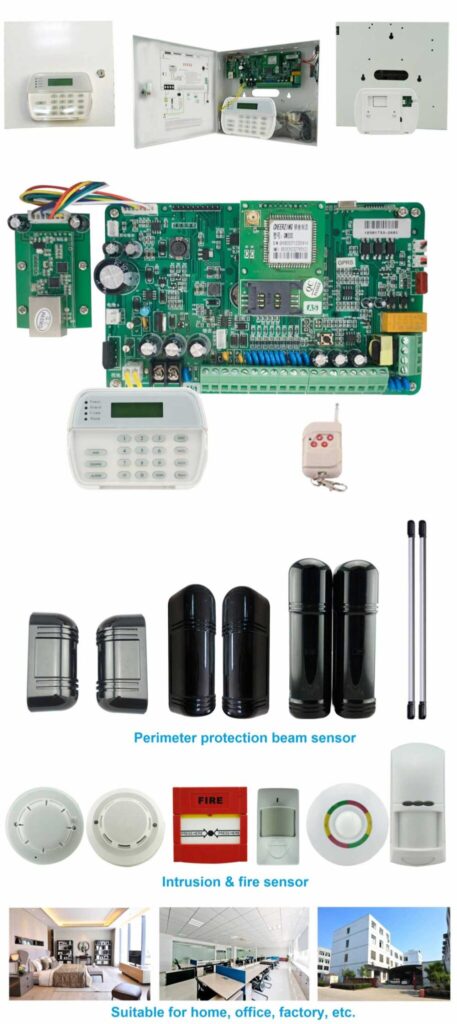
A burglar alarm control panel is the system’s processing hub. It receives signals from detectors—such as PIR sensors, door contacts, glass-break sensors, and vibration detectors—and determines whether to trigger alarms. Each detector or group of detectors is assigned to a zone, allowing the system to identify which area has been violated.
Zone Limitations in Standard Panels
Traditional control panels typically offer 4, 8, or 16 onboard zones. For small environments, this may suffice. In large facilities, however, limited zones cause:
- Combined sensors on shared zones, reducing event accuracy
- Difficulty in pinpointing alarms
- Challenges in meeting compliance requirements such as UL 681 or EN 50131
- Increased risk of nuisance and false alarms
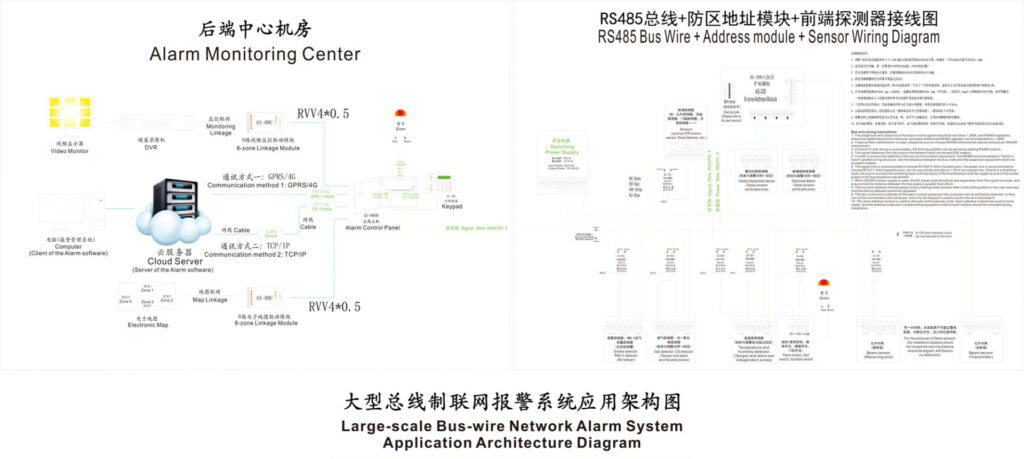
Zone Expansion and Scaling Methods
To overcome zone constraints, security professionals rely on:
- Zone Expander Modules (Zone Expansion Boards)
- Multiplexed (MUX) Bus-Based Expansion
- RS-485 or proprietary communication buses
- Remote Input Modules (RIMs)
These allow burglar alarm control panels to scale from small systems to enterprise-wide intrusion alarm networks.
Key Considerations for Zone Expansion in Large Facilities
1. Assess Facility Needs and Alarm Coverage
Before wiring expansion zones, conduct a structured assessment:
- Total floor area and building layout
- Number of access points and high-risk areas
- Environmental interference sources
- Sensor density per zone
- Power distribution and wiring pathways
This evaluation guides how many expansion modules are needed and where they should be located.
2. Ensure Component Compatibility
Zone expanders must match the burglar alarm control panel’s:
- Bus communication protocol (RS-485, CAN, or proprietary)
- Voltage levels and current consumption
- Supervision requirements
- Manufacturer integration rules
Mismatched expanders result in unstable communication, missing events, or bus overload.
3. Wiring Type and Signal Integrity
For professional burglar alarm control panel zone expansion wiring, the recommended cable types include:
- Twisted pair cable: Minimizes noise and maintains signal integrity
- Shielded cable (FTP/STP): Reduces EMI and cross-talk
- 18–22 AWG conductors: Adequate for both data and sensor input wiring
Proper grounding and isolation are critical for long cable distances in large sites.

Step-by-Step Guide to Burglar Alarm Control Panel Zone Expansion Wiring
1. Preparation and Tools
Essential tools and materials:
- Zone expander modules
- Twisted pair or shielded alarm cable
- Cable markers and labeling tools
- Multimeter for continuity checks
- Screwdrivers, crimpers, and insulating sleeves
- Surge protection devices (recommended for large campuses)
Follow facility safety protocols and disconnect the main power before wiring.
2. Selecting the Wiring Topology
Daisy-Chain (Bus) Topology
Advantages:
- Lower cabling cost
- Easier to extend modules sequentially
- Widely supported by RS-485-based panels
Disadvantages:
- A single cable fault can compromise downstream modules
- Requires termination resistors at endpoints
Star Topology
Advantages:
- Higher reliability
- Fault isolation is easier
- Suitable for multi-building layouts
Disadvantages:
- More cable consumption
- Some control panels may not support star bus wiring
Large facilities often adopt a hybrid topology, combining star distribution to each building with daisy-chain wiring inside each building.
3. Installation Steps
- Mount the zone expander close to the supervised area
- Run data bus wires (A/B terminals, COM, power) according to manufacturer guidelines
- Terminate resistors based on panel requirements
- Assign zone addresses via DIP switches or software
- Connect sensors with correct End-of-Line resistors (EOL) for supervision
- Restore power and test communication
- Verify each expanded zone using the panel’s diagnostics
- Log all wiring paths and zone assignments for auditing and future maintenance
4. Troubleshooting Common Issues
| Issue | Cause | Solution |
|---|---|---|
| Weak signal or interference | Long cable runs, EMI | Use shielded cable, add repeaters |
| Bus communication errors | Incorrect polarity, address conflict | Correct wiring, set unique module addresses |
| Ground loops | Improper grounding | Ensure single-point grounding |
| False alarms | Incorrect EOL values | Replace with correct resistors |
Best Practices for Reliability and Compliance
1. Follow International Security Standards
Two widely recognized standards:
- UL 681 – Installation and Classification of Burglar and Holdup Alarm Systems
- EN 50131 – European standard for intrusion alarm systems
These define wiring requirements, supervision rules, environmental categories, and installation quality criteria essential in large facilities.
2. Maintenance & Lifecycle Management
To sustain system reliability:
- Perform semiannual zone-by-zone functional tests
- Check expander module firmware versions
- Inspect wiring for wear, oxidation, or rodent damage
- Maintain updated site documentation
- Plan expansion margin (20–30% spare zones) for future growth
3. Procurement & Cost Optimization
For large-scale deployments:
- Evaluate total cost of ownership (panel, expanders, wiring, labor)
- Choose suppliers offering long-term product support
- Standardize models across facilities for easier training
- Consider bulk procurement contracts to reduce per-unit cost
- Calculate ROI by comparing incident reduction vs. expansion investment
Advanced Techniques and Innovations
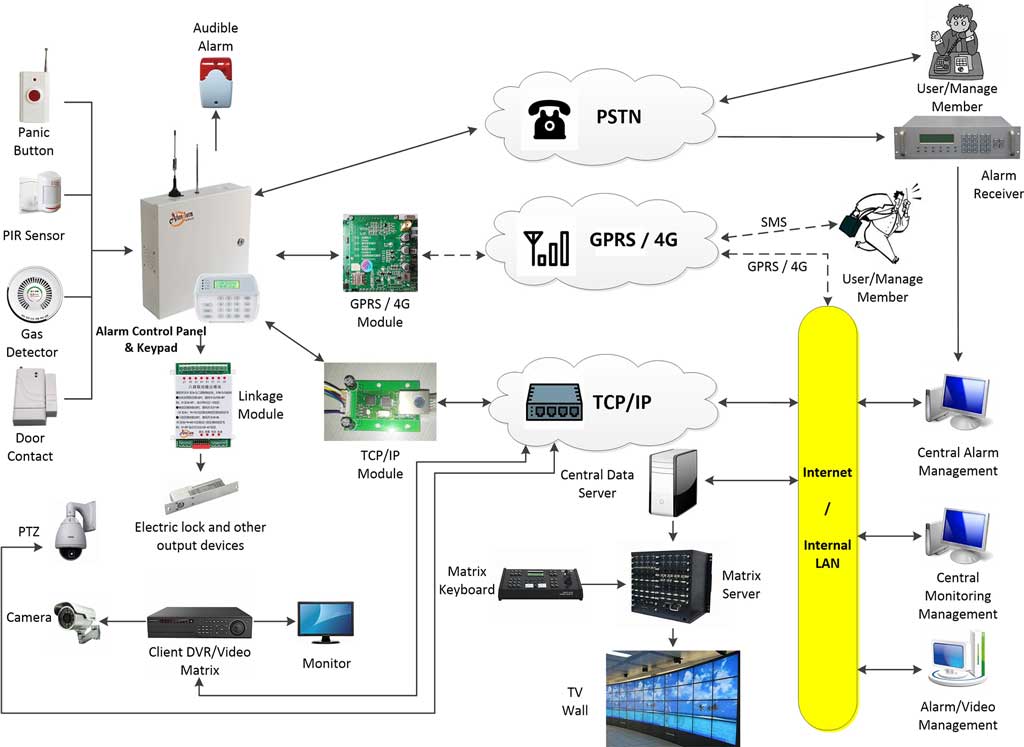
1. Integration with Smart and IoT-Enabled Systems
Modern expanders support:
- IP-based communication
- Cloud supervision
- Remote diagnostics
- Hybrid wired/wireless zoning
These enhance management efficiency in large, distributed environments.
2. Real-World Case Examples
Industrial Park — 76-Zone Expansion
A logistics park deployed multiple RS-485 expanders across three buildings. By segmenting each floor into dedicated zones, security teams achieved a 38% reduction in false alarms.
Cold Storage Facility — Shielded Cable Implementation
By replacing long unshielded runs with shielded twisted pair, signal stability improved significantly, solving intermittent communication issues.
3. Future Trends
- Wireless zone expansion using encrypted mesh networks
- AI-based zoning that adjusts sensitivity by time period
- Self-diagnostic bus modules capable of auto-reporting faults
These innovations will complement traditional burglar alarm control panel zone expansion wiring rather than replace it.
Conclusion
Effective burglar alarm control panel zone expansion wiring is essential for securing large facilities with complex layouts and higher operational risks. By applying the right expansion modules, optimal wiring strategies, and adherence to industry standards, security teams can achieve precise detection, enhanced reliability, and long-term scalability.
Professionals responsible for design, installation, and procurement are encouraged to evaluate their current systems using the principles outlined in this guide and consult certified engineers when planning expansion projects.
A well-planned zone expansion strategy is a long-term investment—one that strengthens protection, reduces incidents, and ensures peace of mind across the facility lifecycle.
References
- AS-9000 Series Alarm Control Panel Wiring Instructions
- UL 681 – Installation and Classification of Burglar and Holdup Alarm Systems, Underwriters Laboratories.
- EN 50131 – Intrusion and Hold-Up Alarm Systems, CENELEC standard series.
- MarketsandMarkets – Global Burglar Alarm Systems Market Analysis, latest edition.
- Technical documentation from Honeywell Vista Series, DSC PowerSeries NEO, and other leading burglar alarm control panel manufacturers.
- Articles from Journal of Security Engineering on wiring integrity and large-scale intrusion system design.