
In today’s dynamic commercial real estate landscape, multi-tenant buildings such as office towers, mixed-use developments, and industrial complexes demand adaptable security solutions. The core challenge lies in implementing expandable intrusion detection setups that accommodate tenant turnover, evolving access needs, and tightening regulatory demands without disrupting overall protection or inflating costs. Scalable alarm systems address this by allowing seamless growth, ensuring compliance with key standards like NFPA 72 for fire alarm signaling and UL 681 for burglar alarm installations.
This guide delivers targeted strategies for multi-occupancy security scaling, drawing on industry benchmarks and real-world deployments. It equips facility managers and engineers with actionable insights to mitigate risks, optimize operations, and maintain robust intrusion protection across shared spaces.
Defining Scalability in Intrusion Detection for Shared Spaces
Scalability in alarm systems for multi-tenant environments goes beyond sheer size—it’s about engineered flexibility. Key attributes include the ability to integrate additional sensors, zones, or user partitions without overhauling the central panel; upgrading communication protocols like IP or cellular backups with minimal infrastructure changes; and enabling tenant-specific controls while preserving system-wide integrity.
Compliance is foundational. For instance, NFPA 72 mandates supervised signaling paths with regular testing intervals to ensure reliable emergency notifications, particularly in high-occupancy settings where rapid alerts can prevent escalation. Similarly, UL 681 classifies systems based on installation quality, emphasizing certified components for commercial burglar alarms. The Security Industry Association (SIA) highlights that properly scalable designs can reduce long-term operational costs by up to 40% through efficient lifecycle management, as noted in their 2024 global security market report.
Key Architectural Approaches for Multi-Tenant Alarm Deployments
Selecting the right model depends on building type, risk profile, and tenant needs. Two primary frameworks stand out for effective multi-tenant building alarm expansion.
Centralized Partition Model: Ideal for Cost-Effective Shared Infrastructure
This approach uses a single high-capacity control panel divided into logical partitions for each tenant. It supports independent arming/disarming, unique credentials, and shared resources like power supplies and monitoring links.
Benefits include reduced per-tenant hardware expenses, streamlined central maintenance, and simplified audits for standards compliance. For office complexes or co-working hubs, this model excels by allowing quick reconfiguration during tenant changes.
Distributed Panel Setup: For Enhanced Isolation in Sensitive Environments
In scenarios with high-risk occupants, such as financial firms or research labs, dedicated panels per tenant provide full autonomy. Each includes isolated communication and monitoring accounts.
While this increases initial capital outlay and space demands, it isolates risks and simplifies billing. Drawbacks like complex servicing are offset in environments prioritizing data-sensitive security.
Step-by-Step Planning Checklist for Expandable Security Systems
To execute a reliable expansion, follow this engineering workflow tailored for facility managers overseeing multi-tenant intrusion systems.
- Assess Zoning Physically and Logically
Map all access points: tenant doors, shared hallways, utility rooms, rooftops, and garages. Categorize into exclusive tenant zones, common infrastructure areas, and critical shared spaces like electrical panels. Output: A detailed zone-partition matrix to guide configurations. - Evaluate System Capacity Reserves
Check panel specs for zone limits, partition counts, user slots, and expansion slots. Aim for 60-70% initial utilization to leave room for growth, per SIA best practices. For example, if a panel supports 512 zones, deploy no more than 358 at startup. - Build Redundant Communication Layers
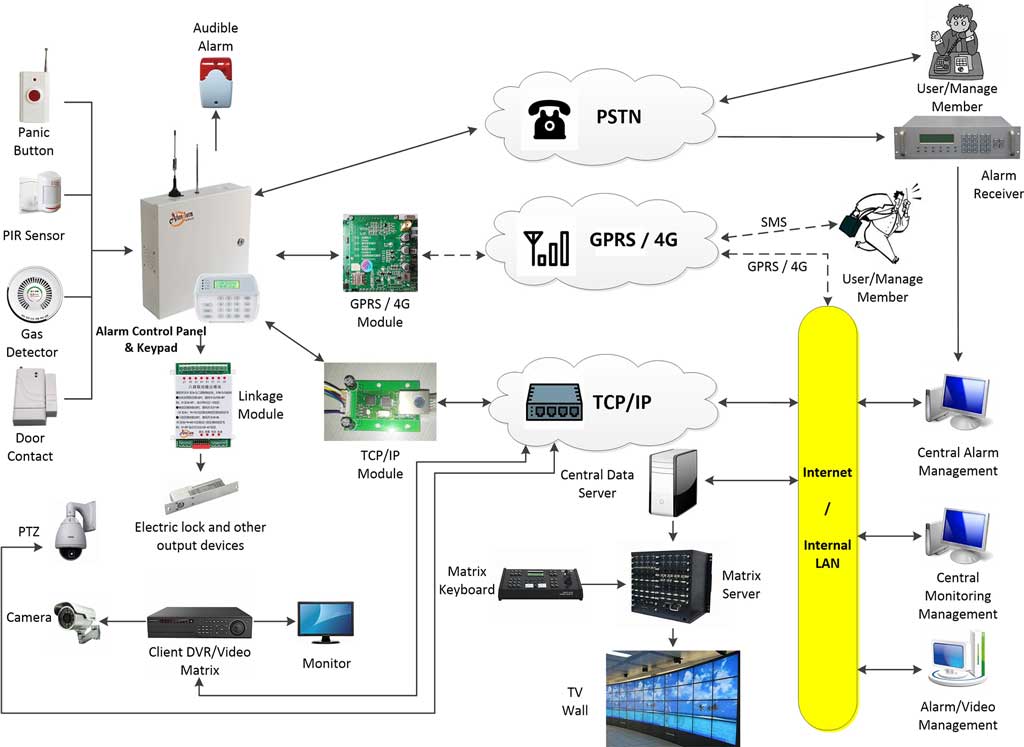
Prioritize supervised IP as primary, with LTE/5G backups. Add secondary paths for premium tenants. Verify against NFPA 72’s 24-hour supervision requirements and UL 681’s transmission standards to avoid signal failures. - Establish Tenant-Specific Access Policies
Assign unique partitions and central station accounts. Implement role-based permissions and logging. Prohibit shared codes to prevent cross-tenant vulnerabilities. - Standardize Hardware for Future Additions
Use compatible expansion modules and track firmware. Maintain digital records of configurations, including IP addresses and zone assignments, to facilitate seamless upgrades.
Common Pitfalls and Prevention Tactics in Alarm Scaling
Avoidable errors can undermine even well-planned systems. Here’s how to sidestep them.
- Power Supply Overloads: As sensors multiply, calculate loads with a 25% buffer. Ensure batteries meet UL’s 24-hour standby plus 5-minute alarm runtime.
- Partition Management Lapses: Enforce quarterly audits and change logs to prevent zone misassignments, which SIA data links to 40% of commercial system issues.
- Network Security Oversights: Segment alarm traffic on VLANs, encrypt data, and limit ports. This is vital in IP-based setups for multi-tenant properties to thwart cyber threats.
Real-World Expansion Example: From 4 to 10 Tenants
Consider a mid-rise office building starting with four tenants. Two years later, occupancy doubles. A scalable approach involves adding zone modules, creating new partitions, programming distinct monitoring codes, and testing transmissions end-to-end with the central station. This maintains compliance and cuts downtime.
Contrast this with fragmented add-ons, which inflate costs and invite instability, as evidenced by SIA’s findings on retrofit expenses in ad-hoc growth scenarios.

Analyzing Lifecycle Costs in Commercial Alarm Infrastructures
Forward-thinking designs minimize expenses over time. Scalable systems curb rewiring, panel swaps, and reconfiguration fees. SIA’s 2024 report estimates the global physical security market at $60.1 billion, with services reaching $319 billion in 2023, underscoring how lifecycle planning slashes operational outlays—often by 20-40% in commercial settings.
In practice, buildings incorporating expansion margins report lower five-year costs, per industry benchmarks, by avoiding frequent overhauls amid tenant flux.
Establishing a Governance Structure for Sustained Performance
Long-term success requires ongoing oversight: annual capacity reviews, firmware updates, battery tests, and path verifications. Develop standard procedures for tenant onboarding/offboarding. Document everything in a formal policy to preserve institutional knowledge.
Achieving Lasting Security Through Proactive Design
Effective scalable alarm systems in multi-tenant buildings stem from disciplined planning—partition foresight, capacity buffers, redundancy, controls, and documentation. For facility managers and engineers, this translates to compliant, stable, and cost-efficient intrusion detection that adapts to change.
Treating scalability as integral ensures your setup evolves as an enabler of safety, not a recurring hurdle.