
Executive Perspective: Why Alarm Systems Fail Silently Before They Fail Functionally
In commercial intrusion engineering, system failure rarely begins with a complete breakdown. It begins with ambiguity—small inconsistencies in telemetry interpretation, marginal delays in acknowledgment cycles, and partial degradation of communication paths that remain technically “online” but operationally unreliable.
This is the central engineering anxiety that most B2B evaluations overlook. A control panel that reports “connected” is not necessarily a system that is available under stress. In real deployments, especially across logistics hubs, banking infrastructure, and distributed retail networks, the most damaging failures are not total outages, but partial visibility collapse: event codes that arrive without context, buffered alarms that never reconcile, or failover paths that activate too late to preserve operational intent.
The Unified Telemetry Resilience Architecture (UTRA) is introduced precisely to formalize this gap between nominal connectivity and deterministic system behavior under stress conditions.
1. UTRA as a Standard-Aligned Engineering Model (Not a Conceptual Overlay)
Unlike legacy architecture descriptions that remain vendor-specific, UTRA is structured to align directly with established life-safety and intrusion detection standards, particularly those defined under
EN 50131 Intrusion and Hold-up Systems Standard and
UL 1610 Central Station Burglar Alarm Units.
This alignment is not decorative—it is structural. In certified deployments, compliance is not evaluated at the panel level alone but across the entire telemetry chain, including transmission stability, supervision timing, and fault reporting determinism.
UTRA formalizes this into a single engineering expectation:
a system is only as secure as its least observable failure mode.
That statement becomes critical in practice, because most alarm infrastructures fail not at the sensor layer, but in the translation between field telemetry and central monitoring interpretation.
2. The Intrusion Telemetry Continuum: Where Engineering Fragility Actually Appears
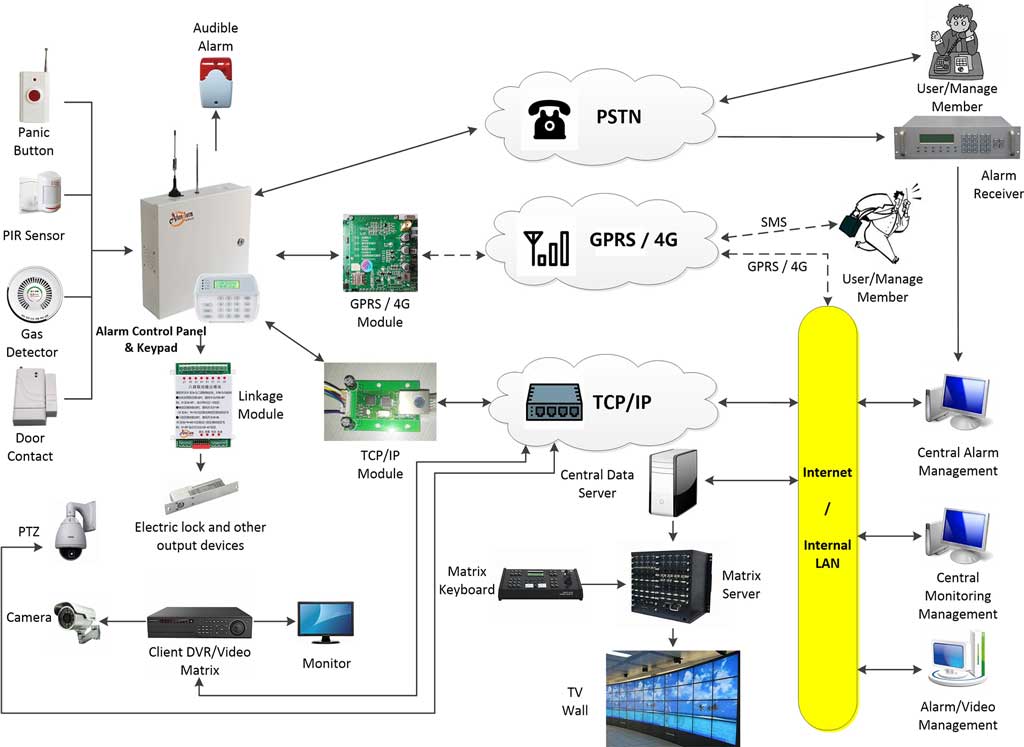
A commercial intrusion system is often described as a layered stack, but in real-world deployments, it behaves more like a continuous stress pipeline. Each stage introduces transformation risk, and each transformation reduces semantic certainty.
At the edge layer, physical sensors generate binary truth states—motion, fracture, vibration, or contact disruption. But immediately after ingestion, the control layer begins transforming physical certainty into interpreted events. This is where early ambiguity is introduced: debounce logic, zone mapping tables, and firmware-level prioritization rules all begin shaping what the system “thinks” happened.
By the time data reaches the communication layer, the event has already been abstracted twice—first into a logical zone state, then into a protocol representation such as SIA DC-09 or legacy Contact ID.
The critical engineering issue is that every abstraction layer increases interpretive dependency on upstream correctness. If any upstream layer misclassifies state transitions under stress conditions, the downstream CMS receiver is not alerted to uncertainty—it is only given a finalized packet.
This creates a dangerous illusion of certainty.
3. Protocol Reality: Contact ID vs DC-09 Under Load Conditions
Legacy systems built on analog transmission assumptions still persist in modern deployments due to backward compatibility requirements. However, their engineering limitations become increasingly visible under congested or degraded network conditions.
In systems relying on voice-emulated signaling, even minor waveform distortion introduces semantic failure. Compression artifacts, jitter accumulation, or timing drift in tone-based encoding do not degrade gracefully—they collapse interpretation entirely. The CMS receiver either decodes the event correctly or discards it without intermediate visibility.
By contrast, native IP-based signaling such as
SIA DC-09 does not rely on waveform reconstruction. Instead, it preserves event semantics within structured digital payloads transmitted over TCP/IP or UDP/IP transport layers.
However, it must be emphasized that this does not eliminate failure modes—it shifts them. Instead of tone distortion, engineers now face issues such as socket congestion, NAT traversal inconsistencies, and asynchronous acknowledgment drift.
The UTRA framework does not treat DC-09 as “better,” but as “more diagnostically expressive under failure,” which is a fundamentally different engineering property.
A typical DC-09 packet in production environments includes structured metadata boundaries that allow post-event forensic reconstruction of transmission integrity. This becomes essential when diagnosing intermittent failures that do not appear in standard connectivity logs.
4. Failover Engineering: The Illusion of Redundancy Without Temporal Guarantees
Multi-path communication is often described as redundancy, but in enterprise alarm engineering, redundancy without timing guarantees is functionally incomplete.
The critical variable is not whether a secondary path exists, but how quickly the system detects primary degradation and completes state migration without losing event continuity.
In real deployments, the most operationally dangerous condition is not total link failure, but partial degradation where the primary path remains “technically active” while failing to deliver acknowledgments within deterministic windows.
Under UTRA, failover is therefore treated as a timing-bound state transition problem rather than a simple path switch.
A properly engineered system maintains concurrent supervision across IP and cellular paths, but more importantly, it preserves event buffering semantics during transition windows. Without this, alarm packets are not lost—they are delayed beyond their actionable window, which is equivalent to operational loss in security contexts.
This is where compliance thresholds under
EN 50131 Security Grade 3 Timing Requirements
become practically significant, because they define not just whether failover exists, but whether it is temporally valid.
5. Field Bus Engineering: RS-485 as a Deterministic but Physically Vulnerable Backbone
At the field level, RS-485 remains dominant due to its electrical resilience and predictable differential signaling behavior. However, its deterministic nature masks a key vulnerability: physical topology sensitivity.
Unlike IP networks that degrade through congestion, RS-485 networks degrade through structural distortion—impedance mismatch, stub formation, and reflection artifacts. These failures are particularly problematic because they often manifest intermittently rather than consistently.
From an engineering standpoint, this creates a high-risk diagnostic category: “non-reproducible field faults.” These are the most expensive failures in intrusion deployments because they resist lab replication while persisting in production environments.
Termination accuracy, cable quality variance, and grounding asymmetry all contribute to latent instability that only appears under specific load conditions, often coinciding with environmental stress or physical tampering attempts.
UTRA treats this not as wiring discipline alone, but as a signal integrity governance problem across the entire deployment lifecycle.
6. Performance Benchmarks: Making Reliability Measurable Instead of Assumed
One of the most important corrections UTRA introduces is the shift from qualitative reliability claims to measurable telemetry performance baselines.
In validated deployments, system behavior is no longer described as “stable” or “fast failover,” but as bounded within measurable constraints:
- Path failover must occur within a bounded detection-to-migration window under congested network conditions
- Heartbeat supervision must maintain consistency under jitter variance, not just nominal intervals
- Packet acknowledgment latency must be statistically bounded rather than averaged
- Event buffering must guarantee non-loss semantics during transport interruption windows
These metrics matter because alarm systems are not evaluated under ideal conditions. They are evaluated during infrastructural stress—power instability, network congestion, or coordinated physical intrusion attempts.
A system that performs correctly 99.9% of the time but fails unpredictably in the remaining 0.1% is not a reliable security system. It is a probabilistic liability model.
7. Athenalarm AS-9000 as a Reference Implementation Layer
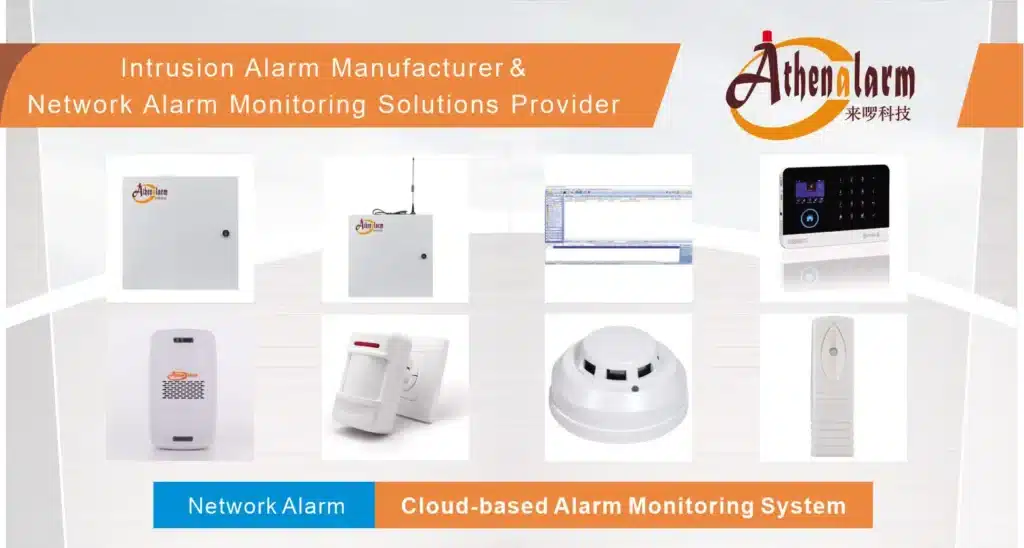
Within this framework, the AS-9000 platform is positioned not as a product claim but as a reference architecture demonstrating how multi-path telemetry, RS-485 field integrity, and IP-based CMS integration can coexist within a unified operational model.
Its significance lies not in individual components, but in architectural consolidation: communication modules, field expansion logic, and event buffering are no longer treated as independent subsystems but as synchronized elements of a single telemetry lifecycle.
This matters because most deployment failures originate at subsystem boundaries rather than within subsystems themselves.
8. Engineering Action Pathway: What a Serious Evaluator Actually Tests
A meaningful evaluation of intrusion infrastructure does not begin with feature comparison. It begins with failure modeling under constrained conditions.
In practical terms, engineers evaluating a system aligned with UTRA principles should focus less on advertised capabilities and more on behavioral consistency under three stress scenarios:
First, whether the system preserves event integrity during partial network degradation rather than simply reporting disconnection.
Second, whether failover transitions maintain temporal determinism when acknowledgment latency exceeds nominal thresholds.
Third, whether field bus disturbances propagate predictably or collapse into non-diagnostic failure states.
If a system cannot produce stable diagnostic behavior under these conditions, its compliance labels are operationally irrelevant, regardless of certification status.
Conclusion: From Feature Evaluation to Behavioral Certainty
The strategic value of UTRA is not in redefining intrusion system design, but in shifting evaluation from structural description to behavioral predictability under stress.
Most enterprise security failures are not caused by absence of technology, but by mismatch between assumed system behavior and actual failure behavior.
UTRA resolves this by forcing the system description to include not only how it operates when stable, but how it behaves when stability is no longer guaranteed. In real deployments, this distinction is the difference between a system that reports alarms—and a system that reliably delivers actionable truth under failure conditions.