
Introduction: Why a Single Sensor Can Never Protect an ATM
Automated Teller Machines remain one of the most targeted financial assets in the physical security landscape. Organized crime groups continue to deploy increasingly sophisticated attack methods—from mechanical drilling and gas explosions to cabinet prying, full machine theft, and emerging cyber-physical threats like jackpotting, where malware forces the machine to dispense cash without authorization.
Many ATM operators still rely on a single alarm sensor or basic cabinet contact, assuming that once the ATM door opens, the alarm will trigger and the problem is solved. In reality, that approach leaves enormous blind spots.
Modern attacks frequently bypass simple alarm triggers:
- Criminals cut the cabinet from the rear panel
- Gas is injected into the safe before the door is opened
- Machines are lifted using heavy equipment before the alarm triggers
- Seismic drilling attacks occur without opening the safe door
- Skimming devices are installed to capture card data, often combined with hidden cameras for PIN theft
- Jackpotting malware is loaded via USB ports or internal hard drive swaps, exploiting software vulnerabilities
Because of these evolving threats, banks that operate large ATM networks increasingly rely on a multi-layer ATM alarm system architecture rather than a single detection device.
A properly engineered ATM security system integrates multiple sensor layers designed to detect:
- Access attempts
- Structural attacks
- Physical displacement
- Safe drilling or cutting
- Environmental anomalies
- Cyber intrusions and tampering with internal electronics
Each layer triggers alarms at different stages of an attack, providing early detection, redundancy, and verification.
This guide explains how to design a bank-grade ATM alarm system architecture, including:
- Which sensors an ATM alarm system should include
- When to use seismic detectors vs vibration sensors
- How to link ATM cabinet protection with ATM enclosure monitoring
- How banks design ATM intrusion alarm topologies that security teams trust
- Integration with central monitoring centers and emerging AI technologies
- Maintenance and troubleshooting best practices to ensure long-term reliability
The goal is to help security engineers, alarm installers, and ATM operators design alarm systems that detect attacks before the cash is compromised, while also complying with industry standards like PCI DSS and reducing operational costs through efficient false alarm management.
Understanding the Real Threat Landscape Facing ATM Machines
Before designing a multi-layer ATM alarm system, it is important to understand how ATMs are actually attacked in the field.
ATM attacks generally fall into five major categories, with recent data from 2023-2024 showing a surge in hybrid cyber-physical methods.
1. Physical Safe Attacks
Criminals attempt to penetrate the ATM safe using:
- Drilling
- Grinding
- Thermal cutting
- Hydraulic spreading
These attacks generate specific vibration and seismic patterns, which can be detected by seismic detectors. In high-risk areas, attackers may use advanced tools like diamond-tipped drills, making early detection crucial to prevent breaches.
2. Gas Explosive Attacks
A rapidly growing attack method in Europe and parts of Asia involves:
- Injecting gas into the ATM safe
- Igniting the gas
- Blowing open the safe door
This type of attack can destroy an ATM in seconds.
While seismic sensors can sometimes detect preparation activity, multi-layer detection becomes essential to detect cabinet tampering beforehand. Recent incidents highlight the need for gas detection sensors in vulnerable regions.
3. ATM Ram-Raid Theft
Criminals use vehicles to physically remove the ATM from the building, often employing “hook and chain” methods where chains are attached to the machine and pulled by trucks.
If the ATM alarm system only monitors door status, the machine may already be gone before the alarm triggers. Data from 2023-2024 indicates a 600% rise in such physical displacement attacks in some areas.
4. Internal Access or Maintenance Abuse
Not all ATM breaches are external. Sometimes:
- Unauthorized technicians access the safe
- Maintenance doors are opened outside service windows
- Internal wiring is tampered with
Door sensors alone cannot always distinguish legitimate access from suspicious activity. Integrating access logs with biometric verification can help mitigate insider threats.
5. Rear-Panel or Side-Panel Attacks
Instead of attacking the safe door, criminals attack:
- The rear cabinet panel
- The machine body
- The floor anchoring points
This bypasses traditional door-based alarm triggers. Emerging threats also include jackpotting, where attackers gain physical access to install malware, leading to unauthorized cash dispensing—incidents surged in 2024, with losses exceeding $20 million in the US alone.
To address these, consider regional crime patterns during risk assessments, as threats vary by location (e.g., explosive attacks more common in Europe).
Why ATM Security Requires a Multi-Layer Alarm Architecture
A modern ATM intrusion alarm architecture is built around the concept of defense in depth.
Instead of relying on a single sensor, the ATM alarm system deploys multiple detection layers, each responsible for detecting different attack indicators.
A typical multi-layer ATM alarm system includes:
| Layer | Function | Typical Sensors |
|---|---|---|
| Access detection | Detect door or panel opening | Magnetic contacts |
| Tamper detection | Detect enclosure interference | Tamper switches |
| Structural attack detection | Detect drilling or cutting | Seismic detectors |
| Movement detection | Detect ATM displacement | Tilt sensors |
| Environmental detection | Detect abnormal conditions | Shock / vibration sensors |
| Cyber detection | Monitor software anomalies | Intrusion detection software |
This layered architecture provides three critical benefits.
Early Attack Detection
Seismic sensors can detect drilling before the safe is breached, while AI-integrated cameras can spot skimming device installation in real time.
Redundancy
If one sensor fails or is bypassed, others still trigger alarms. For instance, if a door contact is disabled, a tamper switch can activate.
Event Correlation
Multiple sensors triggering simultaneously improves alarm verification accuracy, reducing false alarms. Advanced systems use AI to correlate data from sensors, video, and transaction logs for better decision-making.
Implementing this requires compliance with standards like PCI ATM Security Guidelines, which emphasize layered protection to safeguard cardholder data.
The Core Sensors Every ATM Alarm System Should Include
Designing a bank-grade ATM alarm system begins with selecting the correct combination of sensors.
Below are the essential detection technologies used in professional ATM security systems, with detailed comparisons and installation steps.
ATM Door Sensors: The First Line of Intrusion Detection
Door sensors remain the foundation of every ATM alarm system.
These sensors monitor the opening of:
- ATM safe doors
- Upper service panels
- Rear cabinet doors
- Cash cassette compartments
Typical Technology
Most ATM alarm systems use:
Magnetic reed switches
These consist of two components:
- Magnet
- Reed contact
When the door opens, the magnetic field breaks and the alarm is triggered.
Best Installation Practices
To maximize reliability:
- Prepare the surface: Clean and secure the mounting area inside the cabinet to ensure firm adhesion.
- Position the components: Align the magnet on the door and the reed switch on the frame, maintaining a gap of no more than 1/4 inch.
- Secure wiring: Route wires through armored conduit to prevent cutting, and use cable ties every 6 inches.
- Test alignment: Open and close the door multiple times to verify consistent triggering.
- Add tamper protection: Install sensors in tamper-resistant housings to detect removal attempts.
Protect wiring within armored conduit and monitor both safe doors and upper ATM service doors.
Common Mistake
Many ATM deployments monitor only the safe door, leaving upper cabinet panels unprotected.
Professional ATM alarm system designs always monitor both compartments. A frequent error is improper gap alignment, leading to false alarms—always calibrate with a multimeter to check circuit integrity.
Seismic Detectors: The Critical Sensor for Safe Attack Detection
Seismic detectors are among the most important sensors in an ATM intrusion alarm architecture.
They detect:
- Drilling
- Hammering
- Grinding
- Explosive attack preparation
Unlike vibration sensors, seismic detectors analyze structure-borne vibrations transmitted through metal, with advanced pattern recognition to filter out non-threat vibrations.
How Seismic Detectors Work
A seismic detector contains:
- Piezoelectric sensors
- Signal analysis electronics
- Pattern recognition algorithms
These components distinguish between:
| Normal Vibration | Attack Vibration |
|---|---|
| Traffic noise | Drilling |
| ATM operation | Hammering |
| Environmental vibration | Cutting tools |
Seismic detectors offer high sensitivity and strong false alarm filtering, making them ideal for high-value assets.
Where to Install ATM Seismic Detectors
Correct placement is essential.
Recommended installation locations include:
- ATM safe door
- Safe side wall
- Cash vault interior wall
Avoid installing on:
- Plastic surfaces
- Loose panels
- Thin outer cabinet walls
Direct contact with the safe body ensures accurate detection.
Installation Steps
- Select mounting spot: Choose a rigid metal surface on the safe, away from moving parts.
- Drill mounting holes: Use a template to drill precise holes, avoiding damage to internal components.
- Attach detector: Secure with screws and apply sealant to prevent vibration damping.
- Connect wiring: Link to the alarm control unit using shielded cable to minimize interference.
- Calibrate sensitivity: Use the device’s built-in tools to test with simulated attacks (e.g., light tapping) and adjust thresholds.
- Test integration: Simulate an attack and verify alarm transmission to the monitoring center.
Improper calibration is a key error—overly sensitive settings can trigger on traffic, while low sensitivity misses subtle drills.
Vibration Sensors vs Seismic Detectors: Choosing the Right Technology
Many ATM installers confuse vibration sensors with seismic detectors, but they serve different roles.
| Feature | Vibration Sensor | Seismic Detector |
|---|---|---|
| Sensitivity | Low | High |
| Signal processing | Basic | Advanced pattern analysis |
| False alarm filtering | Limited | Strong |
| Drilling detection | Poor | Excellent |
| Cost | Lower | Higher |
Vibration sensors detect general shocks and are prone to false alarms from environmental factors, while seismic detectors use AI-like algorithms for precise threat identification.
When to Use Vibration Sensors
Vibration sensors can be useful for:
- Basic cabinet protection
- ATM vestibule protection
- Supplemental monitoring
They are cost-effective for low-risk sites but lack the sophistication for safe protection.
When to Use Seismic Detectors
Banks typically require seismic detectors when protecting:
- ATM safes
- Bank vaults
- High-value cash storage
For true ATM safe protection, seismic detectors are strongly recommended, especially in areas with high drilling attack rates.
ATM Tilt Sensors: Detecting Machine Removal and Ram-Raid Attacks
Ram-raid attacks have become increasingly common.
Criminals may:
- Attach chains to the ATM
- Pull it out with a vehicle
- Use construction equipment to remove the machine
Tilt sensors detect changes in the ATM’s orientation.
How Tilt Sensors Work
Tilt sensors monitor:
- Angle changes
- Vertical displacement
- Structural movement
If the ATM tilts beyond a predefined threshold (e.g., 5-10 degrees), an alarm is triggered.
Placement
Tilt sensors are usually installed:
- Inside the ATM base
- On the safe frame
- Within the alarm control module
Installation Steps
- Identify base: Locate a stable point in the ATM’s lower frame.
- Mount sensor: Affix using brackets, ensuring level alignment with a spirit level.
- Set threshold: Program the angle limit via the control panel software.
- Wire connections: Integrate with the main alarm bus.
- Test: Gently tilt the machine (safely secured) to confirm activation.
A common pitfall is mounting on unstable surfaces, which causes nuisance alarms from minor vibrations.
ATM Cabinet Tamper Sensors
Tamper sensors detect attempts to disable the alarm system itself.
Typical tamper detection points include:
- Alarm control panel enclosure
- Sensor housings
- ATM cabinet electronics
Tamper switches trigger alarms when:
- Covers are removed
- Devices are opened
- Sensors are detached
This prevents criminals from disabling sensors before attacking the ATM.
Installation Steps
- Open enclosure: Access the panel or housing.
- Position switch: Place the plunger against the cover.
- Secure and wire: Connect to the tamper circuit.
- Test: Remove the cover to verify immediate alarm.
Overlooking tamper protection on all components is a frequent oversight, leaving systems vulnerable to sabotage.
Integrating ATM Safe Protection with ATM Body Protection
One of the biggest design mistakes in ATM alarm systems is protecting only the safe.
However, the ATM consists of two major security zones.
Zone 1 — ATM Safe
Protects:
- Cash cassettes
- Vault door
- Safe structure
Recommended sensors:
- Seismic detectors
- Safe door contacts
Zone 2 — ATM Machine Body
Protects:
- Upper service panels
- Cash dispenser module
- Internal electronics
Recommended sensors:
- Door contacts
- Tamper switches
- Vibration sensors
By monitoring both zones, the ATM alarm system detects pre-attack activity before criminals reach the safe. For enhanced protection, integrate with video surveillance: link alarms to cameras for visual verification, reducing response times.
Designing a Bank-Grade ATM Alarm System Topology
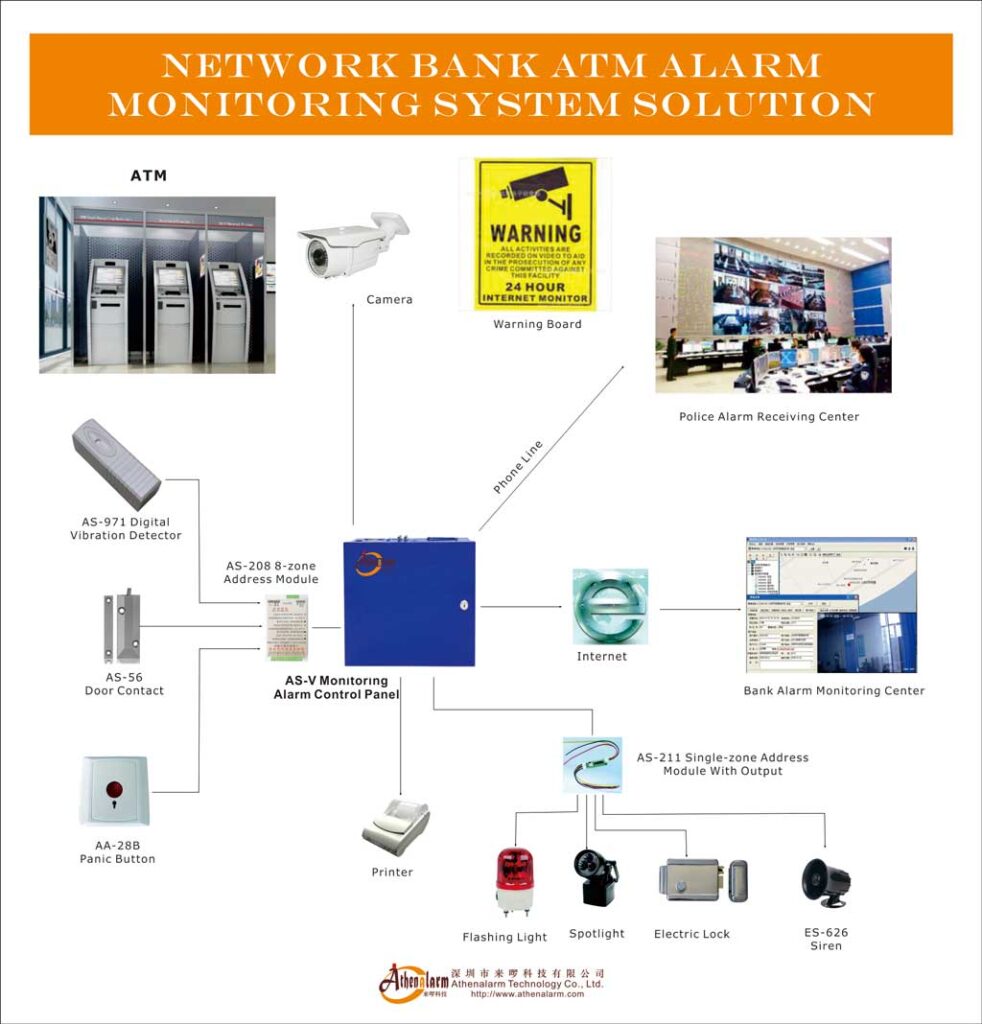
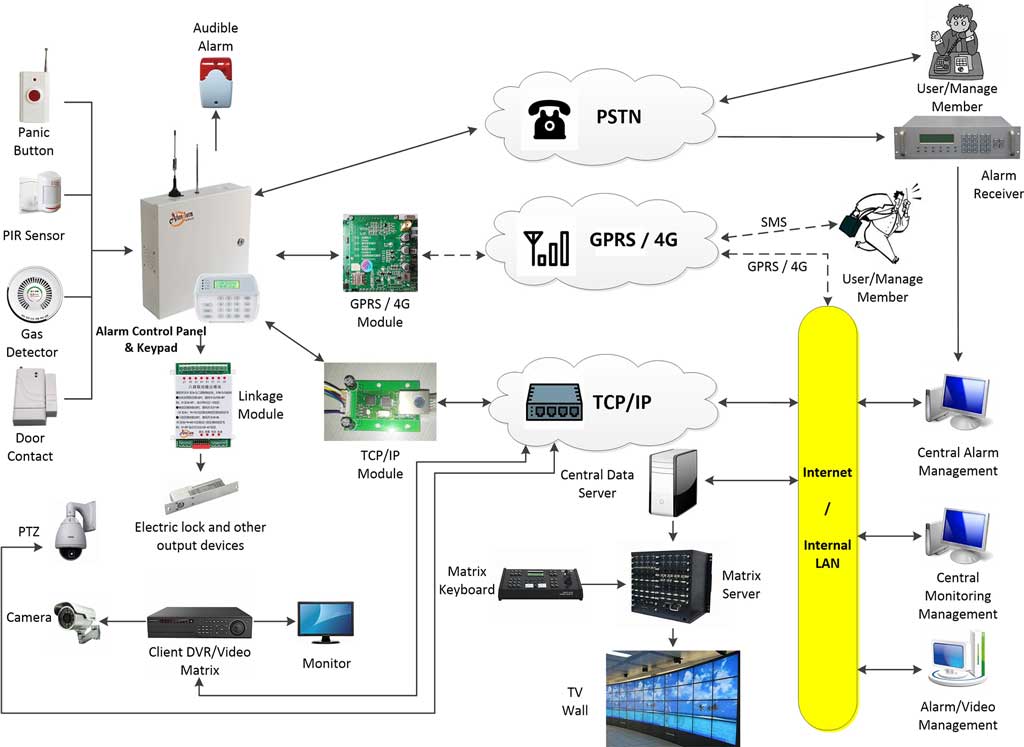
Sensor selection alone is not enough. The system architecture determines whether alarms reach monitoring centers reliably.
A professional ATM security system typically includes the following components.
1. ATM Alarm Control Unit
The alarm control unit collects signals from:
- Door sensors
- Seismic detectors
- Tilt sensors
- Tamper switches
It processes these inputs and generates alarm events. Choose units with expandable zones for future upgrades.
2. Communication Module
The alarm system must transmit events to a monitoring center.
Common communication channels include:
- IP networks
- Cellular communication
- Secure bank network connections
Many ATM alarm systems use dual communication paths (e.g., IP primary, cellular backup) to prevent signal loss. Ensure encryption to comply with data security standards.
3. Monitoring Center Integration
Alarm signals are forwarded to:
- Bank security control rooms
- Third-party alarm monitoring centers
- Law enforcement dispatch systems
Integration with monitoring software allows operators to:
- Identify ATM location
- Review alarm history
- Trigger response protocols
For optimal setup, use 24/7 monitoring services that provide real-time alerts and coordinate with local authorities. Remote diagnostics can also enable over-the-air updates, reducing onsite visits.

Step-by-Step Guide: Designing a Multi-Layer ATM Alarm System
Below is a practical design workflow used by professional security engineers.
Step 1 — Conduct a Risk Assessment
Evaluate:
- ATM location risk level (e.g., urban vs. rural)
- Crime history (review local police reports and industry data)
- Physical accessibility (e.g., bollards, lighting)
- Environmental conditions (e.g., traffic vibration)
High-risk locations may require additional sensors and faster communication paths. Document findings in a report to justify budget allocations.
Step 2 — Define Protection Zones
Separate the ATM into security zones:
| Zone | Protection Objective |
|---|---|
| Safe zone | Cash protection |
| Cabinet zone | Equipment protection |
| Surrounding area | Attack preparation detection |
Include perimeter monitoring if the ATM is freestanding.
Step 3 — Select Appropriate Sensors
Typical configuration:
| Sensor | Purpose |
|---|---|
| Door contacts | Access detection |
| Seismic detector | Safe attack detection |
| Tilt sensor | Machine movement detection |
| Tamper switches | Anti-sabotage detection |
Budget for quality: Seismic detectors cost more but reduce losses from undetected attacks.
Step 4 — Install Sensors Properly
Critical installation rules include:
- Secure mounting on metal surfaces
- Protected wiring routes
- Tamper-resistant installation
- Sensor calibration
Improper installation is a leading cause of false alarms and missed attacks. Always use certified installers and follow manufacturer guidelines.
Step 5 — Configure Alarm Logic
Alarm control panels should be programmed to:
- Distinguish maintenance mode from intrusion (e.g., via scheduled windows or key fobs)
- Correlate multi-sensor events (e.g., vibration + tilt = high priority)
- Prioritize high-risk alarms
Example alarm logic:
| Event | Response |
|---|---|
| Safe drilling detected | Immediate high priority alarm and law enforcement dispatch |
| Door opened outside maintenance window | Security notification and video review |
| Tilt detection | Emergency alarm with GPS tracking activation |
Use software tools to simulate scenarios during configuration.
Step 6 — Test the System Thoroughly
Testing must include:
- Sensor activation tests (e.g., simulate drilling with tools)
- Communication tests (e.g., failover to backup channel)
- Alarm transmission verification
- Monitoring center confirmation
Banks typically require periodic inspection and certification of ATM alarm systems, such as quarterly audits.
Step 7 — Plan for Maintenance and Upgrades
Establish a maintenance schedule:
- Monthly: Visual inspections and basic tests.
- Quarterly: Full sensor calibration and software updates.
- Annually: Comprehensive audit with simulated attacks.
Budget 10-15% of initial costs annually for upkeep to ensure reliability.
Reducing False Alarms in ATM Alarm Systems
False alarms can overwhelm monitoring centers and reduce system credibility.
Common causes include:
- Poor sensor placement (e.g., seismic on loose panels)
- Loose mounting surfaces
- Improper seismic sensitivity settings
- Environmental vibration (e.g., nearby construction)
Professional installation and calibration dramatically reduce false alarm rates. Use AI-enhanced systems that learn normal patterns over time, filtering out benign events. A key tip: During setup, monitor for 48 hours in a “learning mode” to baseline vibrations.
Troubleshooting false alarms:
- Review logs: Identify triggering sensor and time.
- Check environment: Note nearby activities.
- Recalibrate: Adjust thresholds incrementally.
- Upgrade if needed: Replace outdated sensors.
Reducing false positives by 50% can save thousands in response costs annually.

The Future of ATM Alarm Systems
ATM security continues to evolve.
Emerging technologies include:
- AI-assisted alarm verification: Machine learning analyzes video and sensor data to confirm threats, reducing false alarms.
- Remote seismic sensitivity tuning: Cloud-based adjustments without onsite visits.
- Smart alarm analytics: Predictive maintenance to foresee sensor failures.
- Integration with ATM video surveillance: AI detects skimming or loitering in real time.
- Biometric and blockchain enhancements: For secure access and tamper-proof logs.
- IoT connectivity: Enabling fleet-wide monitoring and automated responses.
However, regardless of technological advances, the multi-layer alarm architecture remains the foundation of ATM security. As threats like jackpotting grow, AI integration will be key to proactive defense.
Conclusion: Building ATM Alarm Systems That Banks Actually Trust
A truly effective ATM alarm system is never based on a single sensor.
Instead, it combines multiple detection technologies that monitor:
- ATM access
- Safe attack activity
- Physical displacement
- Equipment tampering
- Cyber anomalies
By implementing a multi-layer ATM security system architecture, banks gain:
- Earlier attack detection
- Greater system reliability
- Reduced alarm failures
- Stronger protection for high-value ATM assets
- Compliance with evolving regulations
For security engineers and ATM operators, the key takeaway is clear:
Layered detection is the only strategy that consistently protects ATMs against modern attack techniques.
When designed correctly—with door sensors, seismic detectors, tilt sensors, and tamper monitoring working together, integrated with AI and central monitoring—an ATM intrusion alarm system becomes a powerful defense mechanism that financial institutions can truly trust.