

Introduction: The Hidden Security Challenge of Multi-Site Businesses
For many organizations, physical security is no longer confined to a single facility. Modern enterprises often operate dozens, hundreds, or even thousands of distributed locations, each of which requires reliable protection against intrusion, vandalism, and operational risks.
Examples include:
- National retail chains operating hundreds of storefronts
- Bank ATM networks distributed across cities or countries
- Hotel groups with properties across regions
- Industrial parks with multiple warehouses and production sites
- Logistics and distribution networks with geographically dispersed hubs
For these organizations, deploying individual standalone alarms at each site is no longer sufficient. Traditional alarm systems were designed for single-site protection, not for enterprise-scale security management.
Without centralized control, security teams often face critical operational challenges:
- Inability to monitor hundreds of alarms simultaneously
- Lack of unified incident visibility
- High operational costs due to decentralized management
- Slow response times during emergencies
- Limited ability to analyze security trends across locations
This is why an advanced alarm monitoring system has become the backbone of modern multi-site security operations.
A properly designed monitoring infrastructure allows organizations to manage large-scale security operations from a single monitoring center, enabling real-time control, intelligent alert management, and centralized analytics. Modern systems go further by integrating intrusion detection with video verification, interactive mapping, and multi-path communication—turning raw alarm signals into actionable intelligence while dramatically reducing false alarms and response times.
This guide provides a practical, technical, and operational framework for understanding how alarm monitoring systems empower multi-site enterprises to operate secure, scalable security networks focused on burglar alarm protection.
1. Why Multi-Site Businesses Need Alarm Monitoring Systems
The Growing Complexity of Distributed Security
As businesses expand geographically, their security infrastructure becomes increasingly complex. Each new branch, store, or ATM adds another potential entry point for security threats.
Without centralized monitoring, companies typically face the following issues:
Fragmented Security Operations
When each site operates its own independent alarm system:
- Local staff may manage alarms inconsistently
- Alarm logs remain isolated
- Security teams cannot see the full picture
Slow Incident Detection
Standalone systems only alert local personnel. If staff are unavailable, incidents may go unnoticed.
Examples include:
- Break-ins during non-business hours
- ATM cabinet tampering
- Unauthorized access to warehouses
High Operational Costs
Managing hundreds of systems individually leads to:
- Increased maintenance overhead
- Inefficient troubleshooting
- Difficulty implementing security policy updates
Limited Scalability
As companies add locations, security teams struggle to maintain visibility.
A traditional security model does not scale efficiently.
The Role of Alarm Monitoring Systems
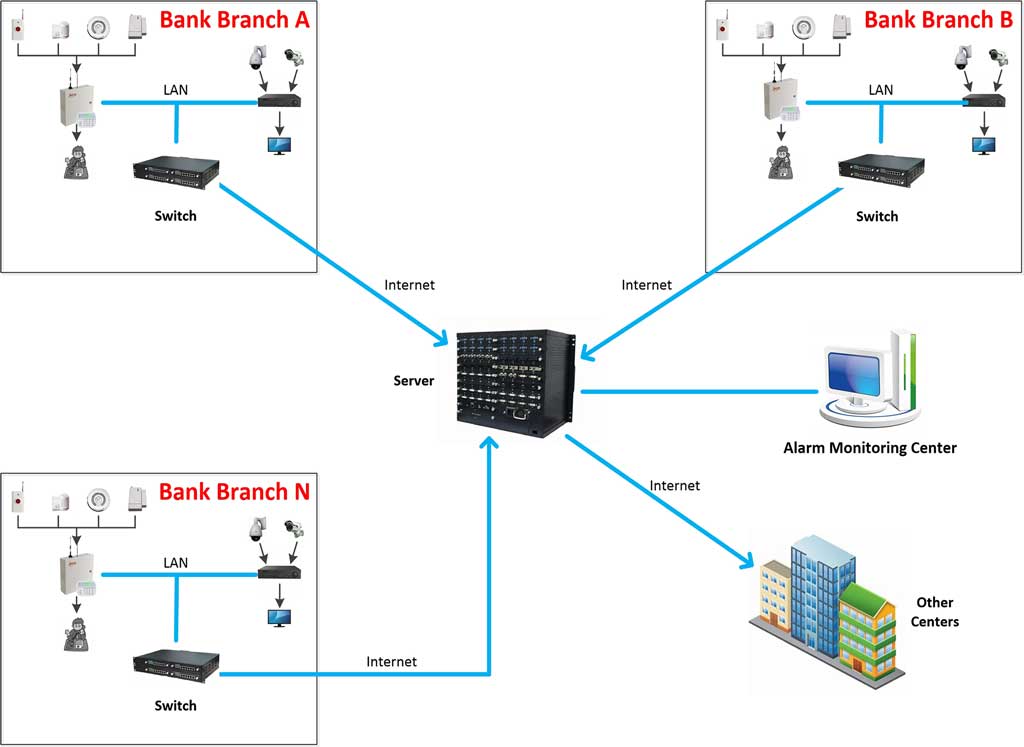
An alarm monitoring system solves these problems by providing a centralized platform where all alarm signals from distributed sites are transmitted and managed.
Instead of isolated alarms, organizations gain:
- A central monitoring center
- Real-time alarm transmission
- Remote system management
- Centralized event logging
- Enterprise-wide security visibility
This transformation turns individual alarms into a coordinated security network. With cloud-based software and video integration, operators can instantly view live footage, interactive maps, and stored evidence—critical for effective burglar alarm response across hundreds of locations.
2. Standalone Alarm Systems vs Centralized Alarm Monitoring
Understanding the difference between traditional alarm systems and monitoring systems is essential.
Traditional Standalone Alarm Systems
Standalone alarms typically operate like this:
- Sensors detect intrusion
- Local alarm siren activates
- Local personnel investigate
Limitations include:
- No centralized oversight
- Limited remote control
- Inconsistent response procedures
Standalone systems are acceptable for small businesses, but they fail when applied to large enterprises—especially when no one is on site to respond.
Centralized Alarm Monitoring Systems
Centralized monitoring systems operate differently:
- Sensors detect intrusion
- Alarm signal is transmitted to a monitoring center
- Monitoring platform analyzes the alert (including linked video)
- Operators verify the alarm
- Response procedures are triggered
This architecture enables:
- Enterprise-level monitoring
- Standardized response procedures
- Remote security management
For multi-site businesses, centralized monitoring dramatically improves operational efficiency and situational awareness while supporting real-time video verification to confirm genuine burglar intrusions before dispatching help.
3. Architecture of a Multi-Site Alarm Monitoring System
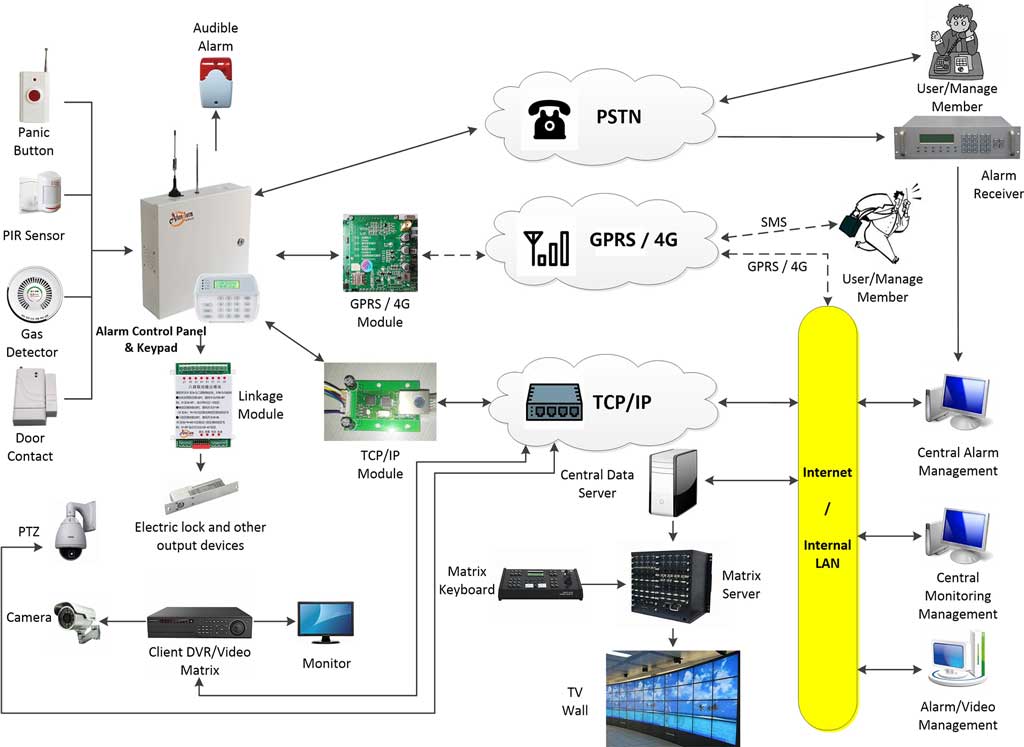
Designing a large-scale alarm monitoring infrastructure requires several components working together.
1. Field Security Devices
Each location includes:
- Intrusion detectors (motion, PIR)
- Door contacts
- Glass break sensors
- Vibration sensors
- Alarm panels
- Linked CCTV cameras for video verification
These devices detect security events and provide the visual confirmation needed for rapid, accurate response.
2. Alarm Control Panel
The control panel acts as the local security hub.
Functions include:
- Collecting signals from sensors
- Managing arming/disarming states
- Communicating with the monitoring center
Modern panels often support:
- Ethernet
- Cellular communication
- IP networking
3. Network Communication Layer
Reliable signal transmission is critical.
Common communication methods include:
- Broadband IP networks
- Cellular networks (4G/5G)
- Dedicated security communication networks
- VPN tunnels
Many enterprises deploy dual-path communication (primary IP + secondary cellular backup) to ensure alarms always reach the monitoring center, even during outages. Encryption protects data in transit, and automatic failover mechanisms keep the system online 24/7.
4. Central Monitoring Software Platform
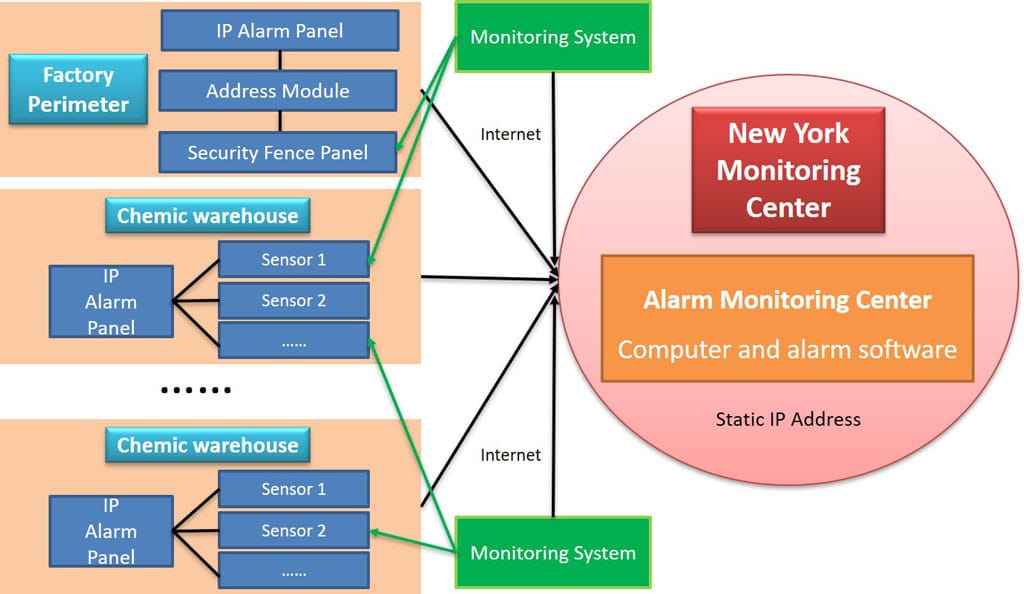
At the heart of the system lies the monitoring software platform—typically a cloud-based or server-client architecture.
Key functions include:
- Real-time alarm display with pop-up video and interactive maps
- Event classification
- Remote device control
- Incident logging and video clip storage
- Reporting and analytics
Operators can view alarms from all sites simultaneously, with linked cameras automatically displaying live footage for instant verification.
5. Monitoring Center Operations
The monitoring center acts as the command center for the entire security network.
Operators can:
- Verify alarms using video and sensor data
- Dispatch response teams
- Notify local authorities
- Contact site managers
A single monitoring center may manage thousands of sites simultaneously, with hierarchical dashboards for regional or business-unit filtering.
4. Designing a Scalable Multi-Site Monitoring Platform
Building a reliable monitoring platform requires thoughtful planning.
Step 1: Assess the Security Scope
Begin by mapping all locations:
- Number of facilities
- Geographic distribution
- Risk levels
- Operating hours
Example:
Retail chains may require different monitoring policies for flagship stores, warehouses, and regional offices.
Step 2: Standardize Security Infrastructure
To simplify operations, enterprises should standardize:
- Alarm panels
- Sensor types
- Communication protocols
- Camera models for consistent video verification
Benefits include:
- Easier maintenance
- Faster deployment
- Simplified training
Step 3: Establish a Central Monitoring Center
Organizations must determine where monitoring will occur.
Options include:
- In-house monitoring center
- Third-party monitoring service
- Hybrid models
A central monitoring facility should include:
- Redundant servers
- Secure network connections
- Trained operators
- Backup power systems
Step 4: Implement Network Communication
Reliable communication is critical.
Best practices include:
- Primary IP transmission
- Secondary cellular backup (dual-path)
- Encrypted data transmission
- Automatic failover mechanisms
This ensures alarms reach the monitoring center even if one network fails. For remote or unmanned sites, 4G/5G becomes the primary path.
Step 5: Integrate Multi-Site Alarm Management Software
The monitoring platform must support:
- Multi-site dashboards
- Hierarchical account structures
- Alarm prioritization
- Remote control capabilities
- Automatic video pop-up and map display
Security teams should be able to:
- Filter alarms by region
- Group sites by business unit
- Quickly identify critical incidents
- Access stored video evidence anytime
Step 6: Develop Standard Operating Procedures
Security incidents must follow clear workflows.
Examples include:
- Alarm received
- System verifies signal and displays linked video + map
- Operator reviews camera or sensor data
- Operator contacts site personnel (if needed)
- Dispatch security response or authorities
Consistency ensures faster and more reliable incident handling. Document these procedures and conduct regular drills.

5. Centralized Alarm Data Analysis
One of the greatest advantages of alarm monitoring systems is data visibility.
Instead of isolated alarm events, organizations gain access to enterprise-wide security intelligence—including video clips and regional patterns.
Security Trend Analysis
Monitoring software can analyze:
- Intrusion frequency
- False alarm rates
- Regional security patterns
- Video-recorded incidents
Example:
A retail chain may discover that certain locations experience repeated after-hours door alarms or that ATM units in certain areas face frequent tampering attempts. Stored video evidence helps confirm patterns and support insurance claims or police reports.
Risk Identification
Alarm data can reveal hidden vulnerabilities:
- Poorly secured entrances
- Unreliable sensors
- Operational mistakes by staff
These insights improve overall security design.
Performance Metrics
Enterprises can measure:
- Alarm response time
- Incident resolution time
- System uptime
- False alarm reduction
This transforms security from a reactive function into a data-driven operation.
6. Remote Arming and Disarming Across Multiple Sites
Remote management is essential for large security networks.
Without it, staff would need to manually configure each alarm system.
Centralized Control Capabilities
Modern monitoring systems allow operators to:
- Arm systems remotely
- Disarm facilities
- Reset alarms
- Change access schedules
- View live video status
This dramatically reduces operational overhead.
Example: Retail Chain Operations
Consider a retail chain with 300 stores.
Without remote management:
Managers must manually arm alarms every night.
With centralized monitoring:
- Stores automatically arm at closing time
- Monitoring center verifies status via software
- Alerts trigger if a store fails to arm
- Operators can override or check video feeds instantly
This prevents human error and improves security compliance.
7. Alarm Verification and False Alarm Reduction
False alarms are a major operational challenge.
Large organizations may receive thousands of alerts each week. Monitoring systems help reduce false alarms through:
- Alarm verification procedures
- Multi-sensor correlation
- Event classification
- Real-time video verification
Important: Video integration is the single most effective way to cut false alarms—operators can confirm an intrusion in seconds instead of guessing.
Example Verification Process
- Intrusion signal received
- Monitoring software automatically displays live video from linked cameras and interactive map location
- System checks additional sensors for correlation
- Operator reviews footage to confirm genuine intrusion
- Only then dispatch response or notify authorities
This prevents unnecessary dispatches and reduces operational costs while providing high-quality evidence for law enforcement and insurance.
8. Operational Efficiency Improvements
Centralized monitoring dramatically improves security operations.
Key efficiency gains include:
Reduced Staffing Costs
Instead of security teams at each location, a central monitoring center manages all sites.
Faster Incident Response
Operators instantly receive alarms—with video—and initiate response procedures.
Standardized Security Policies
All sites follow consistent security procedures.
Simplified Maintenance
Technical teams can troubleshoot systems remotely.
These improvements significantly lower the total cost of security ownership while delivering 24/7 professional burglar alarm protection.
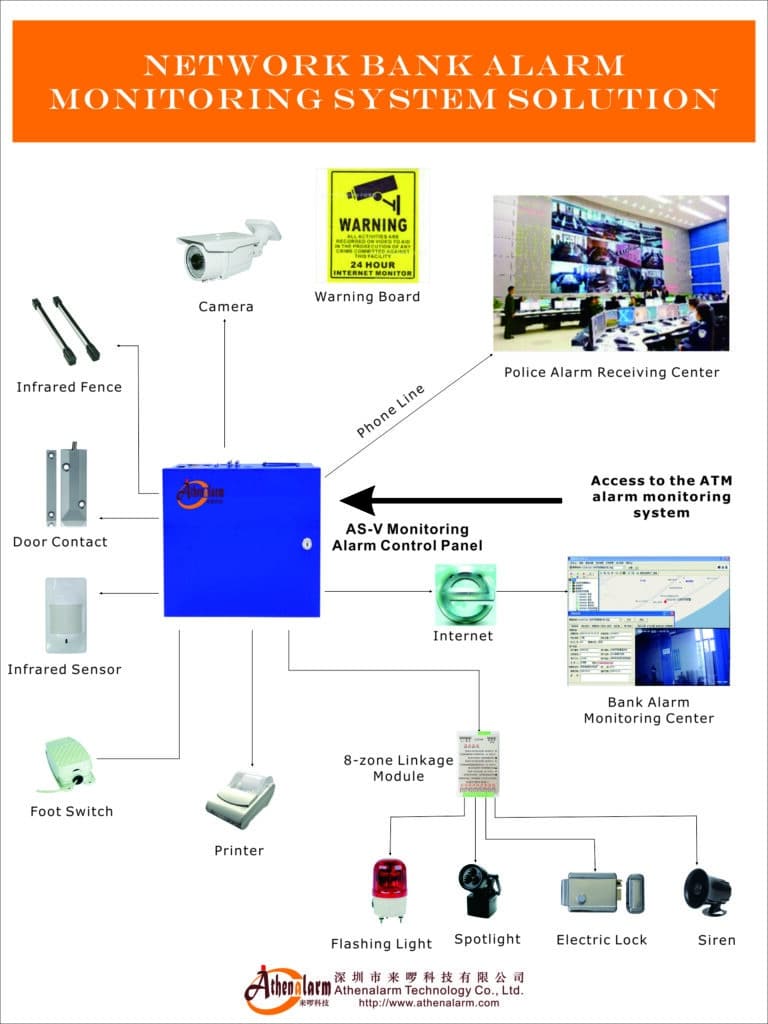
9. Real-World Use Case: Managing a National ATM Network
Consider a bank operating 1,500 ATM machines across multiple cities.
Each ATM cabinet contains sensors monitoring:
- Door openings
- Vibration
- Drilling attempts
- Power failure
Without centralized monitoring:
- Alarms may go unnoticed
- Local staff may respond slowly
With a centralized alarm monitoring system:
- ATM sensors detect tampering
- Alarm signal is transmitted via dual-path (IP + 4G) to the monitoring center
- Operators see automatic video pop-up (if cameras installed) and map location
- Security teams are dispatched immediately
The system also records tampering patterns across regions, enabling banks to identify organized criminal activity and adjust security measures proactively. Stored video clips provide irrefutable evidence for investigations.

10. Best Practices for Deploying Large-Scale Alarm Monitoring Systems
Organizations should follow these guidelines:
- Prioritize System Reliability — Implement redundant communication channels and backup power. Test failover monthly.
- Standardize Equipment — Consistency simplifies operations and maintenance. Choose panels and cameras with proven multi-site compatibility.
- Train Monitoring Operators — Well-trained operators ensure accurate alarm verification using video and maps. Conduct regular drills.
- Use Data Analytics — Security data (including video) should drive operational improvements and predictive maintenance.
- Plan for Future Expansion — Choose monitoring platforms with scalable cloud architecture and hierarchical multi-level support.
- Integrate Video Verification from Day One — Link every critical sensor to a camera to slash false alarms and speed response.
- Address Cybersecurity — Use encrypted transmission, strong access controls, and regular software updates to protect the monitoring platform itself.
- Test and Document Everything — Perform end-to-end system tests quarterly and maintain detailed SOPs and site maps.
Conclusion: The Strategic Role of Alarm Monitoring Systems in Enterprise Security
As businesses expand geographically, security operations become increasingly complex.
Traditional standalone alarm systems are no longer sufficient for protecting large distributed organizations.
A well-designed alarm monitoring system transforms security operations by providing:
- Centralized visibility
- Remote management
- Enterprise-wide analytics
- Faster incident response
- Scalable security architecture
- Real-time video verification and evidence collection
For organizations managing hundreds or thousands of locations, centralized monitoring is not just a technical upgrade—it is a strategic necessity.
Companies that invest in advanced monitoring infrastructure gain a significant advantage: the ability to secure large-scale operations efficiently, intelligently, and reliably.
For security system integrators, distributors, and enterprise decision-makers, understanding how to design and deploy these systems is essential for building modern, resilient security networks focused on effective burglar alarm protection. Start with a thorough risk assessment and a pilot deployment at a few sites—you’ll quickly see the difference a powerful alarm monitoring system can make.