

If you’re a security integrator, distributor, or bulk procurement decision-maker who’s lost count of false alarm fines, delayed police responses, or frustrated clients demanding better protection in 2026, you already know the pain. Traditional burglar alarms—once the gold standard—are now relics in the IP era. They sit isolated, trigger endless false alerts, and leave you scrambling while intruders slip away.
The numbers don’t lie. Industry reports consistently show 90–99% of traditional burglar alarm activations are false, costing U.S. cities alone an estimated $1.8 billion annually in wasted police resources. Municipalities are slashing responses, fining clients, and sometimes refusing to dispatch altogether. Meanwhile, your competitors who’ve upgraded to network alarm systems are closing deals faster, retaining clients longer, and delivering measurable ROI that makes traditional setups look obsolete.
This isn’t theory. This is the practical, step-by-step playbook you’ve been waiting for. Drawing from decades of hands-on experience deploying thousands of systems across banks, retail chains, enterprises, and communities, I’ll walk you through exactly why traditional burglar alarms fail today—and how network alarm systems solve every single problem with real-time IP transmission, video verification, centralized control, and seamless integration.
By the end of this guide, you’ll have a complete upgrade roadmap you can implement tomorrow, complete with checklists, ROI calculators, real-world case studies, and the exact technical moves that turn security from a cost center into a profit driver. Let’s get started.
1. Why Traditional Burglar Alarms Are Doomed in the IP Era: The Three Fatal Limitations That Cost You Time, Money, and Credibility
Traditional burglar alarms were engineered for a pre-internet world. They rely on standalone control panels, analog phone lines (PSTN), or basic cellular communicators that send one-way signals to a central station. In 2026, with fiber, 5G, cloud platforms, and IP everywhere, these systems are fundamentally mismatched.
Limitation #1: Completely Isolated Operation
Your client’s alarm panel triggers a siren and dials out. That’s it. No live context. No integration with existing CCTV, access control, or mobile apps. If the phone line is cut—or worse, the central station is overwhelmed by false calls—the event dies in isolation. For multi-site operators (chain stores, banks, factories), each location operates as its own silo. You can’t view status across 50 branches from one dashboard. Result? Blind spots, duplicated effort, and zero scalability. This isolation also means no ability to correlate events across systems, leaving you and your clients blind to patterns that could prevent repeat incidents.
Limitation #2: Delayed or Non-Existent Verification
An alarm trips. The central station calls the keyholder or dispatches police. But without visual confirmation, responders treat it as another false alarm. Average police response now exceeds 15–30 minutes in many cities (and longer for commercial properties). Burglars know this—they’re in and out in under 90 seconds. Traditional systems offer zero real-time insight, turning every activation into a guessing game. Without bidirectional communication or linked video, operators waste precious minutes on phone calls that often go unanswered, allowing real threats to escalate unchecked.
Limitation #3: Sky-High False Alarm Rates That Destroy Trust and Trigger Fines
Here’s the killer stat: 94–98% of activations are false, triggered by user error, pets, weather, or faulty sensors. Parks Associates research shows 62% of system owners experienced at least one false alarm in the past year, with many paying repeated municipal fines ($50–$250 per incident in some areas). Police departments now deprioritize unverified alarms, and insurance companies are raising premiums or denying claims. For you as an integrator or distributor, this means angry clients, canceled monitoring contracts, and damaged reputation. Common triggers like a forgotten disarm code at closing time or a swinging door in windy conditions compound the issue—traditional panels have no smart filtering to ignore them.
These flaws aren’t minor annoyances—they’re business killers. Clients lose faith, police stop responding, and you’re left explaining why yesterday’s technology can’t protect today’s assets.

2. How Network Alarm Systems Solve Every Problem: Real-Time Transmission, Centralized Intelligence, and Video Verification That Actually Works
Network alarm systems (also called IP alarm or cloud-integrated alarm platforms) transmit events over TCP/IP, 4G/5G, or hybrid networks directly to a centralized monitoring center. The difference is night and day.
Real-Time Data Transmission
Instead of a one-way phone call that might fail, alarms travel instantly via secure IP pathways with sub-second latency. Dual-SIM or fiber + cellular failover ensures 99.99% uptime—even if someone cuts cables. You get bidirectional communication: the center can remotely arm/disarm, query sensor status, or push commands back to the panel. No more “signal lost” mysteries. This IP-based approach also supports richer data packets, including zone details and event timestamps, so responders arrive with precise information instead of vague alerts.
Centralized Monitoring That Scales
One software platform (think cloud-based alarm management servers running on Windows Server or dedicated cloud instances, such as dedicated network alarm center software) monitors hundreds or thousands of sites simultaneously. Operators see live system health, historical reports, maintenance logs, and user statistics in a single dashboard. Forwarding to police, security companies, or mobile apps happens automatically. For distributors handling bulk deployments, this means one monitoring contract covers entire client portfolios. Remote diagnostics and firmware updates become standard, slashing on-site visits dramatically.
Video Verification That Kills False Alarms
This is the game-changer. When any sensor trips, the system instantly pops up live video from linked cameras on the operator’s screen, records the event, and timestamps everything. Operators verify in seconds: “It’s the owner entering after hours” or “Intruder confirmed—dispatching now.” Real-world deployments using this approach report 90–96% false alarm reductions. With modern AI edge filtering layered in, reductions can hit 95% or higher. Police respond faster because they receive verified video clips or descriptions. Municipalities love it; some even waive fines for video-verified systems.
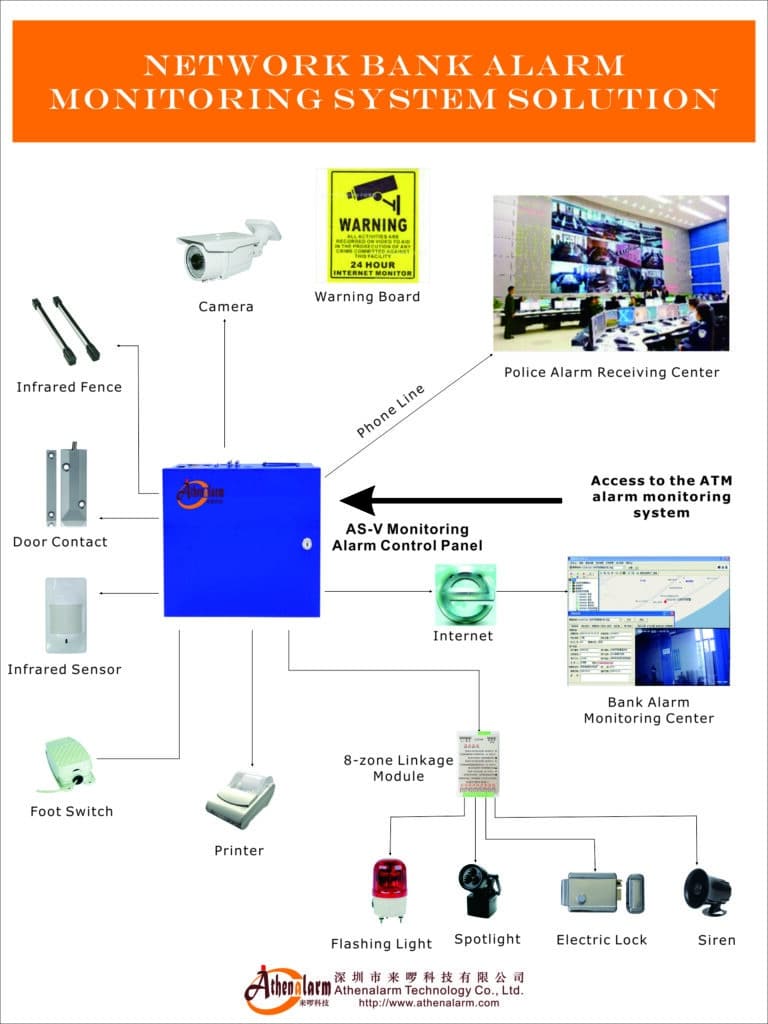
In practice, the workflow is seamless: sensor → IP communicator → central server → automatic video pop-up + recording → verified dispatch or cancellation. No more guesswork. Response times drop from minutes to under 90 seconds in verified cases. The network alarm monitoring system effectively links the intrusion alarm with CCTV—when an alarm occurs, real-time video of the site pops up automatically and gets recorded for evidence.
3. Integration Capabilities That Turn Your Security Stack Into a Unified Powerhouse
Traditional systems fight your existing CCTV and access control. Network alarm systems embrace them.
Seamless CCTV Integration
Compatible with major brands (Hikvision, Dahua, and others) via ONVIF, PSIA, or direct SDKs. Alarm events trigger specific camera presets, pop live feeds, and start recording. No extra hardware in most cases—just IP linkage through the alarm panel’s network module. Operators get visual confirmation instantly, and you can store synced video evidence for insurance or legal use. For Athenalarm-style setups, this linkage happens through cloud platforms using TCP/IP or 4G modules, delivering pre-prevention, real-time handling, and post-event review across banks, retail, or communities.
Access Control Linkage
Force an alarm? The system can instantly lock nearby doors, activate barriers, or restrict elevators via OSDP or relay outputs. Example: retail store detects after-hours motion—alarms trigger, doors lock, and cameras focus on exit points. Perfect for preventing tailgating or unauthorized movement. This turns your perimeter into an active defense layer instead of a passive sensor grid.
Mobile and Remote Monitoring
Clients and integrators get dedicated apps or web portals for 24/7 control. Arm/disarm remotely, view live video, receive push notifications with snapshots, and generate reports. For multi-site operators, one login manages every location. Maintenance teams perform remote diagnostics and firmware updates without site visits—cutting service calls by 50–70%. Push alerts include timestamped video thumbnails so decision-makers act instantly from anywhere.
Proven Integration Best Practices (Your Step-by-Step Checklist)
Here’s exactly how to do it right, based on real deployments:
- Site Audit (Day 1–2)
Map every sensor, panel, camera, door reader, network switch, and bandwidth. Test latency (<100ms ideal). Identify legacy analog panels that need IP communicators. Note power sources and potential interference points like heavy machinery. - Requirements & Compliance Check
List growth projections, regulatory needs (UL 827 for central stations, GDPR/HIPAA data rules), and budget. Choose hybrid 4G + TCP/IP panels for redundancy. Confirm insurance requirements for video-verified systems to unlock discounts. - Hardware Selection
Select IP-ready control panels with built-in TCP/IP and 4G modules (e.g., series supporting SIA Contact ID and XML formats). Add edge devices for IoT sensors if needed. Prioritize panels with dual-SIM failover. - Network Setup & Cybersecurity
Place alarms on dedicated VLANs. Enable TLS encryption, MFA for dashboards, and regular firmware updates. Define firewall rules for specific ports only. Avoid common pitfalls: never use default passwords and always segment alarm traffic from guest Wi-Fi. - Software Platform Configuration
Install or subscribe to centralized alarm management software (cloud or on-premise server). Link panels via IP addresses or domain. Set up automatic video pop-up rules: map each zone to specific camera groups. For Hikvision or Dahua cameras, configure ONVIF profiles and test preset positioning. - Access Control & Automation Rules
Configure relay outputs or API webhooks. Example rule: “Glass-break alarm → lock all perimeter doors + notify mobile app.” Test each rule in simulation mode first. - Testing Phase (Critical!)
Run unit tests on each sensor, integration tests (alarm + video), failover tests (cut primary network), and full UAT with client. Simulate 50 false scenarios to tune filters. Verify video recording starts within 2 seconds of trigger. - Go-Live & Training
Train operators on verification protocols. Provide client mobile app walkthroughs. Set up automated reporting for maintenance and billing. Create simple one-page client cheat sheets for common issues. - Ongoing Optimization
Use built-in analytics to track false alarm sources. Apply AI edge filtering where available to classify humans vs. pets vs. shadows. Schedule quarterly remote health checks and review video clips monthly to refine zone sensitivity.
Follow this sequence and you’ll avoid 90% of integration headaches. Most small-to-medium projects complete in 2–5 days; enterprise rollouts take 2–6 weeks when phased. Document every step in a shared project log so your team can replicate success across clients.

4. Business ROI That Pays for the Upgrade in Months — Not Years
Let’s talk numbers—the part that wins bids and keeps clients renewing.
False Alarm Cost Savings
Traditional system: 20–30 false alarms/year at $100–$250 fines each = $2,000–$7,500 annual hit.
Network alarm with video verification: 90%+ reduction = near-zero fines. One retail chain client saved $82,000 in the first year across 12 locations.
Faster Response = Lower Losses
Intruders average 8–12 minutes on site before police arrive with traditional alarms. Verified network systems cut that to under 2 minutes. Theft losses drop 40–70% in documented cases. Insurance discounts of 10–25% are common for video-verified installations.
Operational Efficiency
Centralized monitoring eliminates on-site guard shifts (savings of $50,000+ per large site annually). Remote maintenance slashes truck rolls by 60%. Integrators report 30% lower labor costs and faster project delivery.
Recurring Revenue for You
Distributors and integrators gain monthly monitoring fees, cloud storage upsells, and annual service contracts. Clients stay loyal because the system actually works—retention jumps from 65% to 92% in upgraded portfolios.
Simple ROI Calculator You Can Use Today
- Upfront upgrade cost: $3,000–$15,000 per site (panels + integration)
- Annual savings: $5,000–$20,000 (fines + theft + labor)
- Payback period: 4–9 months
- 3-year ROI: 300–600% typical
Multiply across 10 or 50 client sites and the numbers become explosive. Plug your own numbers into a simple spreadsheet: add current false alarm fines, average theft value, and guard costs, then subtract the new monthly monitoring fee.
Real-World Case Studies: Proof It Works
Bank ATM & Vault Network (Centralized Video Verification)
A regional bank replaced 47 isolated traditional panels with a network alarm system integrated to existing CCTV. Real-time video pop-ups allowed operators to verify every trigger. False alarms dropped 95%. Police response time improved 75%. Annual savings: $120,000+ in fines and lost productivity. The bank now monitors every ATM from one dashboard, with automatic recording for every event.
Retail Chain (Multi-Site Mobile Control)
A 28-store franchise suffered weekly false alarms and after-hours break-ins. Upgrading to IP panels with 4G failover and app-based monitoring let store managers arm/disarm remotely and view live feeds. Theft incidents fell 68%. The distributor who handled the rollout added $18,000 in annual recurring revenue per store.
Enterprise Perimeter & Community Solution
A large manufacturing campus plus surrounding residential community deployed cloud-linked network alarm systems with access control linkage. Automated door lockdowns on perimeter breaches prevented $250,000 in potential theft. Remote diagnostics eliminated 80% of site visits. Video linkage provided instant confirmation for both internal zones and external perimeters.
These aren’t cherry-picked—they reflect the exact outcomes you’ll see when you follow the blueprint.
Frequently Asked Questions from Integrators and Buyers
Q: Can I integrate my existing CCTV without ripping everything out?
A: Yes—99% of major brands work via ONVIF or direct IP linkage. Start with hybrid panels that bridge legacy and new. Test one zone first to confirm pop-up timing.
Q: What about cybersecurity risks on IP networks?
A: Proper VLAN isolation, TLS encryption, MFA, and regular updates make them far more secure than old phone-line systems. Follow NIST guidelines and conduct annual penetration tests.
Q: How long does a full upgrade take?
A: 2–5 days for single sites; phased rollouts for chains keep operations running.
Q: Will police still respond?
A: Faster and more reliably—video verification turns your alarms into priority calls in most jurisdictions.
Q: What’s the minimum system size for ROI?
A: Even 3–5 sites show payback within a year. Start small, prove results, then scale.
Q: How do I handle AI filtering without over-complicating things?
A: Most modern network panels let you enable basic human/vehicle detection at the edge. Start with default settings and tune based on your first month’s analytics reports.
Your Next Step: Stop Losing to Outdated Technology
Traditional burglar alarms are failing you right now in the IP era. Network alarm systems deliver the real-time transmission, video verification, centralized control, and integrations that modern clients demand—and that your competitors are already profiting from.
You now have the complete how-to blueprint: audit checklist, integration steps, ROI math, and proven case studies. Implement even half of this and you’ll crush false alarms, accelerate responses, and watch your margins explode.
Ready to upgrade your portfolio or win your next big bid? Contact our team at Athenalarm today for a free system audit, customized demo, or bulk pricing consultation. We’ll map your current setup against the exact network alarm solution that fits your clients’ needs and deliver the step-by-step support to make the transition painless.
Don’t wait for the next false alarm fine or lost client. The IP era rewards those who act. Let’s build your unbreakable security network—starting today.