
In the high-stakes world of professional security, your burglar alarm control panel is the unbreakable nerve center of the entire intrusion alarm system. It processes signals from dozens—or even thousands—of sensors, coordinates instant alerts, and keeps critical assets safe around the clock. Yet there’s a silent saboteur that can undermine even the most robust industrial-grade burglar alarm panel: electromagnetic interference, or EMI.
As a senior expert in the burglar alarm industry with decades of hands-on experience designing, deploying, and troubleshooting large-scale intrusion alarm systems for banks, industrial parks, commercial complexes, and government facilities, I’ve seen EMI turn reliable alarm control panels into sources of costly false alarms, missed intrusions, and operational headaches. This isn’t theoretical. In real deployments, EMI from nearby machinery, power lines, wireless transmitters, or even building infrastructure can corrupt communication between the alarm panel and its sensors, destabilize detection loops, and compromise the very heart of your security posture.
This comprehensive guide cuts through the noise. We’ll dissect exactly how EMI attacks burglar alarm control panels and intrusion alarm panels at the signal and hardware levels. More importantly, you’ll get battle-tested, non-generic layout techniques and protection strategies that go far beyond standard installation manuals. These are the practical, implementable steps that security integrators, facility managers, procurement decision-makers, and technical teams use to harden systems against EMI—delivering rock-solid sensor stability and communication integrity.
If you procure, specify, or maintain burglar alarm panels for enterprise environments, this article will equip you with the knowledge to eliminate EMI-induced failures, reduce service calls, and boost system uptime. Let’s turn hidden threats into conquered vulnerabilities.
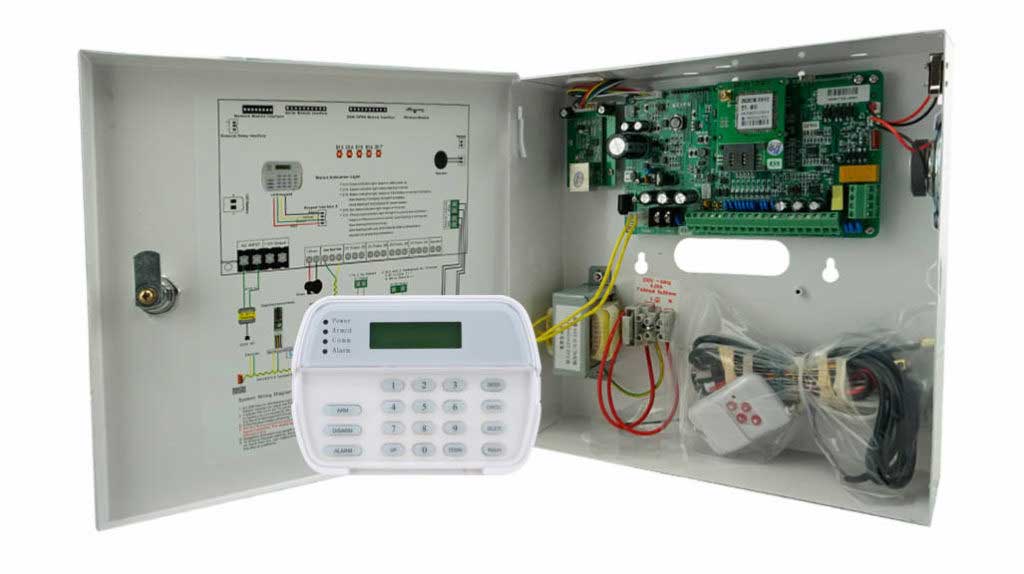
1. The Central Role of the Burglar Alarm Control Panel in Modern Intrusion Alarm Systems
Every effective intrusion alarm system revolves around its burglar alarm control panel (also called the alarm control panel or alarm panel). This is not just a box of electronics—it’s the intelligent hub that receives, processes, and acts on signals from motion detectors, door contacts, glass-break sensors, and perimeter devices. In industrial-grade systems like those supporting up to 1,656 bus zones via addressable modules, the panel orchestrates wired RS-485 loops, wireless 315/433 MHz links, and multi-channel reporting via PSTN, 4G, or TCP/IP.
The panel’s 32-bit ARM microprocessor handles real-time event logging (often 1,500+ events), tamper detection, backup power management, and integration with sirens, keypads, and external outputs. It supports flexible arming/disarming via keypads, SMS, remote apps, or software, and provides scalable protection for multi-site operations. Anti-surge circuits (rated up to 4 kV in premium units) offer baseline resilience, but they don’t address the full spectrum of conducted and radiated EMI that can still penetrate the system. Operating reliably from -10°C to 55°C and 40–70% humidity, these panels are built for demanding environments, yet EMI remains a stealthy threat that can still degrade performance even within these specs.
Why does this matter for EMI? Because the control panel is the single point where all sensor data converges. Any disruption here cascades: a corrupted bus signal can trigger false alarms across an entire floor, or a destabilized wireless link can blind the system to an actual intrusion. In high-security environments—financial institutions, data centers, manufacturing plants—such failures aren’t just inconvenient; they violate compliance standards, erode trust, and expose assets to real risk.
2. Demystifying Electromagnetic Interference (EMI) in Security Environments
EMI is unwanted electromagnetic energy—conducted through wires or radiated through the air—that couples into electronic circuits and disrupts normal operation. In commercial and industrial settings, common sources include:
- Variable-frequency drives (VFDs) and large motors in factories
- Switching power supplies and fluorescent/HID lighting ballasts
- Radio transmitters, Wi-Fi routers, cellular base stations, and nearby broadcast towers
- High-voltage transformers, elevators, HVAC inverters, and renewable energy inverters
- Even internal system components like the panel’s own power supply or adjacent CCTV recorders
EMI manifests in two primary forms relevant to burglar alarm control panels:
Conducted EMI travels along power lines, ground conductors, or signal cables.
Radiated EMI propagates as electromagnetic waves and induces voltages directly into loops, antennas, or unshielded traces.
Unlike surge events (which anti-surge circuits handle), EMI is often continuous or intermittent low-level noise in the kHz to GHz range. It doesn’t always trip obvious breakers but quietly corrupts analog sensor signals, digital bus protocols, or microprocessor timing. In practice, this noise can overlap with the exact frequencies your intrusion alarm panel relies on—such as 315/433 MHz wireless bands or specific LTE bands in 4G modules—making even well-shielded systems vulnerable if not properly hardened.
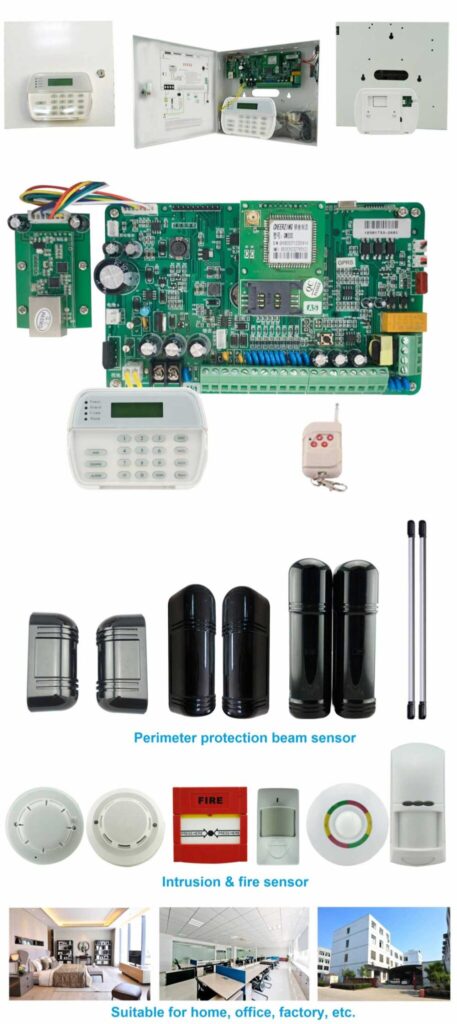
3. How EMI Specifically Disrupts Burglar Alarm Control Panels and Intrusion Alarm Panels
The disruption is insidious because it targets the panel’s core functions: signal acquisition, communication, and decision logic.
Impact on Sensor-to-Panel Communication
Wired zones using RS-485 or similar bus architectures are vulnerable to induced noise on long cable runs. A nearby VFD can inject common-mode voltage that the panel interprets as a zone violation or tamper event. Wireless sensors operating at 315/433 MHz can experience desensitization or packet loss when stronger EMI fields overlap their frequency bands, leading to “silent” zones that fail to report intrusions. For 4G-enabled panels supporting LTE-FDD bands like B1/B3/B5/B8 or LTE-TDD B34/B38/B39/B40/B41, external interference can drop signal-to-noise ratios, delaying multi-channel alerts.
Sensor Stability Degradation
Many intrusion sensors (PIRs, microwave, dual-tech) output analog or pulsed signals. EMI can superimpose noise directly onto these, causing false triggers or complete loss of detection sensitivity. For example, a radiated field near a glass-break sensor’s microphone element can mimic the acoustic signature of breaking glass, flooding the alarm control panel with nuisance alarms. In expandable systems with hundreds of addressable zones, this instability can ripple through the entire loop.
Microprocessor and Logic Instability
The ARM processor in modern burglar alarm panels runs complex firmware for event prioritization and multi-channel reporting. EMI-induced glitches can corrupt memory, cause watchdog timer resets, or scramble the 1500-event log, making forensic analysis impossible. In extreme cases, it leads to panel lockups or erroneous arm/disarm states.
Multi-Channel Reporting Failures
Even when the panel detects an event correctly, EMI can corrupt PSTN lines, 4G modules, or TCP/IP interfaces, delaying or preventing alerts to monitoring centers or mobile apps. This is especially critical in 4G-enabled models supporting specific LTE bands—external interference can drop signal-to-noise ratios below usable thresholds.
Real-world consequence: A manufacturing client once experienced weekly false alarms traced to EMI from an adjacent CNC machine. The burglar alarm control panel logged phantom zone violations, but sensors themselves tested fine in isolation. System downtime for troubleshooting exceeded 40 hours per month until proper mitigation was applied.
4. Deep Dive: Effects on Panel Communication and Sensor Stability
Let’s get technical. Communication stability depends on signal integrity. In a typical RS-485 bus (common in expandable intrusion alarm panels), differential signaling rejects some noise—but not when common-mode EMI exceeds the receiver’s tolerance (often ±7 V). Cable runs exceeding 1,000 meters without proper termination or shielding become antennas, turning your reliable bus zones into unintended receivers of factory-floor noise.
For wireless segments, the Friis transmission equation shows how path loss and interference combine: received power drops when EMI raises the noise floor. Sensors lose margin, leading to intermittent dropouts that the panel may interpret as “trouble” conditions rather than actual alarms. With optional 315/433 MHz frequencies, choosing the less crowded band in your local environment can help—but only if you first map and mitigate surrounding EMI.
Sensor stability is equally fragile. Consider a PIR sensor’s pyroelectric element: it generates microvolt-level signals from IR changes. Induced EMI voltages in the 10–100 mV range (easily picked up on unshielded wiring) overwhelm the amplifier stage, producing erratic outputs that the alarm control panel cannot filter reliably. Dual-tech sensors fare no better when both PIR and microwave channels pick up overlapping interference, leading to compounded false positives.
These effects compound in large-scale deployments. A single EMI source near the main burglar alarm control panel can affect dozens of downstream zones through shared grounding or proximity. In humid or temperature-fluctuating environments (within the panel’s -10°C to 55°C and 40–70% range), EMI coupling can worsen as condensation or thermal expansion subtly alters cable impedance.
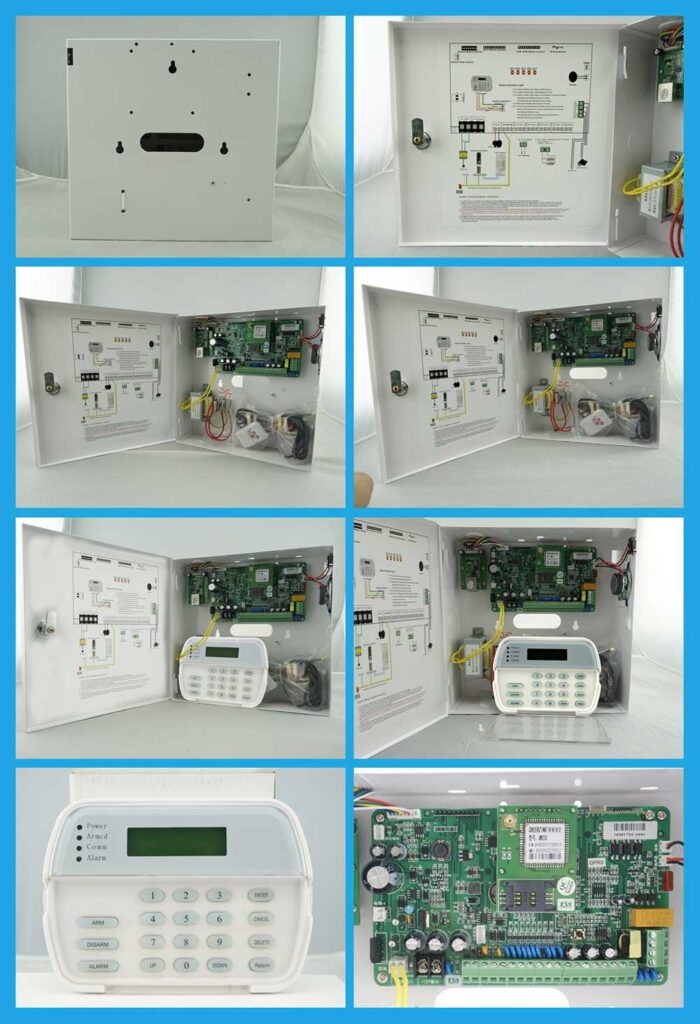
5. Diagnosing EMI Problems in Your Intrusion Alarm System
Before applying fixes, confirm EMI is the culprit. Symptoms include:
- Intermittent or repeating false alarms with no physical cause
- “Trouble” indications on specific zones that clear when the system is powered down and restarted
- Reduced wireless range or frequent supervisory failures
- Corrupted event logs showing timestamps that don’t match actual events
- Panel resets or lockups during peak operating hours of nearby equipment
Practical diagnostic steps:
- Baseline Testing – Arm the system in a controlled “quiet” period (night shift or weekend) and log every event for at least 48 hours.
- Spectrum Analysis – Use a portable EMI meter or spectrum analyzer to scan the installation site for strong fields in the 150 kHz–1 GHz range (common for alarm frequencies). Focus especially on your panel’s wireless bands and 4G frequencies.
- Isolation Testing – Temporarily disconnect zones one by one while monitoring the alarm control panel’s event log and zone status LEDs.
- Power Cycling with Monitoring – Use a data logger on the panel’s power input and sensor lines to capture noise spikes. Compare against the panel’s static consumption current (typically ≤150mA) for anomalies.
- RF Sniffing – Walk the site with a near-field probe to locate radiating sources, paying special attention to areas near VFDs, elevators, or wireless routers.
Document everything with photos, logs, and timestamps. This data becomes your baseline for measuring post-mitigation improvements and satisfies E-E-A-T requirements for professional reporting or compliance audits.
6. Advanced Protection Strategies Beyond Basic Installation
Standard guides tell you to “use shielded cable.” Here are the creative, pro-level tactics that deliver measurable results:
Ferrite Chokes and Common-Mode Filters
Install snap-on ferrite cores (mix 31 or 43 material) on all sensor cables exiting the burglar alarm control panel. For RS-485 runs, add a common-mode choke at both ends. These suppress conducted EMI without affecting legitimate signals. For wireless modules, wrap the antenna coax three full turns.
Active EMI Filters and Surge-Enhanced Suppressors
Layer TVS diodes with gas discharge tubes and EMI filters rated for your frequency band. For 4G modules, use inline RF filters tuned to reject out-of-band noise while passing LTE bands B1/B3/B5/B8 and B34–B41. Combine with the panel’s built-in 4kV anti-surge protection for layered defense.
Optical Isolation for Critical Loops
Convert sensitive zones to fiber-optic or opto-isolated interfaces. This physically breaks the conductive path for EMI while maintaining full functionality—ideal for panels in noisy industrial environments with long bus runs.
Panel Enclosure Upgrades
Replace standard metal cabinets with EMI-shielded enclosures featuring conductive gaskets and honeycomb vents. Ground the enclosure at a single point to the facility’s clean earth to prevent ground loops.
Software-Based Noise Rejection
Modern intrusion alarm panels allow firmware tuning of debounce timers and zone sensitivity. Increase debounce from 500 ms to 2–3 seconds in high-EMI zones to filter transient noise without sacrificing response time. Adjust wireless signal-quality thresholds to ignore marginal packets.

7. Creative Equipment Layout Techniques That Prevent EMI Coupling
This is where most installers fall short—and where you gain competitive advantage. Layout is preventive medicine.
Zoned Separation Architecture
Physically divide the facility into EMI “zones.” Place the main burglar alarm control panel in a dedicated low-noise room (away from electrical rooms, elevators, and machinery). Route zone controllers or expanders closer to their sensor groups, using short local buses and longer backbone fiber if needed. This minimizes cable exposure and keeps addressable modules isolated.
Cable Routing Mastery
- Run all alarm wiring in dedicated metallic conduits separated by at least 12 inches from power cables.
- Cross power and signal lines at 90° angles only.
- Use twisted-pair shielded cable (foil + braid) with the shield grounded at the panel end only—never both ends—to avoid ground loops.
- Avoid cable loops or coils; these act as inductive pickups. Leave 30% spare capacity in conduits for future upgrades.
Grounding Hierarchy for Intrusion Alarm Panels
Implement a single-point star ground for the entire alarm system. Connect the burglar alarm control panel’s ground to the facility’s technical earth (not the noisy power ground). Use heavy-gauge copper strap (minimum 6 AWG) for all bonds. Separate analog sensor grounds from digital bus grounds, joining them only at the panel’s reference point. This preserves the integrity of your 1,656-zone expandable architecture.
Wireless Antenna Placement
Mount external antennas for 4G or wireless sensors on the building exterior, routed through shielded coax with lightning arrestors. Keep internal wireless receivers at least 10 meters from potential EMI sources and test both 315 MHz and 433 MHz options to select the cleaner band.
Panel Orientation and Internal Layout
Inside the enclosure, keep high-speed digital traces (processor bus) away from I/O terminals. Use multilayer PCBs with dedicated ground planes in the panel itself when specifying new units. Position the panel vertically if possible to reduce dust and heat buildup that can amplify EMI effects.
8. Step-by-Step Implementation Guides for EMI Hardening
Guide 1: Retrofitting an Existing Burglar Alarm Control Panel (4–6 Hours)
- Schedule a maintenance window and notify monitoring center.
- Power down the panel and discharge all capacitors (wait 5 minutes).
- Install ferrite cores on every cable entering/exiting the enclosure (minimum 3 turns per core).
- Add inline EMI filters on power input and all communication ports (PSTN, 4G, TCP/IP).
- Re-route sensor cables into new shielded conduits if possible.
- Verify single-point grounding and test each zone for stability using the panel’s built-in diagnostics.
- Monitor event log for 72 hours post-upgrade and compare against your baseline.
Guide 2: New Installation – EMI-Resilient Layout (Full Project)
- Conduct site EMI survey before design.
- Select an industrial-grade alarm control panel with native multi-channel support and expandable bus architecture (look for 32-bit ARM processing and 4kV surge protection).
- Design cable pathways with 30% spare capacity for future shielding upgrades.
- Install the main panel in a dedicated 19” rack or wall cabinet with EMI gaskets.
- Deploy local zone expanders within 100 m of high-sensor-density areas.
- Terminate all shields at the panel only.
- Program zone debounce and sensitivity per EMI risk level using the LCD keypad or software.
- Perform full system commissioning with intentional EMI injection testing (using a calibrated noise generator).
- Document as-built drawings including grounding map and frequency band choices.
Guide 3: Wireless Segment Hardening
- Map existing RF environment with a spectrum analyzer.
- Choose 433 MHz over 315 MHz if local interference is lower (or vice versa) based on your survey.
- Install diversity antennas with automatic failover.
- Enable panel-side signal quality monitoring and set alerts below –85 dBm for early warnings.
9. Real-World Case Studies from the Field
Case 1: Financial Institution
A 24/7 bank branch suffered daily false alarms from EMI generated by nearby subway power lines. After implementing zoned separation and optical isolation on perimeter zones, false alarms dropped 97%. The intrusion alarm panel now logs clean events for compliance audits, with tamper detection and multi-channel reporting functioning flawlessly.
Case 2: Manufacturing Plant
VFD-driven conveyor lines destabilized wireless sensors linked to the burglar alarm control panel. Ferrite arrays plus strategic panel relocation cut supervisory failures from 15/week to zero, while preserving the panel’s 1500-event log for accurate forensics.
Case 3: Multi-Site Corporate Campus
Centralized TCP/IP reporting failed intermittently due to campus Wi-Fi overlap. Upgrading to shielded backbone cabling and dedicated VLANs restored 100% reliability across all sites.
These outcomes translate directly to your bottom line: fewer service dispatches, higher client retention, and stronger bids when you can guarantee EMI-hardened performance.

10. Selecting Future-Proof Burglar Alarm Control Panels and Components
When procuring, prioritize panels with:
- Native support for shielded bus architectures
- Built-in EMI filtering on all I/O
- Expandable to fiber or optical modules
- Comprehensive event logging with signal-quality metrics
- Compatibility with industrial-grade enclosures
Look for certifications beyond basic safety (IEC 62368-1) that include EMC testing (EN 50130-4 for alarm systems). Panels offering 315/433 MHz wireless flexibility and full LTE band support give you the edge in variable EMI environments.
11. Ongoing Maintenance and Monitoring for Long-Term Stability
EMI environments evolve—new equipment gets installed, spectrum usage changes. Schedule quarterly EMI audits, annual grounding integrity tests, and firmware updates. Integrate the burglar alarm control panel’s event log with your central security dashboard for real-time noise trend analysis. Check backup battery health and power supply output (DC 12V–15V) regularly to ensure they don’t become EMI sources themselves.
12. Integrating EMI-Hardened Alarm Panels with Broader Security Ecosystems
A protected burglar alarm control panel becomes the reliable foundation for unified systems. Feed clean events into CCTV, access control, and building management platforms without fear of cascading false triggers. This seamless integration maximizes the value of your intrusion alarm panel across the entire facility.
Conclusion: Turn EMI Vulnerability into Your Competitive Edge
Hidden EMI threats no longer need to compromise your burglar alarm control panel or intrusion alarm panel performance. By applying the advanced layout techniques, shielding strategies, and step-by-step implementations detailed here, you can deliver intrusion alarm systems that operate with military-grade reliability in even the noisiest environments.
Your clients—whether facility managers, security directors, or procurement teams—demand more than basic functionality. They need systems that simply work, day in and day out, without unexplained downtime or false alarms. The professionals who master EMI mitigation win the contracts, reduce liability, and build lasting partnerships.
Ready to harden your next deployment or retrofit an existing installation? Our team at Athenalarm specializes in industrial-grade burglar alarm control panels engineered for exactly these challenges. Contact us today for a free EMI site assessment, custom system design, or quotation on scalable intrusion alarm solutions that conquer interference before it starts.
Protect what matters most. Conquer the hidden threats. Your burglar alarm control panel—and the entire security operation—will thank you.