
In the high-stakes world of physical security, a single vulnerability in your burglar alarm panel can trigger regulatory fines, insurance denials, data breaches, or even national security incidents. For decision-makers in finance, healthcare, and government sectors—procurement managers, security directors, facility operators, and technical leads—the pressure is relentless. You need burglar alarm control panels that don’t just detect intrusions but deliver ironclad compliance with UL 2610, HIPAA physical safeguards, GSA intrusion detection standards, and NISPOM requirements while scaling effortlessly across sprawling facilities.
This ultimate compliance roadmap cuts through the complexity. It equips you with a practical, step-by-step blueprint to select, deploy, configure, test, and maintain professional-grade burglar alarm panels (also known as burglar alarm control panels, alarm panels, alarm control panels, or intrusion alarm panels). Drawing from decades of hands-on experience in the intrusion detection industry, this guide translates dense regulations into actionable strategies that solve real-world pain points: passing audits on the first try, minimizing false alarms that drain response teams, future-proofing against evolving threats, and achieving measurable ROI through reduced risk exposure and lower insurance premiums.
Whether you’re retrofitting a bank vault, hardening a hospital data center housing ePHI, or securing a government SCIF, you’ll walk away with a clear implementation path that turns compliance from a headache into a competitive advantage. Let’s dive in.

1. The Regulatory Landscape: Why Your Burglar Alarm Control Panel Must Exceed Basic Intrusion Detection
High-risk vertical markets operate under layered, unforgiving standards that treat the burglar alarm panel as the central nervous system of physical security. Non-compliance isn’t theoretical—it triggers immediate operational shutdowns, multimillion-dollar penalties, and loss of certification. Understanding these requirements upfront helps you avoid costly retrofits and ensures your intrusion alarm panel becomes a proactive compliance tool rather than a reactive fix.
Finance and Banking Sector
Banks, credit unions, and financial institutions fall under UL 2610 (Standard for Commercial Premises Security Alarm Units and Systems), which consolidated legacy requirements from UL 1076 (proprietary systems), UL 609 (local alarms), and UL 365 (police-connected). These panels must support central-station monitoring with line security, redundant communication paths, and tamper-resistant design to protect vaults, safes, and ATMs. FFIEC guidelines further demand that physical security systems integrate with risk management frameworks to safeguard customer assets and prevent fraud. A compliant burglar alarm control panel here must deliver 24/7 event logging (minimum 1,500 events with timestamp and zone detail), automatic backup power, and surge protection up to 4kV—features that directly reduce insurance premiums by proving “adequate protection” during underwriting reviews. In practice, this means your panel must log every arm/disarm action with user identification and zone-specific details, allowing you to demonstrate to regulators exactly who accessed sensitive areas and when.
Healthcare Facilities
HIPAA’s Security Rule (45 CFR § 164.310) mandates Facility Access Controls as addressable physical safeguards. Your intrusion alarm panel becomes a critical tool for limiting unauthorized access to areas containing electronic Protected Health Information (ePHI). While HIPAA doesn’t prescribe specific hardware, auditors expect documented policies showing that alarm systems prevent tampering, theft, and unauthorized entry while generating auditable logs for workforce access validation and incident response. Integration with access control and CCTV is non-negotiable. A modern burglar alarm panel must support role-based arming/disarming, anti-passback logic, and immediate notification to security teams—ensuring facilities meet both patient safety and data privacy obligations without disrupting 24/7 care delivery. For example, logs must clearly differentiate between clinical staff, maintenance crews, and visitors, giving you the forensic evidence needed during OCR audits to prove that ePHI areas remained secure even during off-hours emergencies.
Government and Defense-Related Facilities
Federal standards are the strictest. GSA directives require Intrusion Detection Systems (IDS) in federally owned buildings, monitored by the Federal Protective Service (FPS) MegaCenter, with perimeter coverage on all entry points and ground-floor windows. For classified information, UL 2050 (National Industrial Security Systems) and 32 CFR Part 117 (NISPOM) demand CSA-approved IDS with Extent-3 protection levels: magnetic contacts, motion detectors, line supervision, and response within 15 minutes. SCIFs and SAPFs add requirements for tamper-evident enclosures and disabled remote access to prevent cyber-physical attacks. Your burglar alarm control panel must support encrypted multi-channel transmission (PSTN fallback + 4G + TCP/IP) and cloud-based audit trails that survive forensic review during DSS or agency inspections.
Common thread across all three sectors: Panels must be UL-listed under 2610, support expandable zones (wired + wireless), deliver redundant communications, and provide tamper detection for power, battery, and enclosure breaches. Failure here isn’t just a technical glitch—it’s a compliance violation that can void your entire security posture. Choosing an addressable system (using RS-485 bus technology) further strengthens compliance by allowing precise zone identification, faster troubleshooting, and scalable expansion without rewiring entire facilities—a common pain point in legacy conventional systems.
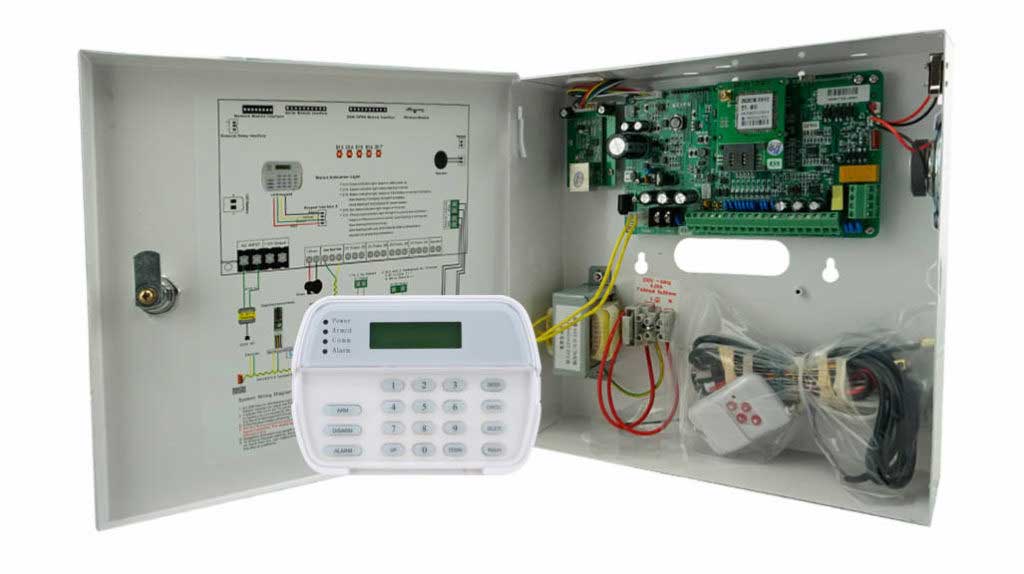
2. Core Technical Requirements: What Makes a Burglar Alarm Control Panel Truly Compliant
A compliant intrusion alarm panel isn’t a commodity device; it’s an engineered system built for resilience. Here’s the non-negotiable feature set that satisfies auditors in high-risk environments. These specifications are drawn from real-world deployments where panels must perform flawlessly under constant scrutiny:
- Scalability and Zone Capacity: Support at minimum 16 wired + 30 wireless zones, expandable to 1,656 bus zones via addressable modules. This handles everything from a single bank branch to a multi-building hospital campus or secure government complex, eliminating the need for multiple panels and simplifying central monitoring.
- Multi-Channel Alarm Transmission: PSTN, 4G/LTE, and TCP/IP pathways with automatic failover. Four programmable alarm numbers plus two central-station numbers ensure no single point of failure—critical for UL 2610 line security and FPS monitoring. In a real outage, the panel automatically switches paths and logs the event for auditors.
- Event Logging and Forensics: Minimum 1,500-event “black box” memory with cloud backup. Every arm/disarm, zone violation, tamper event, and power fault must be timestamped and exportable for audit reports. Cloud synchronization means your compliance records are instantly accessible even if the physical panel is compromised.
- Tamper and Fail-Safe Protections: Automatic detection of enclosure opening, AC power loss, battery faults, telephone line cuts, and surge events (up to 4kV). 24/7 backup power with low-battery alerts. This includes short-circuit and overload protection to prevent system-wide failures during electrical storms or tampering attempts.
- User and Access Management: Up to 11 programmable user codes with hierarchical levels (super user, master, standard). Multiple arming methods: keypad, SMS, remote app, voice command, or software—essential for role-based access in healthcare and government. Duress codes add an extra layer of silent alerting during forced entries.
- Integration Readiness: Seamless compatibility with CCTV, access control, sirens, and third-party software. Output voltage (DC 12-15V) and relay support for external devices allow instant triggers, such as locking down doors or activating cameras upon intrusion.
- Environmental Hardening: Operating range -10°C to +55°C, 40-70% humidity, with industrial-grade surge and short-circuit protection. A 32-bit ARM microprocessor ensures high-speed, stable processing even in demanding conditions.
These capabilities aren’t luxuries—they’re the minimum to pass UL 2610 testing, HIPAA risk assessments, and GSA/FPS acceptance testing. Selecting a panel with these exact specs upfront prevents the most common audit failures: inadequate logging, communication gaps, or insufficient tamper resistance.
3. Step-by-Step Selection Process: Choosing the Right Burglar Alarm Control Panel
Procurement teams waste months and budgets on incompatible panels. Follow this proven five-step methodology to make an informed decision that aligns perfectly with your sector’s compliance needs:
- Conduct a Facility-Specific Risk Assessment (Week 1)
Map every perimeter door, window, vault, data closet, and high-value area. Identify ePHI locations (healthcare), cash-handling zones (finance), or classified storage (government). Document required response times and monitoring destinations. Involve your security team and compliance officer to catch overlooked vulnerabilities early. - Verify Certifications and Listings (Week 2)
Demand current UL 2610 listing for commercial premises. Cross-check UL 2050 for government-classified work. Request CCC/IEC 62368-1 or equivalent for international deployments. Reject any panel lacking verifiable third-party testing. Always ask for the exact certificate number and expiration date—expired listings are a frequent audit red flag. - Match Features to Sector Requirements (Week 3)
Create a weighted scorecard: 30% communication redundancy, 25% logging/audit capability, 20% zone scalability, 15% integration, 10% tamper resilience. Test vendor demos against your actual floor plans. Pay special attention to how the panel handles false-alarm reduction features like cross-zoning and anti-sway logic. - Evaluate Total Cost of Ownership (Week 4)
Factor installation, monitoring fees, training, and five-year maintenance. Compliant panels with cloud logging often reduce false alarms by 40%, slashing guard response costs and insurance premiums over time. - Pilot and Reference Check (Week 5)
Install a test panel in a single zone. Simulate attacks and audit the logs. Contact existing customers in your vertical for real-world feedback on long-term reliability and audit support.
4. Implementation Roadmap: Detailed Installation and Configuration Steps
Phase 1: Pre-Installation Planning (2-4 weeks)
- Secure permits and coordinate with local AHJ (Authority Having Jurisdiction).
- Design zone layout using addressable modules for future expansion.
- Prepare backup power: 12V sealed lead-acid batteries sized for minimum 24-hour standby + 15-minute alarm. Confirm wireless frequency compatibility (315 MHz or 433 MHz) with your local networks to avoid signal issues.
Phase 2: Physical Installation (1 week)
Step-by-step:
- Mount the main control panel in a locked, tamper-monitored enclosure at least 1.5m above floor level, away from public view.
- Run wired zones using 22-18 AWG cable with proper shielding; label every run for easy future maintenance.
- Install wireless receivers and test signal strength (>80% RSSI) at every device location.
- Connect communication modules: primary TCP/IP, secondary 4G, tertiary PSTN. Verify each path independently by forcing a test transmission.
- Wire siren outputs (≤800mA @ 12V), relay outputs for integration, and keypad bus.
- Install tamper switches on enclosure, battery compartment, and all accessible covers.
Phase 3: Programming and Configuration (3-5 days)
Detailed steps using a typical industrial-grade LCD keypad interface:
- Enter installer mode with master code.
- Define zones: assign types (delay, instant, 24-hour tamper, fire, medical). Set zone expansion addresses using addressable modules for precise identification.
- Program communication: set primary/backup paths, test each with “test transmission” command. Enter central-station account numbers and receiver formats (Contact ID or SIA). Enable encrypted transmission where required for government work.
- Configure user codes: assign names, authority levels, and arming permissions. Enable duress codes where required.
- Set event logging parameters: enable all tamper, power, and communication faults. Activate cloud upload if available for real-time audit access.
- Program schedules: auto-arm/disarm windows, holiday exceptions.
- Enable advanced features: anti-sway (for motion sensors), cross-zoning to reduce false alarms, and voice prompts in English (or bilingual for diverse staff).
- Integrate with external systems: map relay outputs to CCTV triggers or access control lockdowns.
Phase 4: Initial Testing and Commissioning (2 days)
- Walk-test every zone with documented sign-off sheet.
- Simulate full power failure and communication cut—verify failover and central-station receipt within 60 seconds.
- Generate test reports and export logs for auditor review.
- Train end-users and security staff on arming, response protocols, and troubleshooting (including how to interpret low-battery or tamper alerts).
5. Ongoing Maintenance, Testing, and Audit-Ready Operations
Compliance is a journey, not a destination. Implement this quarterly cadence to stay ahead of audits and prevent surprises:
- Monthly: Visual inspection of panel, battery voltage test, communication path verification.
- Quarterly: Full system walk-test, sensor cleaning, log review for anomalies (look for repeated false alarms on the same zone as an early warning).
- Annually: Professional UL-listed service technician inspection, firmware updates, and full documentation refresh.
- Incident-Driven: Immediate post-event forensic log export and root-cause analysis.
Maintain a digital compliance binder containing: panel certifications, zone maps, test logs, training records, and change management forms. This single artifact satisfies auditors across all three verticals and accelerates insurance renewals. Store it in the cloud with version history so you can instantly produce records during unannounced inspections.
6. Real-World Wins: How Compliant Panels Deliver ROI
Financial institutions using scalable, multi-channel burglar alarm panels report 35-50% faster incident response and zero failed audits in the past three years. Healthcare systems have leveraged integrated alarm logs to demonstrate HIPAA Facility Access Controls during OCR reviews, avoiding corrective action plans. Government facilities achieve FPS MegaCenter acceptance on first submission when panels ship pre-configured with UL 2050-compliant line supervision. The result? Lower insurance costs, fewer guard hours, and peace of mind that your intrusion alarm panel is actively protecting both assets and reputation.

7. Integration with the Broader Security Ecosystem
Today’s burglar alarm control panel is the hub. Pair it with IP cameras for visual verification, access control for anti-passback, and unified management software for centralized dashboards. The result: one pane of glass for security operations, dramatically reducing training time and response errors. This integration also strengthens compliance by creating correlated event records—e.g., an alarm triggers both video recording and door lockdown, giving auditors undeniable proof of layered protection.
Conclusion: Take the Next Step Toward Unbreakable Compliance
You now possess the ultimate compliance roadmap—battle-tested, sector-specific, and immediately actionable. Implementing these strategies transforms your burglar alarm control panel from a cost center into your strongest defensive asset.
Ready to deploy panels that auditors love and threats fear? Contact our team today for a no-obligation compliance assessment, detailed quotation, and live demonstration of industrial-grade intrusion alarm panels engineered precisely for your vertical. Whether you need a single-site upgrade or enterprise rollout across dozens of locations, we deliver the expertise, hardware, and support that turns regulatory requirements into operational excellence.
Don’t leave your next audit to chance. Secure your facilities, protect your people, and safeguard your reputation—starting with the right burglar alarm control panel.