

Introduction
In recent years, healthcare facilities have become increasingly vulnerable to a wide range of security threats — from theft of high-value medical equipment and violent incidents in emergency departments to cyber-physical breaches targeting connected devices. According to the International Association for Healthcare Security & Safety (IAHSS), hospitals reported a 30% rise in security incidents globally over the past five years.
As a seasoned security expert with over 15 years of experience deploying intelligent protection systems in high-stakes environments, I have witnessed firsthand how integrated smart security solutions are transforming the way medical institutions ensure safety, compliance, and operational efficiency.
This Healthcare Security Case explores a real-world implementation of intelligent security technologies in a mid-sized hospital setting. It aims to educate healthcare administrators, IT professionals, and security managers on practical strategies to overcome modern security challenges — and deliver measurable improvements in both safety and compliance.
Background on Healthcare Security Challenges
Healthcare environments are uniquely complex. Unlike corporate or industrial sites, hospitals must remain open and accessible while protecting sensitive areas such as pharmacies, ICUs, and data centers. The most common challenges include:
- Patient Privacy Breaches: Unauthorized access to electronic health records (EHRs) or surveillance misuse can violate privacy laws such as HIPAA (U.S.) or GDPR (EU).
- Unauthorized Physical Access: Restricted areas like operating theaters and medication storage are frequent intrusion targets.
- Staff Safety Risks: Instances of workplace violence and aggressive patient behavior continue to rise.
- Asset Protection: Theft of portable diagnostic devices and controlled substances results in significant financial losses.
Traditional measures such as static CCTV, guards, or mechanical locks often fall short in dynamic healthcare environments. They lack real-time intelligence, automation, and integration — all critical in reducing false alarms and improving incident response times.
If you are facing challenges like inefficient monitoring, high false alarm rates, or delayed emergency response, this case will provide actionable solutions to help you modernize your healthcare security strategy.
Case Study Overview
Institution Profile:
A 600-bed metropolitan hospital in Southeast Asia, serving approximately 1,200 outpatients daily.
Challenges Before Deployment:
- Multiple unauthorized entries into controlled areas (e.g., pharmacy and data storage rooms).
- Security staff unable to monitor over 500 camera feeds efficiently.
- Incident reporting delays averaging 10 minutes per event.
- Increasing theft of portable ultrasound devices and tablets.
Stakeholders Involved:
Hospital administration, IT & networking team, third-party security vendor, and a compliance officer ensuring adherence to healthcare privacy standards.
The hospital sought a scalable intelligent security system capable of integrating video analytics, alarm monitoring, and access control — while maintaining patient privacy and regulatory compliance.
Intelligent Security Solutions Implemented
1. AI-Powered Video Surveillance
High-definition IP cameras were upgraded with AI analytics for anomaly detection — automatically identifying loitering, aggression, and unauthorized access. The system uses privacy filters to blur patient faces in real time, maintaining compliance with healthcare privacy regulations.
2. Biometric Access Control
Fingerprint and facial recognition terminals were installed at restricted zones such as laboratories, pharmacies, and server rooms. Access events are logged into a centralized database linked to employee ID systems for traceability.
3. Integrated Alarm and IoT Sensor Network
IoT-based motion and door sensors trigger alarms and notify security staff through a centralized command dashboard. Environmental sensors (temperature, smoke, and gas) were also linked to emergency systems for cross-domain situational awareness.
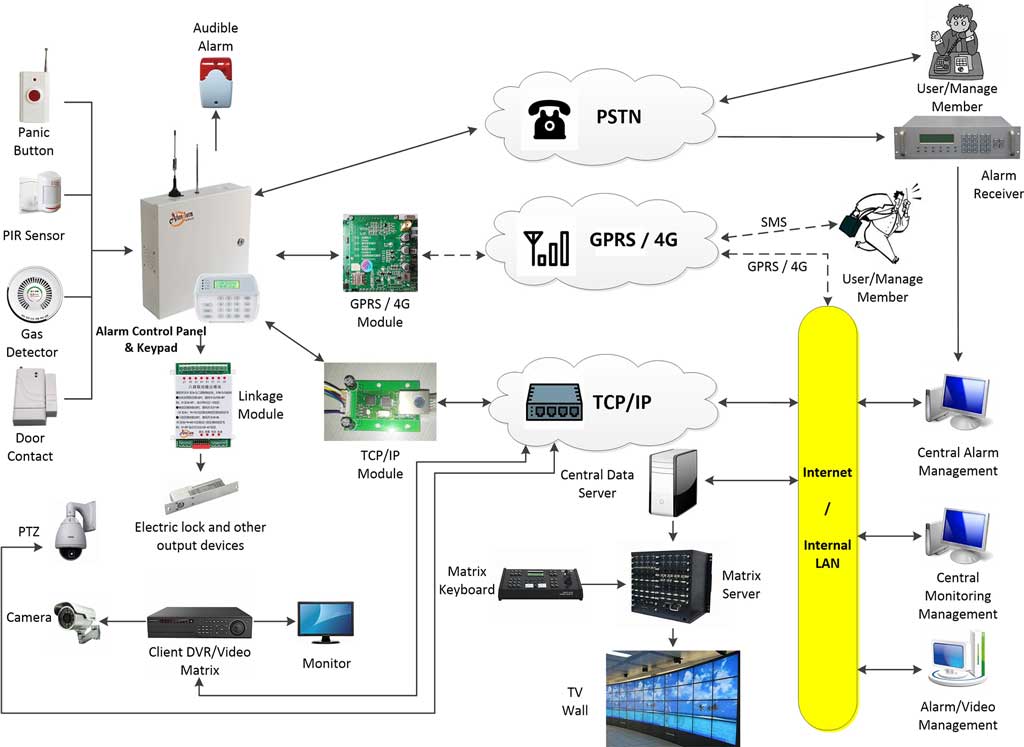
4. Cloud-Based Monitoring and Reporting
All systems were unified under a secure cloud platform that offers real-time monitoring, automatic alerts, and incident analytics accessible from both desktop and mobile devices.
Vendor Selection Criteria:
- Scalability for future facility expansions
- Data encryption and regional compliance
- Low false-alarm rates (<3%)
- Easy integration with existing IT systems
For readers evaluating similar solutions, always begin with a risk assessment, map your critical zones, and define measurable KPIs (incident reduction rate, response time, false alarm percentage) before selecting technologies.
Implementation Process
The hospital followed a structured five-phase deployment plan:
- Assessment: Comprehensive audit of existing security infrastructure and high-risk zones.
- Planning: Design of integrated architecture linking cameras, sensors, and access systems.
- Deployment: Gradual installation during low-traffic hours to minimize patient disruption.
- Testing: 14-day pilot program with controlled intrusion and emergency simulations.
- Go-Live: Full activation followed by staff training and fine-tuning of alert parameters.
Challenges Faced and Solutions
- Minimizing Patient Disruption: Nighttime installations and modular rollouts.
- Staff Resistance: Hands-on workshops and incident response drills increased adoption.
- Data Integration Issues: Custom API bridges were built to sync access control with hospital HR systems.
Best Practice Tip: Always involve clinical staff and IT administrators in training. Their operational insights ensure smooth alignment between technology and daily workflows.
Results and Measurable Outcomes
Quantitative Outcomes (after 6 months):
- 42% reduction in unauthorized access incidents
- 25% faster average response time
- 60% decrease in false alarms
- ROI achieved within 14 months through loss reduction and labor optimization
Qualitative Outcomes:
- Improved staff morale and sense of safety
- Enhanced patient trust due to visible yet discreet protection measures
- Positive compliance audit feedback, reducing potential liability risks
Reader Tool:
Use a simple tracking matrix to measure impact:
| Metric | Before | After | Improvement |
|---|---|---|---|
| Incident Count | 50/month | 29/month | 42% ↓ |
| Average Response Time | 10 min | 7.5 min | 25% ↓ |
| False Alarm Rate | 12% | 4.8% | 60% ↓ |
Lessons Learned and Best Practices
- Integrate, Don’t Isolate: Ensure cameras, alarms, and access systems share data for unified situational awareness.
- Balance Privacy and Security: Implement AI that anonymizes patient visuals while maintaining analytical accuracy.
- Future-Proof Your System: Choose platforms that support AI updates, remote diagnostics, and 5G connectivity.
- Avoid Over-Reliance on Tech: Human oversight remains vital; technology should enhance, not replace, professional judgment.
Emerging Trend: Expect deeper integration between telemedicine platforms and physical security systems, enabling cross-domain threat response and predictive analytics.
For readers, consider conducting quarterly security audits using a structured checklist to sustain performance and compliance.
Conclusion
This Healthcare Security Case demonstrates that intelligent, integrated security solutions can transform hospital safety while optimizing costs and compliance. By embracing AI-powered analytics, IoT-driven alarms, and centralized monitoring, medical institutions can shift from reactive to proactive protection — creating a safer environment for both patients and staff.
If you manage or advise a healthcare facility, now is the time to assess your existing systems, identify integration gaps, and plan for intelligent upgrades. Explore more Deployment Case Studies on our site for practical examples and expert insights.
Proactive security isn’t just protection — it’s care extended beyond treatment.