
Modern organizations rely heavily on interconnected security technologies—CCTV, intrusion alarms, access control, analytics platforms, and building automation. Yet without proper integration, these systems operate as isolated islands, creating blind spots and response delays. Industry breach analyses reveal that over 65% of alarm-related failures stem from poor system interoperability, misconfigured network paths, or untested integrations—weaknesses that are completely avoidable.
This guide provides security integrators, IT managers, and facility operators with expert strategies to design, deploy, and maintain cohesive alarm ecosystems. From interoperability frameworks and cybersecurity safeguards to scalability planning and real-world troubleshooting, it covers how to avoid costly integration mistakes and build a resilient alarm network.

1. Introduction
In today’s security environments, intrusion alarms no longer function as standalone systems. They exist within a broader ecosystem that includes IP cameras, access control, video analytics, and building management infrastructure. A poorly integrated alarm system can create significant vulnerabilities—delayed responses, mismatched event data, or inconsistent logs—undermining an organization’s entire security posture.
Network alarm systems refer to IP-based intrusion detection platforms that transmit data across standard network infrastructures (LAN/WAN, VPN, cloud). When properly integrated, they enable:
- Faster response times through correlated event data
- Reduced false alarms via cross-validation mechanisms
- Centralized monitoring across multi-site environments
- Automated workflows—for example, door lockdowns triggered by intrusion alerts
By following the strategies in this guide, readers can design robust, future-ready alarm networks aligned with enterprise security goals, overcoming common pain points such as fragmented legacy systems, vendor incompatibility, cybersecurity gaps, and scalability concerns.
2. Network Alarm System Fundamentals
A successful integration begins with understanding how network alarm systems are structured and how each component interacts within a security environment.
2.1 Key Components
Hardware Layer
- Intrusion sensors (PIR, magnetic contacts, glass-break detectors)
- Alarm control panels (system configuration interface)
- IP communicators / gateways (network connectivity bridge)
- Edge devices (IoT sensors using MQTT or CoAP)
Software Layer
- Alarm management platforms
- Cloud-based monitoring dashboards
- API middleware
- Mobile alarm applications
2.2 Communication Protocols and Technologies
| Protocol / Technology | Use Case | Key Characteristic |
|---|---|---|
| IP/TCP & UDP | Baseline alarm event transport | Reliable / low-latency transmission |
| MQTT | Lightweight IoT sensor messaging | Extremely low bandwidth consumption |
| RESTful APIs / Webhooks | Integration with VMS, access control, SIEM | Standardized and easy to connect |
| Cloud vs. On-premise | Based on compliance and latency requirements | Flexibility vs. data sovereignty |
| ONVIF / PSIA | Video surveillance and physical security interoperability | Open standards, vendor-neutral |
2.3 Integration Types
Hybrid Integration combines analog and IP systems, making it ideal for environments that want to upgrade gradually while protecting existing investments.
Full IP Integration delivers a completely networked system with the highest scalability and flexibility—the optimal choice for commercial environments.
2.4 Typical Challenges
- Legacy analog panels lacking IP support
- Incompatible vendor-proprietary protocols
- Incomplete or undisclosed API documentation
- Insufficient network bandwidth for data transmission

3. Pre-Integration Planning and Assessment
The quality of pre-integration planning determines roughly 70% of a project’s ultimate success. Below is the structured assessment approach adopted by leading security integrators.
3.1 Conduct a Full Site and Infrastructure Audit
- Inventory existing sensors, alarm panels, network switches, and VMS platforms
- Map communication paths (LAN/VLAN/WAN) and network topology
- Review current cybersecurity posture
- Measure bandwidth and latency—ensure network capacity supports data traffic
- Verify hardware compatibility—confirm new components integrate seamlessly with existing systems
3.2 Requirements Gathering
Before committing to an architecture, clarify the following dimensions:
Growth Projection: Will the system expand to more sensors or additional sites? Design for modular architecture from the outset.
Compliance Requirements: Does the deployment involve GDPR (EU data privacy), HIPAA (U.S. healthcare alarm data), or UL 294/639 certifications? Use compliant cloud services accordingly.
Budget Constraints: Account for hardware upgrades, software licenses, cabling, and cloud subscriptions. A phased deployment strategy can reduce upfront risk.
3.3 Risk Assessment and Redundancy Planning
High-priority actions before any integration begins:
- Penetration testing and vulnerability scans
- Backup communication paths (4G/5G failover)
- Server redundancy for monitoring platforms
- Disaster recovery planning
Identify potential failure points early—addressing network security gaps, hardware limitations, and insufficient redundancy at the planning stage costs far less than fixing them after go-live.
4. Six Core Best Practices for Network Alarm System Integration
Best Practice 1: Ensure Compatibility and Standardization
Why it matters: Most integration failures originate from vendor lock-in or incompatible protocols. Failing to verify API documentation before purchase is the leading cause of costly rework.
How to apply:
- Adopt open standards: ONVIF, PSIA, SIA DC-09, SIA OSDP
- Verify API documentation completeness before procurement
- Use integration platforms such as Milestone MIP SDK or Genetec SDK
- Test compatibility in a lab environment before full deployment
- Prioritize vendors whose products comply with ONVIF/PSIA standards
Troubleshooting tip: If legacy systems lack IP capability, use protocol converters or IP communicators as a bridging solution—no full hardware replacement required.
Best Practice 2: Prioritize Cybersecurity at Every Layer
Why it matters: Alarm systems are increasingly targeted due to weak network protections. A successful intrusion can allow attackers to disable alarms, falsify logs, and move laterally through the network.
Key strategies:
- Enforce TLS/SSL encryption for all data in transit
- Enable multi-factor authentication (MFA)
- Isolate alarm systems in dedicated VLANs
- Apply NIST SP 800-53 or NIST Cybersecurity Framework guidelines
- Conduct regular firmware updates and penetration testing
- Configure firewalls to prevent unauthorized access
- Schedule periodic cybersecurity audits to identify emerging vulnerabilities
Common issue: Misconfigured firewalls blocking alarm traffic. Solution: explicitly define allowed ports, IP addresses, and QoS rules to ensure alarm traffic receives highest priority.
Best Practice 3: Design for Scalability and Redundancy
Why it matters: A good integration remains functional during growth or unexpected outages. Systems designed only for current scale often incur heavy costs when expansion is needed.
Recommendations:
- Use modular system architecture to support independent component upgrades
- Adopt server clustering or cloud-based monitoring for high availability
- Deploy failover network paths (fiber + LTE backup)
- Select hardware that supports firmware-based feature expansion
- Evaluate cloud-based solutions for scalable monitoring and control
Real-world example: A retail chain deployed redundant alarm gateways, achieving 99.99% uptime across 120 stores while reducing annual maintenance costs by 35%.
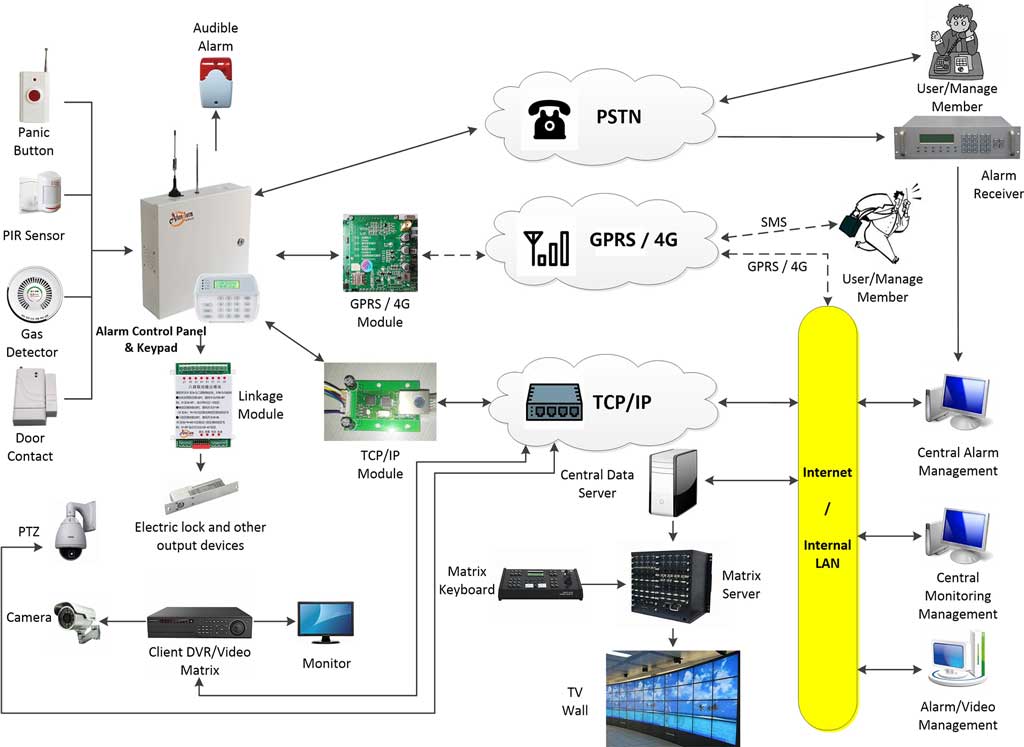
Best Practice 4: Integrate with Centralized Monitoring Platforms
Why it matters: Centralized monitoring increases situational awareness, reduces operator workload, and enables cross-system event correlation.
Recommended platforms:
- Genetec Security Center
- Milestone XProtect
- Honeywell Pro-Watch
- Bosch BIS
Core integration features:
- Real-time alarm-to-video verification—cameras automatically display when an alarm triggers
- Automated workflow actions (door locking, notifications, system-wide responses)
- Unified audit logs across all subsystems
- Cross-system alarm correlation—door forced open + motion detection = priority response event
Best Practice 5: Optimize Data Flow and Analytics
Why it matters: Future-ready alarm systems use data intelligently rather than relying solely on rule-based triggers.
Methods:
- Use AI/ML to analyze behavioral patterns and significantly reduce false alarms
- Implement edge computing for faster local processing and lower latency
- Correlate alarms with video analytics for event validation
- Implement remote diagnostics to troubleshoot issues without on-site visits
- Regularly update firmware and software to address known vulnerabilities
Real-world example: Factories using AI-enabled detection sensors reported up to 70% false alarm reduction after integration, significantly lowering operator fatigue and response costs.
Best Practice 6: Execute Rigorous Testing and Validation
Why it matters: Thorough testing catches problems before go-live, preventing catastrophic failures during actual alarm events.
Test phases:
- Unit testing—validate each device or API endpoint independently
- Integration testing—verify multi-system coordination and event flow
- Failover testing—confirm redundant paths actually activate and minimize data loss
- Latency testing—ensure transmission speed does not delay alarm response
- User acceptance testing (UAT)—operators validate the system under realistic scenarios
Common issues and fixes:
- Alarm delays → optimize routing and reduce network hops
- Duplicate alarms → adjust event filtering logic and configure suppression rules
5. Common Challenges and Solutions
Legacy Analog Systems Analog panels lacking IP support cannot connect to modern networks. Use IP communicators as a bridge, or upgrade to hybrid systems that support both analog and IP—protecting existing hardware investments while enabling network connectivity.
Vendor Incompatibility Deploy middleware for protocol translation, or procure hardware compliant with ONVIF/PSIA standards to ensure interoperability from the outset.
High Integration Costs Adopt a phased deployment strategy to spread costs over time. Leverage open-source tools such as ZoneMinder where appropriate, and consider bulk purchasing of networked components to reduce per-unit costs.
Operator Training Gaps Provide SOP-based systematic training and schedule regular simulated alarm scenario exercises to build operator confidence and reduce response errors.
Cybersecurity Threats Encrypt all alarm signals, enforce firewall-based network segmentation, and conduct regular security audits. Use GDPR/HIPAA-compliant cloud services and maintain comprehensive encrypted audit trails.
Scalability Issues Adopt cloud-based solutions for elastic scaling, and implement modular architecture from the design phase to accommodate future growth without performance degradation.
Real-world result: A commercial building that integrated its alarm system with video surveillance and access control achieved a 40% reduction in incident response time and a 30% reduction in operator workload, alongside a significant drop in annual false alarm rates.

6. Advanced Considerations and Future Trends
Emerging Technologies
AI-driven analytics and edge computing are fundamentally changing the alarm system landscape. AI analyzes behavioral patterns and detects abnormal activity with greater accuracy—this is not merely an optimization, but a paradigm shift in how alarm systems operate.
Three technology vectors are reshaping the field:
AI Analytics continuously learns and adapts to environmental changes, dramatically reducing false positives while improving detection accuracy.
Edge Computing enables local processing that lowers latency and reduces dependence on cloud connectivity, critical for environments where response speed is paramount.
IoT Sensor Networks continue to increase in density, enabling more granular monitoring coverage across increasingly complex environments.
Cost-Benefit Analysis
For procurement decision-makers, evaluating ROI is essential. Key ROI drivers include:
- Reduced security personnel requirements through centralized monitoring
- Lower false alarm handling costs through AI filtering and video verification
- Loss avoidance from faster incident response
- Maintenance cost savings over the system lifecycle
Bulk purchasing of networked components may reduce upfront costs, but the long-term savings on maintenance and upgrades are often more significant.
Sustainability
Energy-efficient networked alarm systems help reduce operational costs while meeting corporate sustainability goals. IP-based systems typically consume less copper cabling than traditional analog systems, and remote management capabilities reduce the need for on-site maintenance visits.
7. Implementation Tools and Resources
Integration Management Software
Honeywell Pro-Watch — Enterprise-level integration platform, suitable for large-scale multi-site deployments.
Genetec Security Center — Unified security platform combining video, access control, and alarms in a single interface.
Milestone XProtect — Open VMS platform with a rich integration ecosystem.
Bosch BIS — Building integration system covering automation, alarms, and access control.
Athenalarm — Cloud-based alarm management platform with flexible deployment options.
ZoneMinder — Open-source video surveillance solution, well-suited for budget-constrained projects.
Hardware Vendors
- Axis Communications — Industry benchmark for network devices
- Bosch / Honeywell / Athenalarm — Professional intrusion detection hardware
- Hikvision / Dahua — Cost-effective deployment solutions
Training and Certification Resources
- ASIS International (PSP, CPP certifications)
- ISC² Security Certification programs
- Manufacturer training academies (Genetec, Milestone, Bosch)

8. Frequently Asked Questions
What is the cost of integrating network alarm systems? Typical deployments range from $3,000 to $250,000 depending on system size, architectural complexity, and licensing model. Bulk purchasing of networked components can significantly reduce per-unit costs.
How long does integration take? Small systems typically require 2–5 days. Enterprise-level multi-site deployments generally take 2–6 weeks, depending on site complexity and the testing cycle required.
Can legacy analog alarm panels be integrated into an IP network? Yes. IP communicators or protocol converters serve as a bridge, eliminating the need to replace existing hardware investments entirely.
What cybersecurity measures are essential? Encryption (TLS/SSL), multi-factor authentication (MFA), network segmentation (VLAN), and NIST-aligned security guidelines are the four non-negotiable baseline requirements.
What is the biggest risk in alarm integration projects? Vendor incompatibility and insufficient pre-integration testing are the two primary risks. A close second is inadequate cybersecurity hardening, which leaves systems exposed after go-live.
What platforms support unified monitoring? Genetec Security Center, Milestone XProtect, Honeywell Pro-Watch, and Bosch BIS all offer mature unified monitoring capabilities.
What standards improve compatibility? ONVIF, PSIA, SIA DC-09, and SIA OSDP. Prioritizing products that support these open standards effectively mitigates vendor lock-in risk.
Conclusion
Proper integration of network alarm systems is no longer optional—it is a critical element of modern security infrastructure. By following the best practices outlined in this guide, organizations can significantly enhance situational awareness, reduce risk, and streamline operations.
The recommended path forward: audit existing infrastructure → adopt standardized technologies → prioritize cybersecurity → implement scalable architecture. With rigorous testing and a commitment to continuous improvement, your integrated alarm ecosystem will remain reliable, efficient, and ready for whatever comes next.