
Introduction
In modern security deployments, a burglar alarm system is only as effective as its ability to communicate consistently with the monitoring center. Even the most sophisticated intrusion detectors lose their value if an alarm signal fails to reach operators in time. Real-world incidents show that communication path failures—cut phone lines, unstable broadband, or weak cellular coverage—can delay emergency responses and compromise asset protection.
To avoid these risks, today’s professional security systems rely on multiple burglar alarm system communication methods such as POTS phone line, cellular, and IP-based signaling, often supplemented by cellular backup to ensure uninterrupted monitoring.
This guide provides a comprehensive technical overview for installers, engineers, product managers, and procurement teams evaluating communication options for enterprise-grade burglar alarm systems. It explains how each method works, where it is best applied, and how to properly configure cellular backup for reliable dual-path signaling.
1. Overview of Primary Communication Methods in Burglar Alarm Systems
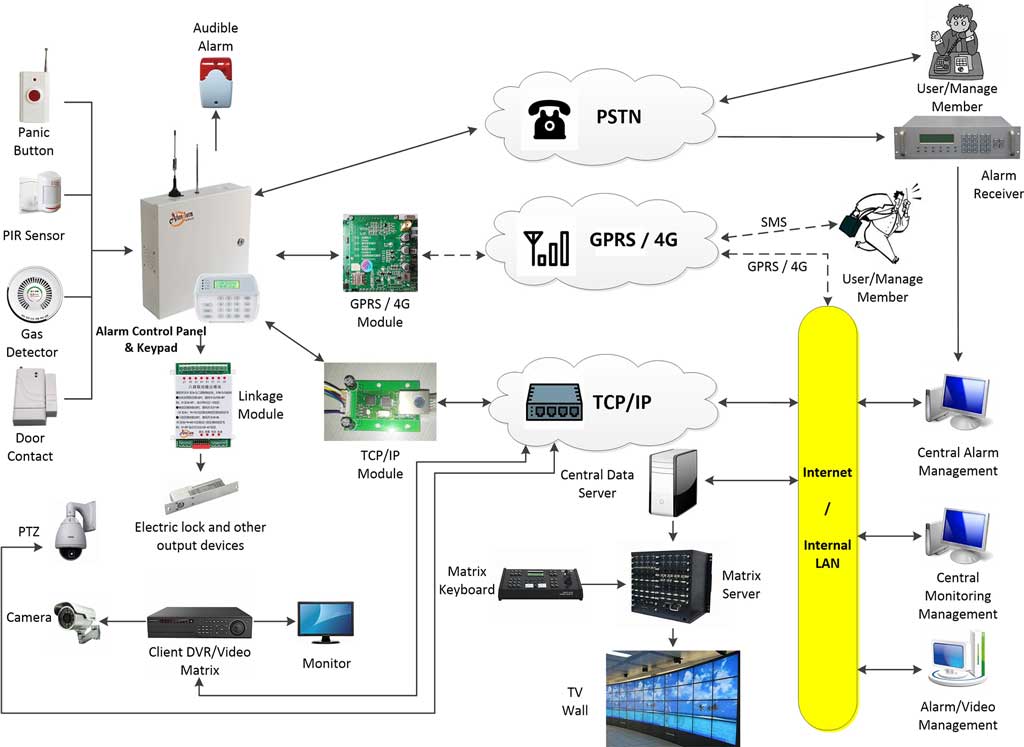
Modern alarm panels support three primary communication paths:
- POTS (Plain Old Telephone Service)
- Cellular communication (GSM, LTE-M, CAT-M1, etc.)
- IP communication (Ethernet or Wi-Fi)
Each burglar alarm system communication method offers unique advantages and trade-offs:
POTS Phone Line
- Pros: Simple integration with older systems, no network configuration needed.
- Cons: Vulnerable to line cuts, declining availability, slow signaling speed.
Cellular
- Pros: Independent from building wiring, fast digital events, resilient to physical tampering.
- Cons: Requires module subscription plans, may face signal challenges in shielded structures.
IP Communication
- Pros: Real-time event reporting, low operating cost, supports rich data formats.
- Cons: Dependent on customer’s internet connection, vulnerable to network outages or cyber threats.
Over the last decade, the industry has shifted from legacy analog dialers to digital IP and cellular alarm communicators, driven by sunset of copper phone networks and modern UL/NFPA requirements for reliable signaling.
Suitability examples:
- Commercial chains: Dual-path (IP + LTE) for redundancy.
- Residential buildings: IP primary with cellular backup for cost-efficiency.
- Industrial sites: Cellular primary where cabling is impractical or vulnerable.
2. Deep Dive into Phone Line Communication
Traditional alarm dialers use PSTN/POTS lines to transmit Contact ID or pulse signals to the monitoring center’s receiver. This method has been widely used for decades due to its simplicity and compatibility with older alarm control panels.
Limitations
- Physical vulnerability: Lines are exposed outdoors and can be deliberately cut.
- Dependency on telecom infrastructure: Increasing numbers of regions are phasing out copper lines in favor of VoIP and fiber, causing compatibility issues.
- Slower signal transmission: Analog events take longer compared to IP packets or cellular data.
Despite limitations, POTS is still used in legacy buildings and low-risk applications where infrastructure upgrades are pending. When integrating POTS in modern deployments, technicians should test for VoIP interference, ensure line seizure capability, and confirm receiver compatibility.
3. Cellular Communication as a Primary or Backup Option
Cellular communication has become a dominant burglar alarm system communication method thanks to its independence from wired infrastructure. Alarm panels communicate with monitoring centers via encrypted data over GSM, CDMA, LTE, or dedicated IoT networks such as LTE-M and NB-IoT.
Advantages
- Tamper-resistant: No cables to cut.
- Fast digital signaling: Supports SIA DC-09 IP protocols and dual-path architectures.
- Wide coverage: Particularly useful for remote sites or temporary installations.
Challenges & Mitigation
- Signal interference: Conduct site surveys and test RSSI levels before module installation.
- Carrier dependency: Use dual-SIM or multi-carrier modules to avoid single-network outages.
- Subscription cost: Optimize data plans for bulk deployments.
Cellular is increasingly adopted as either the primary communication path or backup module in UL-listed commercial alarm systems.

4. IP-Based Communication: The Modern Standard
IP communication utilizes Ethernet or Wi-Fi networks to transmit alarm events using secure digital protocols. IP is often preferred as the primary communication method due to its speed and ability to support rich data formats (video verification, logs, timestamps).
Key Benefits
- High-speed reporting with minimal latency.
- Cost savings by using existing broadband infrastructure.
- Integration capabilities with smart security platforms and cloud dashboards.
Risks & Recommendations
- Cybersecurity threats:
- Use TLS encryption.
- Isolate alarm traffic using VLANs.
- Implement firewalls and strong authentication.
- Internet outages:
- Always pair with cellular backup.
- Use router UPS to maintain local network availability.
For large enterprises, IP is often the foundation of a scalable, monitored security ecosystem.
5. Configuring Cellular Backup for Uninterrupted Monitoring Center Signaling
Cellular backup (dual-path signaling) ensures the system automatically transitions to a wireless connection if the primary communication path fails.
Step-by-Step Configuration Guide
1. Hardware Requirements
- Alarm panel supporting dual-path communication
- Cellular communicator module (LTE/LTE-M recommended)
- Active SIM card with monitoring-compatible data plan
- Optional external antenna for low-signal environments
2. System Integration
- Connect the cellular module to the control panel’s communication bus or serial port.
- Register the module with the monitoring center using SIA DC-09 or manufacturer protocol.
- Configure heartbeat intervals to meet UL/NFPA supervision requirements.
3. Failover Mechanism
- The system continuously monitors the primary path (IP or POTS).
- If no acknowledgment is received within the supervision window, the system switches to cellular.
- The monitoring center receives both the alarm event and a communication path failure message.
4. Best Practices
- Test cellular RSSI signal levels during installation.
- Enable firmware auto-updates to maintain carrier compatibility.
- Install UPS power supplies to ensure module operation during outages.
- Perform quarterly test reports to validate dual-path performance.
5. Troubleshooting Tips
- Network congestion: Add external antenna or switch carrier.
- SIM failures: Validate APN settings and SIM activity status.
- Firmware mismatches: Update communicator software to latest version.
Properly configured cellular backup dramatically increases system resilience and ensures uninterrupted monitoring even during network failures or physical tampering.
6. Best Practices and Considerations for Procurement and Implementation
For procurement managers and product decision-makers evaluating burglar alarm system communication methods, consider the following:
1. Compliance & Certification
- Choose UL-listed or EN-certified communicators and panels.
- Verify compliance with industry standards such as UL 681 and SIA DC-09.
2. Scalability & Future-Proofing
- Select 4G/5G-ready modules to avoid future carrier sunsets.
- Use platforms that support remote firmware updates and diagnostics.
3. Cost-Benefit Analysis
- IP primary + cellular backup often delivers the best lifecycle cost/performance ratio.
- For high-risk environments, cellular primary is recommended to reduce tampering risk.
4. Vendor Evaluation
- Assess manufacturer support, warranty terms, API compatibility, and cloud service stability.
- Review technical documentation for dual-path performance and supervision intervals.
A well-informed procurement strategy ensures reliability, regulatory compliance, and long-term sustainability of alarm communication infrastructure.
Conclusion
Reliable communication is the backbone of any professional burglar alarm system. Understanding the strengths and limitations of phone line, cellular, and IP-based communication methods helps decision-makers select the most appropriate solution for their risk profile and operational environment.
Cellular backup remains a critical component of modern systems, providing uninterrupted monitoring center signaling even when the primary path fails. By implementing dual-path communication, conducting proper site assessments, and following industry standards, organizations can significantly enhance the reliability and resilience of their intrusion detection infrastructure.