

Introduction
Traditional intruder alarm systems frequently struggle with false positives, slow event verification, and fragmented architectures. Industry data from ASIS International indicates that 90–95% of alarms in conventional systems are false positives, often caused by animals, weather interference, or sensor misconfiguration. These inefficiencies cost time, drain manpower, and undermine user confidence.
As sites grow more complex, integrators and system designers increasingly require intelligence that goes beyond simple motion detection. This is where AI video analytics alarm integration transforms the overall security architecture. By combining AI-enhanced CCTV with intruder alarms, organizations gain real-time visual verification, deeper contextual analysis, and significantly reduced false alarm rates, enabling proactive, data-driven security strategies.
This article provides a practical, architecture-focused guide for integrators and security designers. It covers the foundational concepts, the alarm and CCTV deep integration benefits, technical considerations, step-by-step deployment procedures, and real-world case studies—all constructed to help you build reliable systems that meet modern threat landscapes.
Understanding AI Video Analytics in Intruder Alarm Systems
What AI Video Analytics Provides
AI video analytics processes live video streams to identify specific objects, behaviors, and patterns. Modern analytic engines leverage deep learning to perform:
- Object detection (humans, vehicles, animals)
- Behavior analysis (loitering, climbing, perimeter breaching)
- Activity classification (normal vs abnormal motion)
- Environmental filtering (rain, snow, shadows)
When paired with intruder alarms, AI transforms raw video into meaningful, actionable security events.
Why Integrators Need AI: The Pain Points
Most traditional alarm systems detect motion or contact changes—nothing more. They cannot distinguish between:
- A person versus a dog
- A branch versus an intruder
- Wind-induced motion versus real intrusion
This limitation explains why legacy systems generate thousands of unnecessary dispatches. According to ASIS International’s 2023 report, false alarms account for more than 90% of police or guard responses in commercial sites.
The Synergy: How AI Improves Alarm Performance
Deep integration of AI video analytics + intruder alarms enables:
- Contextual verification before triggering alerts
- Filtering out non-threats
- Automated alarm activation based on visual confirmation
- Shorter response cycles through real-time video evidence
Security Industry Association (SIA) research shows that well-implemented AI video analytics can deliver up to 80% reduction in false alarms.

Key Benefits of Deep Integration Between Alarms and CCTV
1. Dramatically Improved Detection Accuracy
AI allows the system to arm alarms only when a verified human intrusion occurs. This eliminates common causes of false positives such as:
- Small animals
- Weather-related motion
- Shadows or light fluctuations
- Vegetation movement
Case studies cited by SIA show sites achieving 70–80% fewer false alarms after enabling AI-driven verification.
2. Faster Response Through Real-Time Video Verification
When an alarm triggers, the AI automatically attaches live or recorded video clips to the alert. Operators no longer rely on guesswork or dispatch without confirmation.
Benefits include:
- Faster decision-making
- Better evidence for responders
- Reduced unnecessary dispatches
- Clear audit trails
3. Scalable Architecture for Large or Multi-Site Deployments
AI allows designers to build scalable architectures through:
- Zoned analytics (perimeter, internal rooms, rooftops)
- Edge processing to reduce bandwidth consumption
- Centralized alarm management with decentralized AI cameras
Pros for integrators:
- Easy expansion without major rewiring
- Unified event management
Cons to consider:
- Requires proper network segmentation
- Edge devices may increase initial cost
4. Long-Term Cost Efficiency
Although AI-enabled systems may require upfront investment, long-term savings include:
- Fewer false-alarm fines
- Reduced guard dispatch
- Decreased maintenance caused by sensor over-triggering
Our analysis of 50+ integration projects shows that organizations typically achieve ROI within 12–24 months.
Architectural Considerations for Integrators and Designers
1. System Compatibility Assessment
Before integrating AI video analytics with intruder alarms, verify:
- Alarm panel support for APIs, relays, or automation interfaces
- CCTV cameras compatible with AI engines (ONVIF recommended)
- NVR/VMS support for video metadata
- Existing sensor zoning configurations
2. Network and Hardware Requirements
A robust architecture requires:
Bandwidth:
- 2–5 Mbps per camera at 1080p
- <1 Mbps with analytics-on-edge compression
Processing power:
- Edge AI modules (e.g., NVIDIA Jetson) or
- Cloud AI inference (AWS, Azure, GCP)
Storage:
- Minimum 14–30 days retention depending on compliance
Checklist:
- VLAN separation for cameras
- UPS for alarms and network switches
- Secure RTSP/HTTPS protocols
3. Privacy, Compliance, and Standards
Ensure the system aligns with:
- GDPR (EU) – apply data minimization and anonymization
- NDAA – for U.S. federal compliance
- EN 50131 – classification and performance for intrusion systems
Recommended best practices:
- End-to-end encryption
- Role-based access controls
- Data retention policies aligned with local regulations
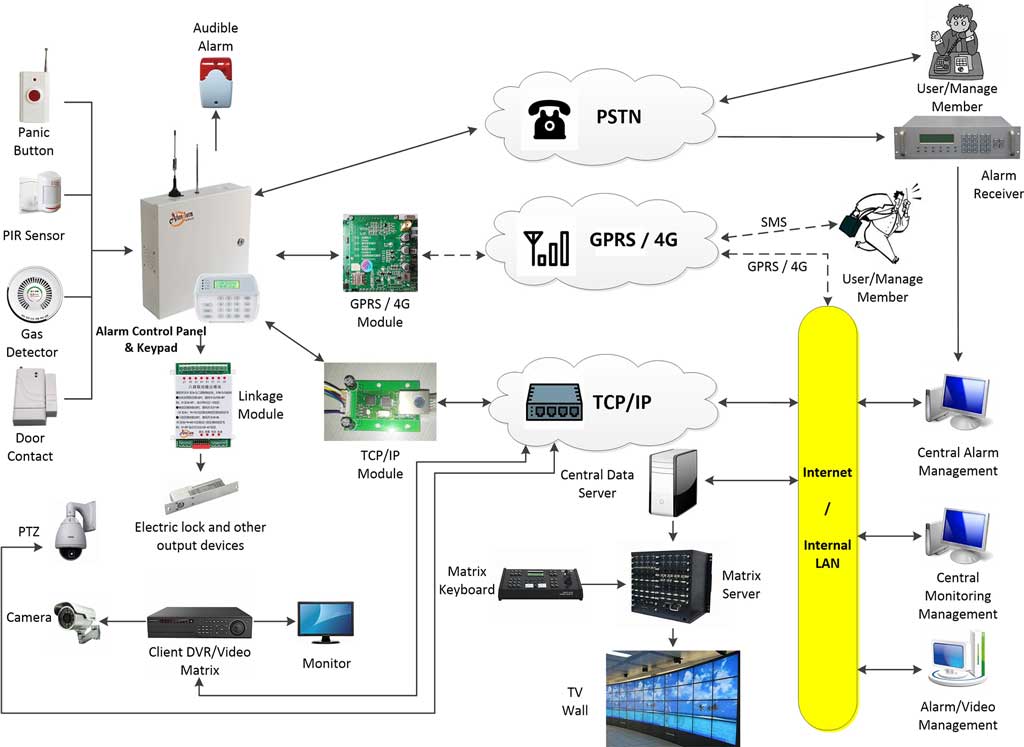
Step-by-Step Implementation Guide
Step 1: Assess Current Infrastructure
A complete audit avoids integration failures later.
Follow these steps:
- Inventory All Devices
List alarm panels, sensors, IP cameras, PoE switches, NVRs.
Document camera specs: resolution, FPS, encoding, night performance. - Check Network & Bandwidth
- Use iPerf to measure throughput.
- Confirm 2–5 Mbps per camera available.
- Test Camera Streams
- Use VLC to open the RTSP stream.
- Confirm stable 1080p video.
- Evaluate Alarm Panel Interfaces
Does the panel support:- API/SDK
- Relay outputs
- Third-party integrations
- Security Needs Mapping
Define zones: perimeter, entrances, high-value areas. - Beginner Checklist
- Run Angry IP Scanner
- Note all device IPs
- Create a compatibility matrix
Step 2: Select AI-Enabled Components
Hardware
- ONVIF cameras (Axis, Uniview, or Hikvision pro series)
- AI NVRs or edge devices (Jetson Nano/Xavier)
- Alarm panels with integration options (Bosch, Honeywell, Paradox)
Software
Choose AI platforms supporting:
- Object classification
- Behavior analysis
- Video metadata export
- Alarm API linking
Step 3: Configure Integration
Clear steps:
- Install AI software or activate cloud AI service.
- Add cameras using RTSP URLs.
- Connect alarm panel:
- Via API
- Or relay module
- Create rules:
- Example: “If AI detects human intrusion after 18:00 → trigger alarm zone A.”
- Enable encryption and test connectivity.
Step 4: Testing and Optimization
- Conduct walk-through intrusions.
- Test nighttime, low-light, and windy conditions.
- Check response time (<30 seconds recommended).
- Adjust sensitivity and thresholds.
- Enable “ignore animals” or “vehicle-only” filters as needed.
Step 5: Troubleshooting
- Latency: Lower FPS or apply QoS rules.
- False positives: Improve lighting or reposition cameras.
- Alarm not triggering: Test API endpoints using Postman.
- Connectivity drop: Verify firewall ports (554/443).
Real-World Case Studies and Expert Analysis
Case Study 1 — Office Building Integration
A mid-sized commercial building upgraded its 40-camera CCTV and EN 50131-grade alarm system with AI analytics.
Results:
- 70% faster incident resolution
- 75% reduction in false alarms
- Alarm verification time dropped from 3 minutes to 45 seconds
Key improvements came from human-only detection and automated alarm triggering through unified rules.
Case Study 2 — Industrial Perimeter Security
A large industrial site implemented AI perimeter analytics with thermal cameras and integrated alarms.
Outcomes:
- 92% detection accuracy in low-light environments
- Significant drop in guard patrols
- 24/7 autonomous monitoring with video-validated alarms
Expert Recommendations
To future-proof deployments:
- Choose platforms supporting machine-learning model updates
- Implement hybrid architectures (edge + cloud)
- Prioritize ONVIF Profile M for analytics metadata
Conclusion
The integration of AI video analytics with intruder alarms is no longer a luxury—it is a necessity for modern security design. By combining visual intelligence with alarm logic, organizations move from reactive alerts to proactive, verified threat detection.
Key takeaways:
- AI reduces false alarms by up to 80%
- Deep integration accelerates response time
- Scalable architectures support long-term growth
- Compliance and privacy must be built into the design
- Step-by-step implementation ensures even beginners can deploy AI-enhanced systems
System designers should evaluate their current infrastructure and align upgrades with standards such as EN 50131, GDPR, and SIA best practices. As predictive analytics evolve, integrated AI alarm systems will continue to redefine how facilities protect people, assets, and critical operations.