

In the past three years, hybrid attacks on intrusion and perimeter alarm systems have grown at an alarming pace. According to ENISA’s Threat Landscape for IoT (2024), cyber-physical incidents rose by over 30%, with several cases involving burglars jamming wireless alarm signals while simultaneously exploiting unsecured IP channels. One well-documented case involved a logistics warehouse where criminals disabled the alarm’s cloud link through credential stuffing while physically cutting an exposed sensor loop — resulting in an undetected breach for nearly 18 minutes.
This type of combined attack — where digital exploitation and physical tampering occur together — defines cyber-physical security in modern alarm ecosystems. Traditional designs focused solely on perimeter sensors or network hardening are no longer sufficient. Security engineers now need an integrated approach that protects the entire alarm system stack: firmware, network paths, control hardware, sensors, communication channels, and installation environments.
This blog provides a practical, engineer-ready guide to cyber-physical alarm security, showing how to protect alarms from cyber and physical attacks using clear steps, checklists, and standards-backed recommendations.
Understanding Cyber-Physical Threats to Alarm Systems
How Hybrid Threats Work
Modern intrusion systems are deeply interconnected: cloud apps, wireless sensors, IP communicators, on-prem control panels, and mobile clients. Attackers now combine:
- Cyber techniques — credential theft, firmware exploitation, weak wireless encryption, network scanning, API abuse.
- Physical intrusions — tampering with sirens, cutting sensor loops, opening control panel covers, or jamming RF signals.
For example, an attacker may disable a cloud link via a brute-force web login attack, then break into a facility assuming the alarm cannot forward events to the monitoring center.
Common Vulnerabilities in Alarm Ecosystems
- Software and Firmware Weaknesses
- Outdated firmware with unpatched CVEs
- Hardcoded default passwords
- Unsupported or unencrypted APIs
- Network Exposures
- Weak Wi-Fi encryption (WPA/WEP)
- Lack of VLAN segmentation
- Open ports exposed to the Internet without rate limits
- Misconfigured firewalls on alarm communicators
- Physical Weaknesses
- Accessible control panels
- Exposed sensor wiring
- Unshielded RF sensors vulnerable to jamming
- Unlocked telecommunications rooms
NIST’s Guide to ICS Security (SP 800-82) and ENISA’s Good Practices for IoT Security both highlight these hybrid risks, noting frequent exploitation of unpatched embedded devices and unsecured physical access points.
Why Traditional Security Fails
Most alarm failures today stem from single-layer protection:
- Firewall without tamper protection
- Hardened panel but open Wi-Fi
- Secure firmware but unprotected cable routes
Hybrid attackers exploit whichever side is weaker, leading to false alarms, delayed detection, and complete system silence during intrusions.
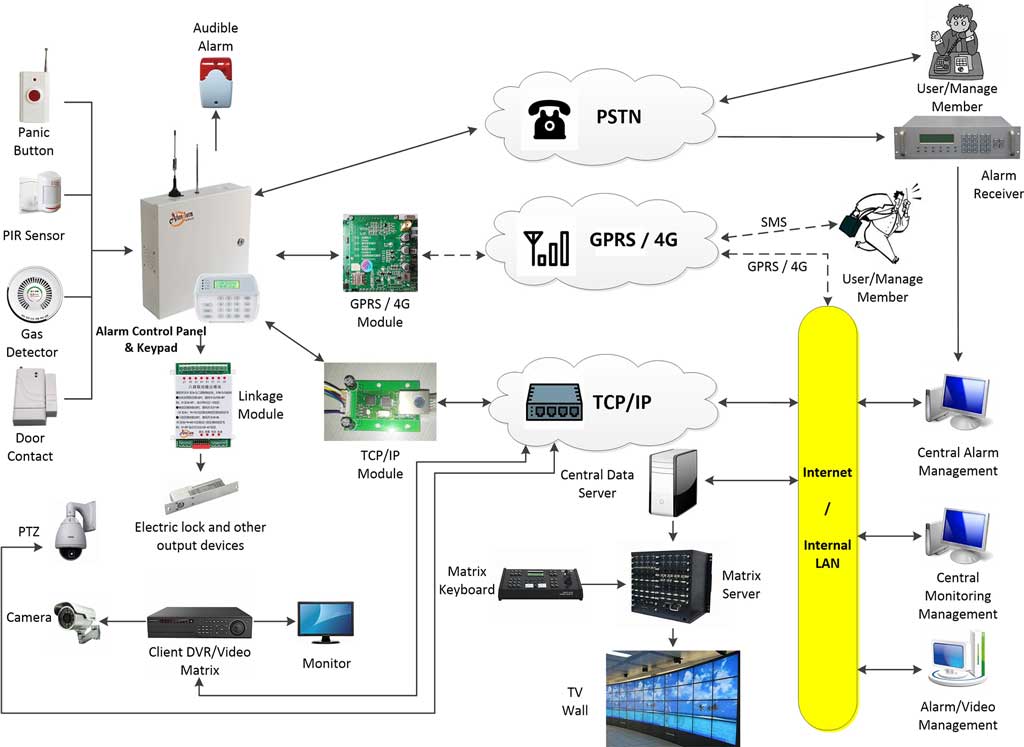
Key Cyber Security Measures for Alarm Systems
1. Assess Current System Health
Security engineers should perform a structured vulnerability assessment on all alarm endpoints.
Step-by-step:
- Scan devices on the alarm network
nessuscli agent scan --target 192.168.10.0/24(Beginners: install Nessus Essentials, add subnet, run default IoT scan profile.) - Check firmware versions
- Log into panel or communicator web interface
- Navigate to System Information → Firmware
- Compare versions with vendor’s security bulletin page
- Review exposed ports
nmap -sV 192.168.10.50 - Document all findings in a simple table (risk, device, fix timeline).
2. Encrypt All Alarm Communications
Alarm networks should enforce SSL/TLS or DTLS for IP communicators and cloud APIs.
Basic Configuration Example (Honeywell/DSC-style panels):
- Go to Communications → IP Settings → Encryption.
- Enable TLS 1.2+.
- Upload CA certificates (from the vendor portal).
- Reboot communicator to enforce encrypted sessions.
3. Segment Alarm Devices Using VLANs
Segmentation prevents malware on corporate networks from reaching alarm IoT devices.
Router/Switch Setup Example:
- Create a VLAN, e.g., VLAN 30 for alarms.
- Assign alarm panel port to VLAN 30 (untagged).
- Assign firewall rules:
- Allow outbound TCP 443 only
- Block all lateral movement
- Add monitoring center IPs to “allowed list.”
4. Deploy IDS/IPS for Alarm Communications
Tools like Suricata or Snort help detect abnormal traffic targeting alarm communicators.
Install on a small gateway (OPNsense or pfSense):
pkg install suricata
suricata -c /usr/local/etc/suricata/suricata.yaml -i em0
Look for anomalies such as repeated login attempts or high-frequency API requests.
Essential Physical Security Enhancements
1. Install Anti-Tamper Sensors Correctly
Most breaches exploit exposed panels or cabinets.
Wiring & Testing Steps:
- Mount tamper switch on panel door frame.
- Wire in series with zone loop (NC).
- Set zone type to “24-hour tamper” in programming.
- Test: open panel cover → alarm must trigger within 1s.
2. Harden Installation Environments
Use this minimum checklist for safe installation:
- Panel installed inside locked metal cabinet
- Cabinet mounted in camera-covered zone
- Conduit used for sensor cables
- No visible cable routes
- Battery placed in restricted-access area
3. Protect Wireless Devices from RF Jamming
For high-risk sites, integrate physical barriers:
- Faraday mesh cages for control rooms
- Shielding window films for RF attenuation
- Redundant communication paths (e.g., IP + LTE)
In a 2022 warehouse breach, RF jammers were used for 14 minutes to mask door sensor activity, but the attack succeeded only because no RF-interference detection was configured. Most modern panels support “RF supervision loss” features — this should always be enabled.
Integrated Cyber-Physical Defense Strategies
1. Conduct Structured Cyber-Physical Risk Assessments
Using ISO 27001 principles, adapt questions specifically for alarms:
- What happens if this sensor fails physically?
- What if its communication channel is spoofed?
- What cyber controls protect this sensor?
- What physical barriers protect the communicator?
Engineers should maintain a risk heatmap for both digital and physical vectors.
2. Deploy AI-Driven Monitoring for Both Worlds
Combine log-based and sensor anomaly detection:
With ELK Stack (Logstash + Elasticsearch + Kibana):
- Feed panel logs via syslog or API.
- Index sensor event frequencies.
- Create alert rules:
- Sudden silence from sensor cluster
- Unexpected firmware change
- High-rate login failures
- Visualize deviations using Kibana dashboards.
AI-based solutions can detect blended anomalies — e.g., a door sensor opened with simultaneous IP disconnects — far faster than human monitoring.
3. Test Defenses Through Controlled Simulations
Perform quarterly red-team exercises:
Safe Simulation Plan:
- Simulate credential brute-force on test accounts.
- Cut power to a non-critical zone panel to validate battery failover.
- Perform RF interference test with low-power legal RF tools.
- Document detection times and operator responses.
SANS Institute reports show integrated testing can reduce response time by 40%, significantly lowering breach impact.

Best Practices and Emerging Trends
Actionable Daily Practices
- Conduct monthly cyber-physical audits
- Train staff to recognize phishing attacks that target alarm management portals
- Require vendors to provide:
- Security certification (UL 2900, ETSI EN 303 645)
- Vulnerability disclosure program
- Signed firmware updates
Future-Proofing Alarm Systems
- Quantum-resistant encryption for long-life alarm communicators
- Blockchain-backed tamper-evident logs for alarm event trails
- Zero-trust architectures for remote alarm management portals
- 5G slicing to isolate alarm traffic from general mobile broadband
Quick Engineer Checklist
- VLAN segmentation implemented
- TLS enabled on all communicators
- Anti-tamper sensors installed and tested
- Cable routes concealed
- RF jamming detection enabled
- Firmware fully updated
- Logs streamed to centralized monitoring
- Red-team test completed in last 90 days
Conclusion
Cyber-physical threats are now the dominant risk for modern alarm systems. Protecting alarms from cyber and physical attacks requires more than patching firmware or adding a lock — it demands a layered, integrated strategy built on visibility, hardened installation, encrypted communication, and continuous testing.
Security engineers who adopt these practices can dramatically reduce breach windows and ensure alarm systems perform reliably even under advanced hybrid attacks. Now is the time to audit your infrastructure and build a resilient cyber-physical alarm security framework before attackers exploit the gaps.
References
- NIST SP 800-82: Guide to Industrial Control Systems (ICS) Security — Detailed cyber-physical risk guidance for embedded and control systems.
- ENISA: Threat Landscape for IoT 2024 — Data on IoT and alarm-related cyber-physical incidents.
- ETSI EN 303 645: Consumer IoT Security Standard — Baseline requirements applicable to IP-based alarm devices.
- SANS Institute: Operational Technology Security Report — Metrics on hybrid-threat mitigation and response times.
- UL 2900-1: Standard for Software Cybersecurity for Network-Connectable Products — Key certification for secure alarm communicators.
- IEEE Transactions on Cyber-Physical Systems (2023–2024) — Peer-reviewed studies on integrated threat models for IoT and alarm systems.