

In intrusion alarm systems, loop supervision is the silent guardian of reliability. A detector can be perfectly selected and correctly positioned, yet the system still fails if the wiring path between field devices and the control panel is not continuously monitored. For technical specialists, understanding alarm loop supervision methods is essential to designing systems that detect not only intrusions, but also wiring faults, tampering, and component failures—before they become security incidents.
This article delivers a deep, practical analysis of loop supervision and modern alarm loop monitoring techniques, focusing strictly on the anti-intrusion alarm domain. It explains how each method works electrically, where it excels or fails, and how to implement it correctly in real projects.
What Is Loop Supervision in Intrusion Alarm Systems?
Loop supervision is the technique used by an alarm control panel to continuously verify the integrity of a detection circuit (zone loop). A supervised loop allows the panel to distinguish between:
- Normal (secure) state
- Alarm condition
- Open circuit (wire cut, loose terminal)
- Short circuit (intentional or accidental bypass)
Without supervision, a compromised cable can silently disable protection, leaving no visible indication at the panel.
From a system knowledge perspective, loop supervision transforms a basic alarm input into a self-diagnosing security channel.
Why Loop Supervision Is Mission-Critical
In professional intrusion systems, loop supervision addresses several real-world risks:
- Cable sabotage in exposed or semi-exposed installations
- Installation defects (poor crimps, oxidation, vibration loosening)
- Aging infrastructure in long-term deployments
- Regulatory compliance with EN and UL intrusion standards
False security is worse than no security. Supervised loops ensure faults generate trouble conditions, not silent failures.
Core Alarm Loop Supervision Methods
1. Normally Closed (NC) Unsupervised Loops – Legacy Baseline
How it works
A single NC contact closes the loop under normal conditions. Opening the contact triggers an alarm.
Limitations
- Cannot detect wire shorting
- Cannot distinguish alarm vs cable cut
- Not compliant with modern intrusion standards
Expert insight
NC-only loops are obsolete for professional-grade systems and should be avoided except in temporary or legacy integrations.
2. Single End-of-Line (EOL) Resistor Supervision
Principle
A resistor is placed at the end of the loop, allowing the panel to monitor loop resistance.
Typical states
- Normal: fixed resistance (e.g., 2.2 kΩ)
- Alarm: open circuit at detector
- Trouble: wire cut (infinite resistance)
Advantages
- Detects open circuits
- Simple and cost-effective
- Widely supported by alarm panels
Limitations
- Cannot reliably detect wire shorting
- Limited tamper detection
Best use case
Residential and light commercial intrusion systems where basic supervision is required.
3. Double End-of-Line (DEOL) Resistor Supervision
Principle
Two resistors create multiple resistance states, enabling richer condition detection.
Common resistance logic
- Normal: R1 + R2
- Alarm: R2 only
- Trouble (cut): infinite
- Trouble (short): near zero
Key benefits
- Detects open and short circuits
- Clear separation between alarm and fault
- Strong tamper resistance
Expert recommendation
DEOL is the minimum professional standard for commercial intrusion alarm loop monitoring techniques.
4. Fully Supervised Tamper Loops
Concept
Tamper switches (enclosures, detectors, junction boxes) are integrated into the supervised loop.
Why it matters
- Detects enclosure opening
- Prevents resistor bypass attacks
- Improves system trustworthiness
Implementation note
Resistors must be installed inside the protected device housing, never in the panel cabinet.
5. Balanced and Digitally Supervised Loops
Advanced approach
High-end systems use digitally encoded resistance values or polling-based zone monitoring.
Capabilities
- Device identification
- Drift detection over time
- Advanced fault diagnostics
Application scenarios
- Critical infrastructure
- Data centers
- High-security facilities
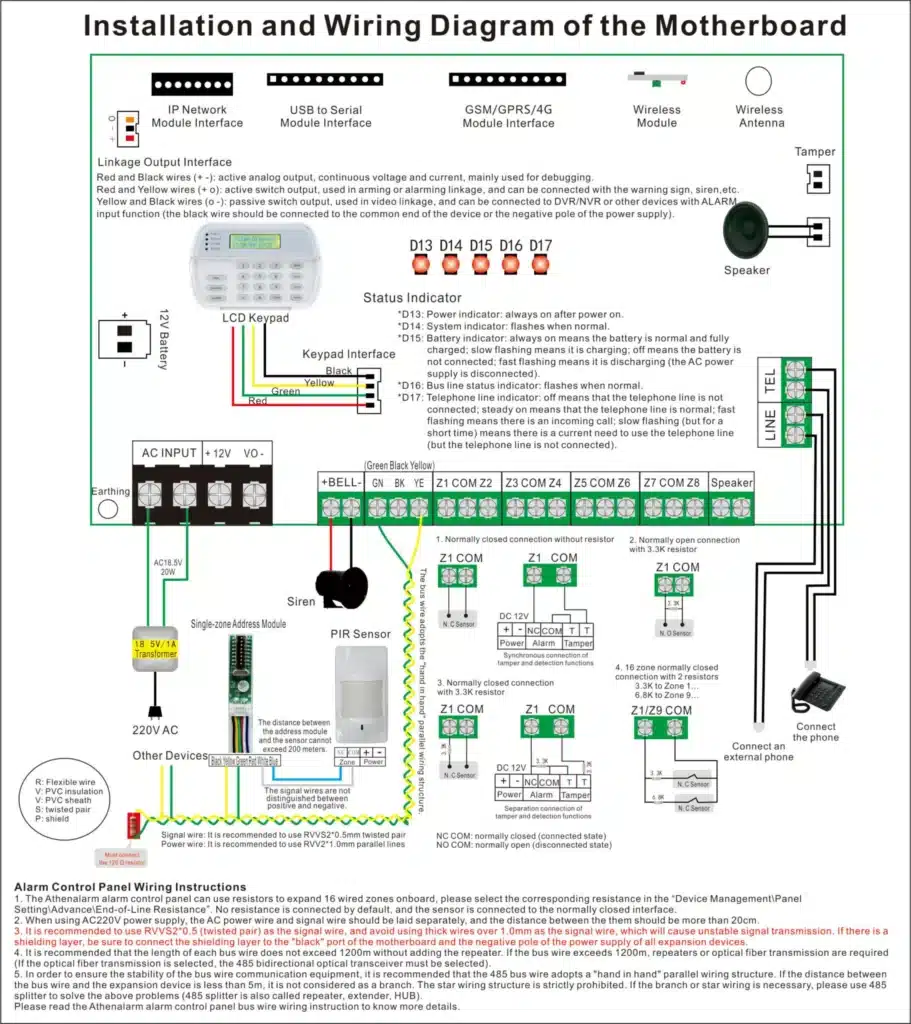
Practical Implementation: Correct DEOL Wiring Step-by-Step
- Verify panel specifications
Confirm supported resistor values and supervision mode. - Install resistors at the detector end
Never place resistors at the panel—this defeats supervision. - Wire alarm and tamper contacts in series
Ensure both conditions affect loop resistance. - Measure resistance before commissioning
Use a multimeter to confirm expected values in each state. - Program zone definitions correctly
Match software thresholds to physical resistor values. - Simulate faults during testing
Cut, short, and open the loop to confirm correct panel response.
This process ensures loop supervision functions as designed, not just as assumed.
Common Loop Supervision Errors (and How to Avoid Them)
- Resistors installed at the control panel
→ Eliminates cable supervision entirely. - Incorrect resistor tolerance
→ Causes false trouble or missed alarms. - Mixed supervision methods on one panel
→ Leads to inconsistent diagnostics. - Ignoring long cable resistance
→ Can push normal states into fault thresholds.
Professional installers treat loop supervision as a measurement system, not just wiring.
Standards and Industry Alignment
Well-designed loop supervision aligns with established intrusion alarm standards, including:
- EN 50131 (Intrusion and hold-up systems – Europe)
- UL 1023 / UL 681 (Household and commercial intrusion systems – North America)
- IEC 62642 (International intrusion alarm system framework)
These standards explicitly emphasize supervised detection circuits to maintain system integrity over time.
Conclusion
Loop supervision is not a wiring detail—it is a core reliability mechanism in intrusion alarm system design. From basic EOL configurations to advanced digitally supervised loops, the right alarm loop monitoring techniques ensure faults are detected, tampering is exposed, and security coverage remains continuous.
For technical specialists, mastering loop supervision means delivering systems that fail safely, diagnose accurately, and comply with professional security expectations. In modern intrusion protection, an unsupervised loop is simply an unacceptable risk.