
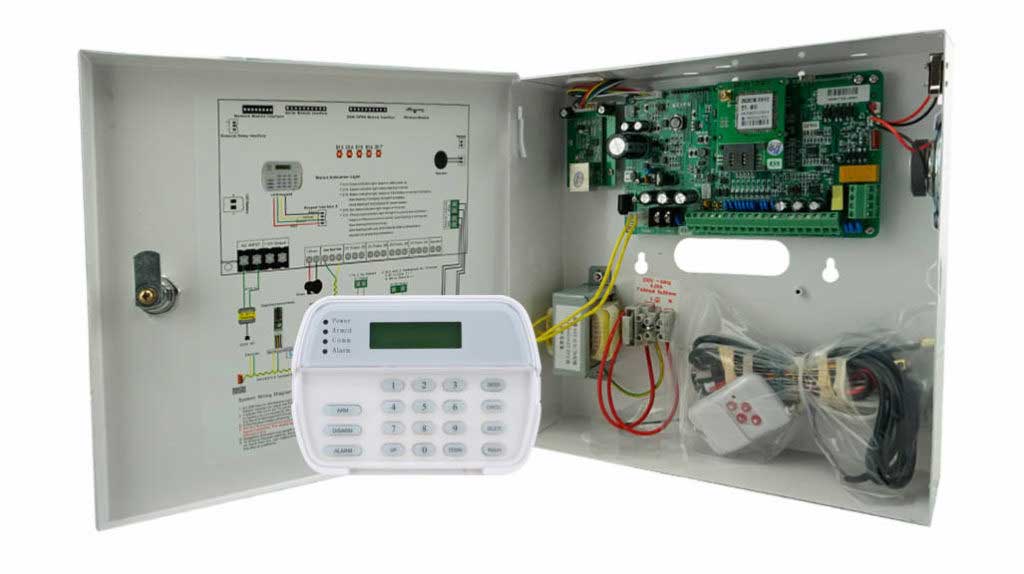
In modern intrusion alarm systems, modularity is no longer optional—it is a baseline requirement. Control panels must reliably communicate with zone expanders, keypads, power modules, I/O boards, and wireless receivers, often across electrically noisy environments. At the center of this architecture lies alarm bus communication.
For product engineers, poor bus design is one of the most common root causes of field failures: intermittent device dropouts, false alarms, supervision loss, or unexplained panel resets. This article provides a practical, engineering-focused analysis of RS485 and CAN bus for alarm modules, explaining how these buses behave in real alarm deployments, how to design them correctly, and how to avoid the most frequent mistakes seen in commercial and high-security installations.
Core Requirements of Alarm Bus Communication
Unlike generic industrial networks, alarm bus communication must meet several security-specific constraints:
- Deterministic behavior: Alarm events must reach the panel within predictable time limits.
- High noise immunity: Cabling often runs near power lines, elevators, HVAC systems, or data trunks.
- Fault tolerance: Open circuits, short circuits, or module failures must be detected, not masked.
- Scalability: The bus must support future expansion without redesign.
- Compliance readiness: Designs should align with EN 50131, UL 1023, UL 864, or similar standards.
RS485 and CAN bus are the two dominant physical/data-link choices used to meet these requirements in modular alarm panels.
RS485 Bus Communication in Modular Alarm Panels
Why RS485 Is Widely Used in Intrusion Alarms
RS485 is a balanced differential signaling standard defined by TIA/EIA-485. It is not a protocol, but a physical layer—making it highly flexible for proprietary alarm communication schemes.
In intrusion alarm systems, RS485 is commonly used for:
- Keypad buses
- Zone expansion modules
- Relay output boards
- Power supply monitoring modules
Its popularity comes from its long-distance capability, low component cost, and strong resistance to electromagnetic interference.
Electrical Characteristics That Matter in Alarm Systems
Key RS485 characteristics relevant to alarm bus communication include:
- Differential signaling voltage typically between ±1.5 V
- Up to 1,200 meters at low baud rates
- Multi-drop topology (one master, multiple slaves)
- Half-duplex operation in most alarm designs
These properties make RS485 suitable for large residential compounds, warehouses, and perimeter protection systems.
Correct RS485 Bus Implementation: Practical Engineering Steps
Improper RS485 wiring is responsible for a significant percentage of alarm communication faults. Follow these proven steps to ensure stability:
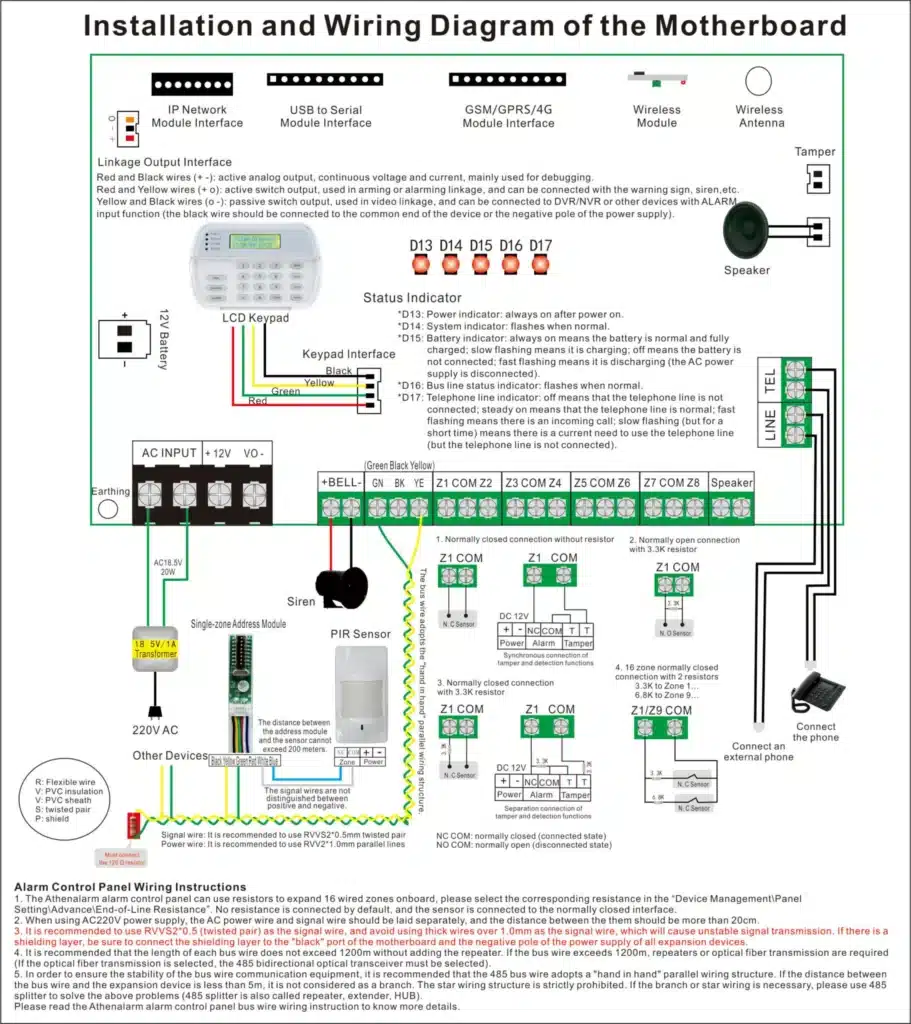
1. Topology Control
Always use a linear daisy-chain topology. Star or ring wiring causes signal reflections and intermittent failures that are difficult to diagnose.
2. Cable Selection
Use shielded twisted pair, typically 22–24 AWG. Avoid mixing cable types on the same bus. Ground the shield at one end only to prevent ground loops.
3. Termination and Biasing
- Install 120-ohm termination resistors at the two physical ends of the bus.
- Add bias resistors at the master side to define idle state and prevent floating lines.
4. Address Management
Each alarm module must have a unique logical address. Address conflicts are a common cause of “random” module offline events.
5. Supervision Strategy
Because RS485 lacks native error detection, alarm manufacturers must implement:
- Poll-response timeouts
- CRC or checksum validation
- Module heartbeat monitoring
When correctly implemented, RS485 remains a cost-effective and reliable solution for many intrusion alarm applications.
CAN Bus for High-Reliability Alarm Modules
Why CAN Is Gaining Adoption in Advanced Alarm Panels
CAN (Controller Area Network), defined under ISO 11898, was designed for safety-critical environments. In alarm systems where reliability outweighs cost—such as financial institutions, data centers, or government facilities—CAN bus for alarm modules offers clear advantages.
Unlike RS485, CAN integrates:
- Collision-free arbitration
- Built-in error detection
- Automatic retransmission
- Fault confinement mechanisms
These features significantly reduce the probability of silent communication failures.
CAN Bus Characteristics Relevant to Alarm Design
Key CAN properties include:
- Data rates up to 1 Mbps (short distances)
- Up to 110 nodes on a single bus
- Message-based communication (not address-based)
- Priority handling via message identifiers
For alarm systems, this allows critical events (tamper, intrusion, power failure) to preempt routine status traffic without software intervention.
Step-by-Step CAN Bus Integration in Alarm Panels
1. Hardware Architecture
Use a dedicated CAN controller or MCU with native CAN support, paired with an isolated CAN transceiver to meet security grounding requirements.
2. Bus Layout
Maintain a straight trunk line with short stubs (≤30 cm). Terminate both ends with 120-ohm resistors.
3. Message Design
Define message IDs by priority:
- Highest priority: intrusion alarms, tamper signals
- Medium priority: supervision and fault events
- Lowest priority: status polling
4. Error Handling Validation
Test the system under fault conditions:
- Disconnect modules
- Inject noise
- Simulate bus overload
A correctly designed CAN-based alarm bus will continue operating gracefully even when individual nodes fail.
RS485 vs CAN Bus: Engineering Trade-Offs in Alarm Systems
| Design Factor | RS485 | CAN Bus |
|---|---|---|
| Cost | Low | Medium |
| Maximum Distance | Very long | Short to medium |
| Error Detection | External (software) | Built-in |
| Determinism | Protocol-dependent | Native |
| Best Use Case | Cost-sensitive, large sites | High-security, mission-critical systems |
Many manufacturers adopt a hybrid architecture, using RS485 for peripheral expansion and CAN internally for critical module communication.
Common Alarm Bus Failures and How to Prevent Them
Based on field failure analysis across commercial alarm deployments, the most frequent issues include:
- Improper termination leading to intermittent faults
- Excessive stub lengths on CAN networks
- Address duplication on RS485 buses
- Ground potential differences causing transceiver damage
Preventive measures include early bus simulation, standardized wiring rules, and automated supervision logic at the panel firmware level.
Conclusion: Designing Bus Communication That Scales and Survives
Alarm bus communication is not a secondary design detail—it directly determines system stability, false alarm rates, and long-term maintenance costs. Product engineers who deeply understand RS485 and CAN bus behavior can design modular alarm panels that scale reliably, comply with standards, and perform consistently in real-world environments.
By selecting the right bus architecture and implementing it correctly, manufacturers can significantly reduce field failures while improving customer trust and system credibility.