

I. From Chaos to Control: The $2.3M Wake-Up Call
It started with a midnight call no logistics manager wants to receive: a $2.3 million cargo theft in a single night. The culprit—a coordinated perimeter breach at an unguarded yard—went undetected for nearly an hour due to a patchwork of outdated analog alarms and unmonitored cameras.
This incident became a turning point for a mid-sized logistics company operating over 3 million square feet of warehouse space across 12 distribution hubs, with 24/7 supply chain operations and high-value freight. The company needed more than conventional alarms—they needed speed, integration, and unified intelligence across all sites.
Eighteen months later, a fully networked alarm ecosystem reduced unauthorized access incidents by 93%, marking a complete transformation from reactive defense to proactive protection.
II. The Challenge: Why Traditional Alarms Failed
Legacy Pain Points
Before modernization, each logistics hub operated in isolation.
- Siloed analog sensors led to an average 40-minute delay in incident response.
- False positives triggered by wind, rain, or wildlife made up 38% of all alerts, overwhelming on-site guards.
- There was no centralized visibility, which meant managers could not coordinate responses or detect cross-site threats in real time.
Risk Profile
The company transported high-value freight, including electronics and pharmaceuticals, exposing it to organized theft and insider collusion. Security standards such as C-TPAT and ISO 27001 mandated improved traceability and event auditing. However, the existing system lacked audit-ready event logs, making compliance costly and inconsistent.
Quantitative Baseline
- 42 security incidents in 12 months
- $1.8 million in direct financial losses
- 12% increase in insurance premiums
- 38% false alarm rate
Leadership recognized that patching legacy systems was no longer viable. What they needed was a networked alarm architecture—a unified, intelligent platform that connected all assets, sensors, and staff through real-time data.
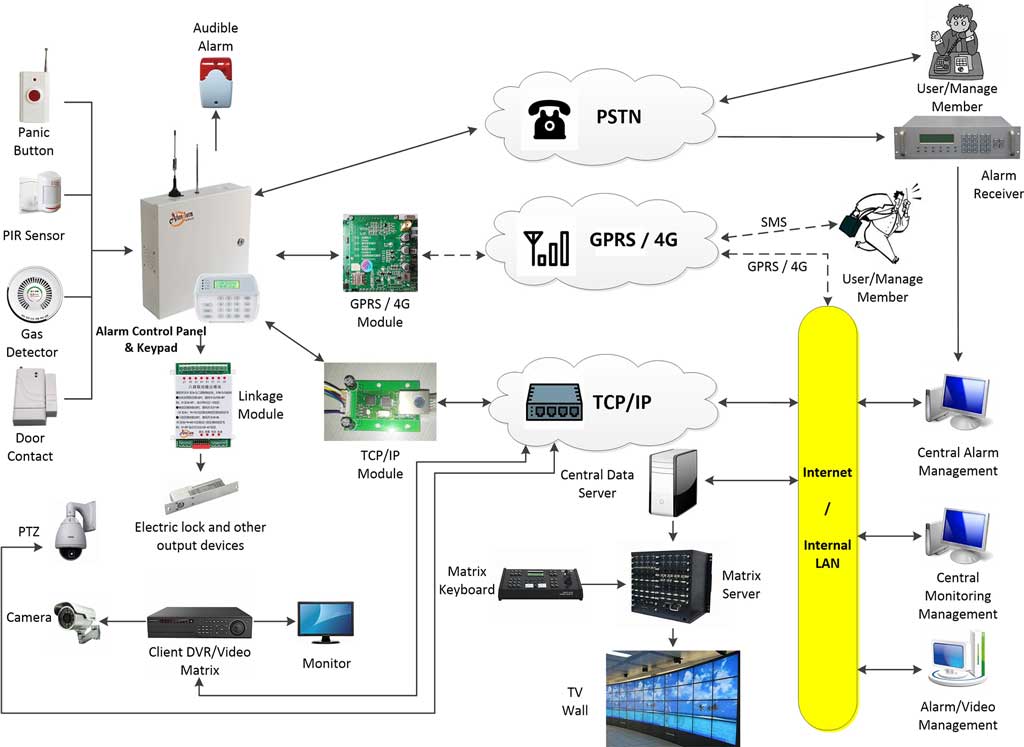
III. Solution Architecture: Building a True Network Alarm Backbone
The project team designed a three-tier architecture—Edge, Core, and Cloud—built for reliability, speed, and scalability. The design emphasized open standards, redundant connectivity, and predictive analytics.
Edge Layer
- 320 IP-based vibration and motion sensors with onboard edge analytics.
- 64 AI-enabled cameras featuring thermal and low-light vision to support perimeter detection under all weather conditions.
- Fiber-optic fence sensors provided 0.1-meter resolution and <1% false positive rate, ensuring precision at long distances.
Core Layer
- Dual redundant alarm controllers with 4G/5G failover paths for uninterrupted operation.
- Data transmission over MQTT protocol on a VLAN-segmented LAN, achieving <200ms end-to-end latency.
- Edge AI inference reduced central processing load by 70%, improving responsiveness at the Network Operations Center (NOC).
Cloud Layer
- A centralized NOC dashboard consolidated all event streams, video feeds, and alerts across 12 sites into a single interface.
- API integration with the company’s Warehouse Management System (WMS) and Transport Management System (TMS) enabled automated security workflows such as dock door lockdown on verified breaches.
- Multi-channel alerts (SMS, email, and push notifications) provided instant updates to mobile patrol units and management.
Technology Summary
| Layer | Component | Specification |
|---|---|---|
| Sensors | Fiber-optic fence | 0.1 m resolution, <1% false positives |
| Network | MQTT over VLAN LAN | <200 ms latency |
| Analytics | Edge AI classification | Reduces central load 70% |
| Integration | WMS/TMS APIs | Auto-lock dock doors on breach |
Scalability and Reliability
The system was designed for modular scalability, allowing new hubs to be added without reconfiguration. Over-the-air firmware updates ensured zero downtime maintenance, while dual-path connectivity maintained 99.999% uptime.
This architecture transformed isolated analog systems into a networked intrusion detection fabric that evolved with operational needs.
IV. Phased Deployment Roadmap
Deployment followed a carefully planned 18-month roadmap to minimize disruption while achieving measurable gains.
| Phase | Timeline | Milestones |
|---|---|---|
| 1 – Pilot | Month 1–2 | One hub, 40 sensors, baseline KPI dashboard established |
| 2 – Expansion | Month 3–6 | Six additional sites integrated, NOC commissioned |
| 3 – Optimization | Month 7–12 | AI rule tuning, insider behavior baseline development |
| 4 – Enterprise Rollout | Month 13–18 | Full 12-site mesh network operational, disaster recovery synchronized |
Each phase included simulated breach testing, staff retraining, and KPI validation. The pilot phase delivered immediate visibility gains, convincing stakeholders to expand enterprise-wide.
V. Measurable Outcomes and ROI
Quantitative Results (18 Months Post-Deployment)
| Metric | Before | After | Improvement |
|---|---|---|---|
| Unauthorized Access Incidents | 42 | 3 | -93% |
| Mean Time to Respond (MTTR) | 40 min | 4.2 min | -89% |
| False Alarm Rate | 38% | 2.1% | -94% |
| Insurance Premiums | Baseline | -28% | $420k annual savings |
Operational Gains
- Driver dwell time at secured docks reduced by 12 minutes, improving truck turnaround efficiency.
- Security guard resources reallocated to audit and compliance duties instead of routine patrols.
- Regulatory audits under C-TPAT and ISO 27001 completed faster and with fewer discrepancies.
ROI Summary
| Metric | Value |
|---|---|
| Total Project Cost | $1.14 million (hardware, licensing, integration) |
| Annual Savings | $1.45 million |
| Payback Period | 9.4 months |
| 3-Year NPV | $4.8 million |
Beyond the financial return, the deployment demonstrated the company’s commitment to resilience and security best practices—an important factor in maintaining client trust and insurer confidence.
VI. Technical Deep-Dive Highlights
1. Sensor Fusion Logic
Combining vibration, thermal, and visual data streams produced a 99.7% detection probability. When a vibration sensor triggered, AI video analytics verified object type—human, vehicle, or wildlife—while thermal imaging confirmed body heat signatures. This multi-layer validation nearly eliminated false positives and allowed human operators to focus only on real threats.
2. Network Resilience
The system employed dual communication paths using fiber and cellular (4G/5G) with satellite backup at key hubs. During outages, edge caching ensured no data loss, with automatic synchronization once connectivity was restored. The result was 99.999% uptime, supporting continuous audit logging and uninterrupted protection.
3. Privacy-by-Design
Video streams passed through a privacy redaction pipeline that blurred faces and license plates before storage, ensuring compliance with GDPR and CCPA. Role-based access controls restricted viewing privileges, reinforcing trust with clients and regulatory bodies.
VII. Lessons Learned and Best-Practice Checklist
- Involve Operations Early – Zone mapping should be done with input from warehouse and logistics managers to align alarms with real workflow.
- Budget for Cabling Surprises – Retrofit environments often require 10–15% extra for unplanned trenching or conduit adjustments.
- Train the NOC Team – Custom alert escalation protocols reduce response confusion during live events.
- Retrain AI Models Quarterly – Site-specific event data improves precision and minimizes drift in object recognition.
- Plan Staggered Firmware Updates – Phased OTA updates prevent simultaneous downtime across multiple hubs.
These lessons have become standard for all future deployments across the company’s network, including access control and smart surveillance integrations.
VIII. Conclusion
In just 18 months, this logistics enterprise evolved from reactive analog systems to a fully networked, intelligent alarm ecosystem. The transformation cut incidents by 93%, slashed response times by 89%, and produced measurable financial returns.
The project showcases how networked intrusion alarms, real-time alert integration, and scalable deployment strategies can redefine security in high-value logistics.
Organizations looking to modernize their perimeter protection can learn from this Network Alarm Case Study.