
In today’s increasingly complex security environment, intrusion threats are no longer limited to simple perimeter breaches. Modern facilities—ranging from commercial offices and warehouses to retail chains and multi-site enterprises—face evolving risks that demand flexible, resilient, and scalable protection strategies. For bulk purchasers, system integrators, and security decision-makers, the core challenge is clear: how to modernize intrusion protection without abandoning reliable legacy infrastructure or inflating deployment and maintenance costs.
This is precisely where the hybrid intrusion detection control panel emerges as the most strategically sound solution.
By combining the proven reliability of hardwired detection zones with the flexibility and rapid scalability of encrypted wireless sensors, hybrid control panels allow organizations to build intrusion alarm systems that are not only powerful today, but adaptable for years to come. This guide draws on decades of real-world deployment experience across commercial, industrial, and enterprise-scale security projects to deliver practical, no-nonsense insights you can apply immediately.
Rather than theory or vendor marketing claims, this article focuses on how hybrid intrusion detection control panels actually perform in the field, how to deploy them correctly, and how to avoid the common mistakes that undermine system reliability and ROI.
Understanding the Hybrid Intrusion Detection Control Panel: Architecture and Functional Design
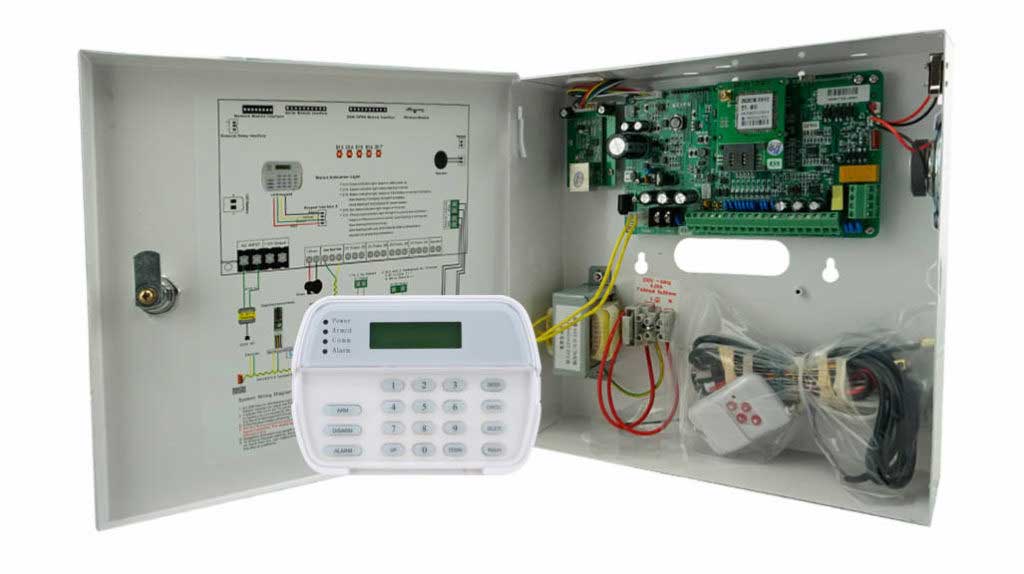
A hybrid intrusion detection control panel is a professional-grade alarm control unit designed to natively support both hardwired and wireless detection zones within a single unified system architecture. Unlike legacy panels that require costly external receivers or modern wireless-only hubs that sacrifice long-term stability, hybrid panels are engineered from the ground up for mixed-environment deployments.
Core Architectural Components
A true hybrid panel typically includes:
- On-board hardwired zone inputs Usually 8–16 zones standard, expandable via wired zone expanders for large facilities. These zones are ideal for doors, windows, roller shutters, and high-security perimeter points.
- Integrated wireless receiver capability Support for modern encrypted RF protocols such as PowerG, Jeweller, or proprietary long-range wireless, often alongside legacy RF frequencies for backward compatibility.
- Multi-path communication modules Ethernet/IP as primary reporting, with cellular (LTE/4G/5G-ready) backup. Some platforms also support Wi-Fi or PSTN for redundancy in regulated environments.
- Advanced system processing and supervision Continuous monitoring of zone integrity, RF signal health, battery status, tamper conditions, and event logging—critical for professional monitoring compliance.
- Integration-ready interfaces Native support for video verification, access control linkage, automation outputs, and cloud-based management platforms.
Real-World Hybrid Panel Examples
As of 2026, widely deployed hybrid intrusion detection control panels include:
- Qolsys IQ Pro Series – Commercial-grade hybrid with PowerG and legacy RF support, metal enclosure, and deep Alarm.com integration
- Hikvision AX Hybrid PRO – High zone capacity with Speed-X wired bus and wireless expansion, strong IVaaS support
- Ajax Superior Hub Hybrid – Fibra wired architecture combined with Jeweller wireless for high-security European deployments
- DSC PowerSeries Neo / Pro – Mature hybrid platform with PowerG and extensive expansion options
- Resideo VISTA-21iPLTE – A proven choice for upgrading existing wired installations with modern communication paths
What differentiates these platforms is not just compatibility, but true hybrid design philosophy—allowing installers to intelligently allocate wired and wireless detection where each performs best.
Why Hybrid Intrusion Detection Control Panels Outperform Wired-Only and Wireless-Only Systems
When evaluating intrusion alarm platforms, professionals typically weigh three options: wired-only, wireless-only, or hybrid. Field experience consistently shows that hybrid systems offer the most balanced and future-proof solution.
Limitations of Wired-Only Systems
- Labor-intensive installation and expansion
- High retrofit costs in finished buildings
- Limited adaptability for layout changes or phased growth
Limitations of Wireless-Only Systems
- Ongoing battery replacement logistics
- RF challenges in metal-dense or large facilities
- Higher sensor cost per zone over time
Why Hybrid Systems Dominate Professional Deployments
Hybrid intrusion detection control panels eliminate these trade-offs by:
- Preserving wired reliability at critical perimeter points where tamper resistance is essential
- Deploying wireless sensors in interior spaces, remote areas, or expansion zones without structural disruption
- Reducing installation labor by up to 50% in retrofit projects
- Lowering lifetime maintenance costs by minimizing battery-dependent zones
- Improving system uptime and resilience through dual-path communications and supervised RF links
In multi-site commercial deployments, hybrid systems consistently demonstrate higher operational stability and lower false alarm rates compared to single-technology solutions.
Key Advantages of Hybrid Intrusion Detection Control Panels in Real Deployments
From both technical and commercial perspectives, hybrid panels deliver measurable benefits:
1. Scalable Zone Architecture
Hybrid panels scale effortlessly from small installations to enterprise-level systems exceeding 200 zones—without replacing the core control unit.
2. Optimized Security Layering
Wired zones protect high-risk perimeters, while wireless sensors cover interiors, glass-break points, and temporary or evolving spaces.
3. Lower Total Cost of Ownership
Reduced cabling, fewer service calls, and selective battery usage significantly lower long-term operating costs.
4. Enhanced Anti-Jamming and Supervision
Modern wireless protocols use encrypted two-way communication, frequency hopping, and constant supervision—detecting interference or sabotage instantly.
5. Compliance and Insurance Acceptance
Most hybrid panels meet UL and EN Grade 2/3 standards, simplifying approval with insurers and regulatory bodies.
How to Select the Right Hybrid Intrusion Detection Control Panel
Selecting the right hybrid panel requires a structured, use-case-driven evaluation:
- Zone capacity and expansion flexibility
- Wireless protocol security and range
- Communication redundancy and carrier options
- Ecosystem integration (apps, video, access control)
- Vendor support, firmware roadmap, and training availability
For bulk purchasers, always validate the panel’s long-term availability and backward compatibility, especially when standardizing across large portfolios.
Step-by-Step Professional Installation Guide
Phase 1: System Planning
- Conduct a full risk and layout assessment
- Assign wired zones to perimeter and high-security points
- Allocate wireless zones for interior coverage and future growth
Phase 2: Panel Installation and Power
- Secure the enclosure in a protected, central location
- Connect primary AC power and install backup batteries
- Verify grounding and surge protection
Phase 3: Hardwired Zone Deployment
- Use end-of-line resistors as specified by the manufacturer
- Label all loops clearly for future maintenance
- Test resistance and tamper supervision before closing circuits
Phase 4: Wireless Device Enrollment
- Enroll devices one-by-one, verifying signal quality
- Optimize placement to avoid metal interference
- Assign correct zone types and attributes
Phase 5: Programming and Commissioning
- Configure partitions, reporting paths, and delays
- Test all alarm, tamper, and fault conditions
- Confirm monitoring station acknowledgment
Advanced Optimization for Large-Scale and Multi-Site Deployments
- Use wired zones for mission-critical assets
- Deploy wireless PIR-Cams for video verification
- Centralize monitoring via dealer portals
- Schedule proactive battery and firmware maintenance
- Standardize zone naming conventions across sites
Long-Term Maintenance and Upgrade Strategy
Hybrid intrusion detection control panels are designed for longevity:
- Annual system health audits
- Scheduled battery replacement cycles
- Firmware updates for security and feature expansion
- Wireless zone additions without service disruption
This ensures the system evolves alongside operational needs—without structural overhauls.
Final Thoughts: Why Hybrid Intrusion Detection Control Panels Are the Smart Long-Term Choice
A hybrid intrusion detection control panel is more than a control unit—it is the backbone of a modern, adaptable security strategy. For integrators, procurement teams, and security managers, it offers the rare combination of technical resilience, operational flexibility, and financial efficiency.
When specified and deployed correctly, hybrid systems consistently outperform single-technology solutions, delivering reliable protection today while remaining ready for tomorrow’s challenges.