

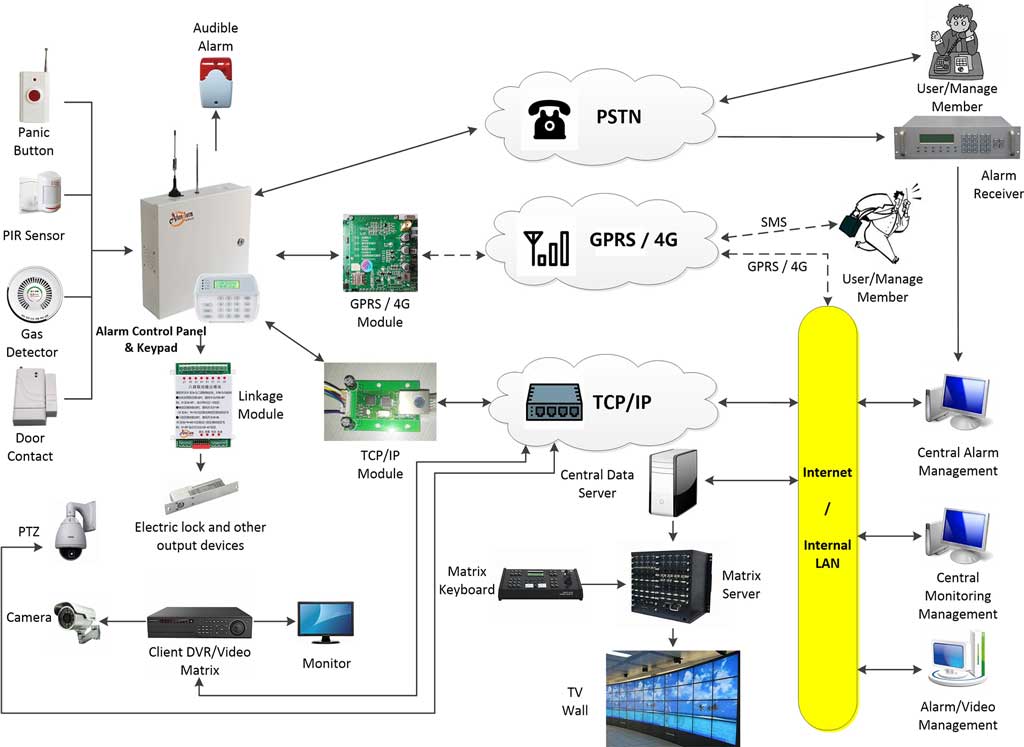
In the intrusion alarm industry, central monitoring stations (CMS) or alarm receiving centers (ARC) handle signals from burglar alarms, motion detectors, door contacts, and integrated systems. The choice between cloud-based alarm monitoring and on-premises alarm monitoring directly impacts response times, uptime, and regulatory adherence for dealers, integrators, and end-users.
This comparison focuses on practical deployment strategies for IT managers, operations teams, and procurement specialists in the security alarm sector. We’ll break down pros, cons, security risks, compliance requirements, and decision-making steps—with real-world data and standards like UL 827.
Key Differences at a Glance
| Aspect | Cloud-Based Monitoring | On-Premises Monitoring |
|---|---|---|
| Infrastructure | Hosted in provider’s data centers (e.g., AWS, Azure-compliant setups) | Servers, receivers, and software on-site |
| Upfront Cost | Low (subscription model) | High (hardware, servers, redundancy setup) |
| Scalability | Instant—add signals or users via dashboard | Requires physical upgrades |
| Uptime/Redundancy | Built-in geo-redundant failover | Manual backups and dual power lines |
| Internet Dependency | Required for signal transmission | Works offline (with local receivers) |
| Typical Use Case | Multi-site dealers, growing ARCs | High-security sites (government, finance) |
Pros and Cons for Alarm Monitoring Operations
Cloud-Based Pros
- Rapid Deployment and Scaling: Add new subscriber accounts or integrate video verification in hours, not weeks. Ideal for expanding commercial alarm monitoring services.
- Automatic Updates and Maintenance: Providers handle UL 827-compliant patches, reducing downtime from outdated automation software.
- Cost Efficiency: Pay per signal or per month—often 30-50% lower TCO over 5 years for mid-sized ARCs (based on SIA channel surveys). No capital outlay for duplicate receivers or HVAC/fire suppression.
- Remote Access: Operators monitor from anywhere with secure VPN—critical for hybrid teams post-pandemic.
Cloud-Based Cons
- Internet outages can delay signal receipt (mitigated by dual-path cellular/IP communicators).
- Perceived loss of data control, though modern providers use encrypted tunnels and SOC 2 Type II audits.
On-Premises Pros
- Full Data Sovereignty: Signals stay within your physical facility—preferred for defense contractors or facilities requiring zero third-party access.
- No Latency from External Networks: Direct receiver-to-server processing ensures sub-second response for critical intrusion events.
- Customization: Tailor automation rules for unique integrations (e.g., legacy panels).
On-Premises Cons
- High initial investment ($100K+ for redundant setup per UL 827).
- Ongoing IT burden: Patch management, backups, and hardware refreshes fall on your team.
- Scalability limits: Expanding beyond 5,000 signals often requires forklift upgrades.

Security Considerations in Alarm Centers
Security isn’t binary—both models can meet high standards with proper implementation.
Cloud Advantages: Reputable providers (e.g., those with UL 827A hosted certification) deliver enterprise-grade encryption (AES-256), intrusion detection, and 24/7 SOC monitoring. Redundant data centers exceed most on-site setups.
On-Premises Advantages: You control firewalls, air-gapped backups, and physical access. However, many stations underestimate cyber risks—SIA’s 2026 Megatrends report notes increasing ransomware targeting monitoring platforms.
Practical Tip: Use dual-path communication (IP + cellular) regardless of model. For cloud, require provider attestation of compliance with NIST 800-53 or IEC 62443-4-2 for industrial security.
Compliance: Meeting UL 827 and Beyond
UL 827 (Central Station Alarm Services) governs all U.S. listed ARCs and explicitly supports cloud-hosted automation since the 2018 revision (with UL 827A for providers).
Key Requirements (Both Models):
- Triple redundancy for power, communications, and automation.
- Cybersecurity measures (new in 2025 edition): ongoing threat monitoring, patch management, ransomware-resistant backups.
- Annual UL audits of facility, records, and response procedures.
Cloud-Specific Path: Use a UL 827A-listed automation provider (e.g., Manitou Cloud, Bold Technologies). The provider handles infrastructure redundancy; your site only needs operator workstations, secure internet (dual carriers), and 24-hour battery backup. This cuts setup costs by 60-70% while maintaining listing.
On-Premises Path: Full responsibility for servers, receivers, and HVAC/fire suppression per UL 827 sections 17-19.
Non-compliance risks fines, lost insurance discounts, or inability to serve national accounts.
Step-by-Step: How to Choose and Deploy
- Assess Your Needs
- Count signals, growth rate, and sites.
- Check regulatory requirements (e.g., government contracts often mandate on-prem).
- Calculate TCO
- Cloud: Subscription (~$0.50-$2 per account/month) + internet.
- On-Prem: Hardware ($50K-$200K) + 2-3 years maintenance.
- Evaluate Providers
- For cloud: Demand UL 827A proof, uptime SLA (>99.99%), and audit reports.
- For on-prem: Verify software supports UL 1981 Rev 3 automation.
- Test Migration (Hybrid Approach)
- Start with cloud for new accounts while keeping legacy on-prem.
- Use signal forwarding to bridge systems during transition.
- Implement Security Baseline
- Enable MFA, encrypted signal paths, and regular penetration testing.
Real-World Data and Trends
The global alarm monitoring market grows at ~4.5% CAGR through 2028 (Technavio). Cloud adoption accelerates—SIA reports show hosted solutions now represent 25-30% of new ARC deployments, driven by labor shortages and AI-enhanced automation (disrupting traditional SOC workflows per 2026 Megatrends).
Case Example: A regional dealer using on-prem spent $150K on upgrades; switching to UL 827A cloud reduced annual costs by $45K while adding video verification for 40% of accounts.
Final Recommendation
Choose cloud-based for scalability, cost control, and ease—especially if you’re a growing dealer or multi-site operator. Opt for on-premises only when data residency or ultra-low latency is non-negotiable (and you have dedicated IT).
Hybrid models often win: Use cloud automation with on-site receivers for the best of both worlds. Whichever path, prioritize UL-listed partners and regular security audits—your subscribers’ safety depends on it.